Hyperliquid HIP-3
Hyperliquid's protocol upgrade letting anyone who stakes 500k HYPE deploy their own perpetual-futures exchange on HyperCore, turning a single perp DEX into a permissionless market-creation layer secured by slashable deployer stake.
▶ Run interactive simulation animated mechanism with editable parameters
How it works onchain
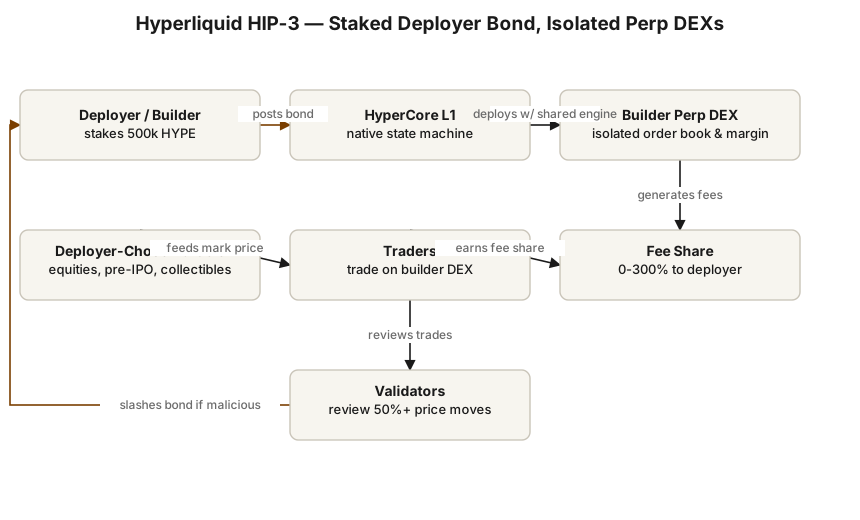 Open full-size diagram
Summary
HIP-3 ("builder-deployed perpetuals") is the Hyperliquid Improvement Proposal that converted Hyperliquid from a single, team-curated perpetuals exchange into a permissionless factory for perp exchanges. Any "builder" who stakes 500,000 HYPE (roughly $16M at late-2025 prices) can deploy an independent perp DEX on HyperCore — with its own order books, margining, asset listings, oracle, collateral choice, and fee capture — while inheriting Hyperliquid's matching engine, liquidation system, and liquidity infrastructure. Announced on testnet in late September 2025 with a bug bounty, and activated on mainnet on October 13, 2025, HIP-3 opened the door to onchain perps on assets Hyperliquid's core validator oracle cannot serve: US equities, pre-IPO valuations, indices, commodities, FX, and even collectibles. Deployer misbehavior is disciplined by validator slashing of the staked bond. By mid-2026, HIP-3 markets accounted for over a third of all Hyperliquid volume, with 30-day aggregate volume of roughly $89B — though a May 2026 oracle failure on a pre-IPO market showed the cost of pushing oracle responsibility onto deployers.
Design (Mechanism)
- Staked deployer bond. Deploying a perp DEX on mainnet requires staking 500k HYPE (a requirement the docs say is "expected to decrease over time"), which must be maintained for at least 183 days after deployment. The bond is the economic security backing the deployer's operational responsibilities.
- One DEX per deployer, isolated margining. Each deployer runs one perp DEX with independent order books and margining, so a broken builder market cannot contaminate core Hyperliquid markets. Enabling cross-margin for an asset is irreversible and gated on liquidity/oracle-reliability standards, with validators reviewing any 50%+ daily price move.
- Dutch-auction listings with reserved slots. A deployer's first three assets bypass auctions; additional listings go through a Dutch auction sharing hyperparameters (31-hour cadence, minimum price) with the HIP-1 spot-ticker auction, and each deployer holds seven reserve deployments usable at the current auction price.
- Deployer economics. Deployers configure a fee share of 0–300% (0–100% in "growth mode," which trade.xyz used to cut equity-perp fees ~90%); shares above 100% raise the protocol fee on that DEX. Staking discounts, referral rewards, and collateral-alignment incentives are supported, and deployers may choose non-USDC collateral (e.g., USDH, USDe).
- Deployer-chosen oracles. Because equities, pre-IPO shares, and collectibles do not trade on the CEXs feeding Hyperliquid's validator oracle, HIP-3 deployers run or select their own price oracles — the design's central trust concession.
- Validator slashing as backstop. Validators can slash a deployer's stake via stake-weighted vote for malicious or negligent operation, with published guidelines of up to 100% for invalid state transitions, ~50% for downtime, and ~20% for performance degradation.
Outcome
Ongoing and, so far, one of the most consequential exchange-infrastructure upgrades of the cycle. Mainnet activation came October 13, 2025. Early deployers included trade.xyz / Unit (US stock perps — NVDA, TSLA, AAPL, and the "XYZ100" Nasdaq-style index, which alone did $285M in early volume and, per one report, over 90% of early HIP-3 open interest), Ventuals (pre-IPO valuation perps on SpaceX and OpenAI), Hyena, Kinetiq's "Markets," Felix, and TROVE (Pokémon cards, CS2 skins). Aggregate 30-day HIP-3 volume reached roughly $89B with ~94k unique traders (Loris Tools, mid-2026); open interest grew from ~$790M in January 2026 to a ~$3.2B peak by June 2026, and HIP-3 volume exceeded 35% of all Hyperliquid volume. The headline failure so far: on May 29, 2026, bad offchain data fed Ventuals' SPACEX oracle, flash-crashing the market ~45% in 30 minutes, force-liquidating 405 users across 1,393 positions ($1.5M notional); Ventuals said it was evaluating compensation, and no slashing was reported.
Why it worked
- Skin-in-the-game listing rights. A ~$16M slashable bond filters for serious operators far better than a listing fee, and aligns deployers with market quality for at least 183 days.
- Shared infrastructure, isolated risk. Builders got a world-class matching/liquidation engine for free while isolated margining kept their failures from propagating to core markets — the May 2026 SpaceX crash hurt that market's traders but not Hyperliquid itself.
- It unlocked demand Hyperliquid couldn't serve itself. Equities, pre-IPO, and exotic markets require oracle and legal-risk decisions the core team didn't want to own; HIP-3 outsourced both the upside and the liability to deployers, and a third of platform volume followed within months.
- Fee-share flexibility (growth mode) let deployers price like startups, subsidizing early volume in competitive categories like stock perps.
Limitations and criticisms
The weak points are visible even in a mechanism that is working as designed. Deployer-run oracles are the load-bearing trust assumption, and the SpaceX incident showed slashing is a deterrent, not a shield — 405 traders were liquidated on bad data before any governance response was possible, and compensation was discretionary. The 500k-HYPE bond makes deployment an oligopoly of well-capitalized teams rather than truly permissionless, and concentration is real (one deployer held ~90% of early open interest). Slashing itself depends on honest, coordinated validators, which remains a theoretical collusion risk, and thinly traded long-tail markets (collectibles, pre-IPO) are structurally manipulable around illiquid reference prices.
Lessons
- A slashable bond converts listing permission into an underwriting problem — deployers price their own operational risk — but bonds deter negligence ex ante and punish it ex post; they do not make wronged traders whole. Insurance or automatic-compensation pools are the missing piece.
- Oracle responsibility is the real product boundary. The moment you list assets that don't trade on deep public venues, someone must own the price feed; HIP-3's honesty was making that ownership explicit and bonded rather than pretending decentralization.
- Isolated margining is what makes permissionless listing safe to try. Blast-radius containment, not listing review, is the scalable safety mechanism.
- High capital requirements trade permissionlessness for quality — HIP-3 is better described as "permissioned by capital" — and that trade-off appears to have been correct for markets where a bad operator can liquidate real users.
Redesign (EDITORIAL — hypothesis, not fact)
This section is editorial speculation. Three changes seem worth testing. First, route a slice of deployer fee share into a mandatory per-DEX insurance fund that auto-compensates traders liquidated by oracle prints later deemed invalid (e.g., reverted >X% within N minutes) — turning discretionary goodwill like Ventuals' "evaluating compensation" into a credible commitment. Second, require two independent oracle sources with a deviation circuit-breaker that pauses liquidations (not trading) when feeds disagree beyond a threshold; the SpaceX crash was a single-feed failure of exactly this shape. Third, tier the bond: a smaller stake with tighter OI caps and mandatory isolated margin for new deployers, scaling caps up with track record, so the deployer set can grow beyond a handful of $16M-capitalized teams without raising systemic risk.
Sources
- HIP-3: Builder-deployed perpetuals — Hyperliquid Docs — primary (docs)
- Hyperliquid announces HIP-3 feature on testnet (Sept 2025) (news)
- Hyperliquid Prepares to Activate HIP-3 Upgrade — blocmates (news)
- Hyperliquid HIP-3 Explained: Permissionless Perpetual Markets — Datawallet (analysis)
- The HIP-3 projects are changing the Hyperliquid ecosystem — ChainCatcher (analysis)
- HIP-3 Data & Analytics — Loris Tools (analysis)
- Oracle Error Triggers 45% Crash on Hyperliquid's SpaceX Pre-IPO Market (May 2026) (news)
- The Transformational Potential of Hyperliquid's HIP-3 — FalconX (analysis)
- Hyperliquid's HIP-3 & HIP-4 — CoinGecko Learn (analysis)
Related experiments
Last verified: 2026-07-27 · Spot an error? Suggest a correction