Marinade Finance
Solana's first liquid staking protocol, which issued mSOL against algorithmically delegated stake and later evolved into a validator stake-auction marketplace with slashable performance bonds.
▶ Run interactive simulation animated mechanism with editable parameters
How it works onchain
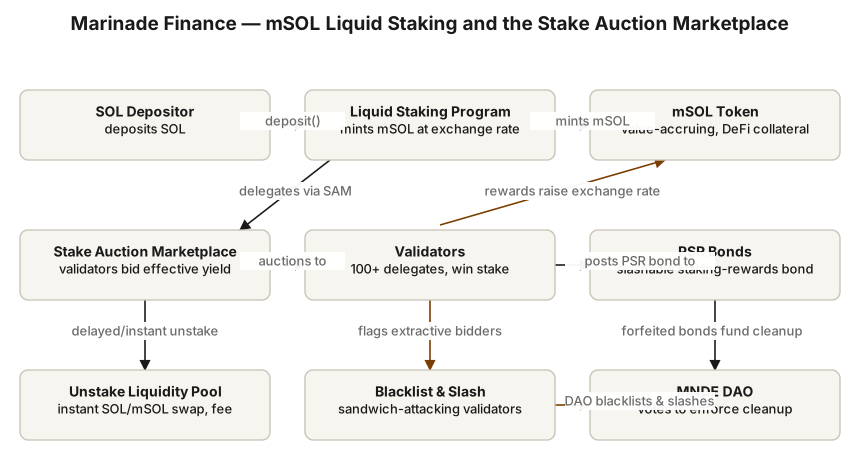 Open full-size diagram
Summary
Marinade Finance is Solana's original liquid staking protocol. Users deposit SOL and receive mSOL, a value-accruing liquid staking token, while the protocol algorithmically delegates the underlying stake across roughly one hundred validators to earn rewards and spread Solana's stake distribution. The project began at the March 2021 Solana x Serum hackathon (where it took third place), merged with the rival hackathon team SmartPool (bringing in Lucio Tato and Marco Broeken alongside Michael Repetny's team), and launched on mainnet on August 2, 2021 without venture funding. Its initial 100,000 SOL deposit cap filled in about 2.5 days. Marinade transitioned to DAO governance with the MNDE token in October 2021, added "Marinade Native" (automated delegation without smart-contract custody) in 2023, and in 2024 replaced its scoring-formula delegation with the Stake Auction Marketplace (SAM), where validators bid yield to receive stake and post slashable "Protected Staking Rewards" bonds. It remains a live, evolving protocol with roughly $1.7B TVL at the end of 2024 and a growing institutional product (Marinade Select) through 2025.
Design (Mechanism)
Liquid staking token (mSOL). Depositing SOL into the open-source liquid staking program (MarBmsSgKXdrN1egZf5sqe1TMai9K1rChYNDJgjq7aD) mints mSOL. Rather than rebasing, mSOL appreciates against SOL each epoch as staking rewards accrue to the pool, so the mSOL/SOL exchange rate encodes cumulative yield. mSOL is a standard SPL token usable as DeFi collateral.
Delegation strategy. Marinade splits deposits across a large validator set (100+), originally chosen by a public scoring formula weighing performance, commission, and decentralization (data-center and superminority concentration). This made Marinade an explicit decentralization vector for Solana, steering stake away from the largest operators.
Exit paths. Two unstake routes: delayed unstake (deactivating stake accounts over an epoch boundary, no fee) and instant unstake via an internal SOL/mSOL liquidity pool that charges a small dynamic fee — an early "unstake liquidity as an AMM" design.
Governance. The MNDE token (launched October 7, 2021) governs the DAO; MNDE lockers could also "direct" a share of stake toward chosen validators, an early form of gauge-like stake direction.
Marinade Native (2023). A non-custodial automation layer (proxy mnspJQyF1KdDEs5c6YJPocYdY1esBgVQFufM2dY9oDk): users keep native stake accounts (no smart-contract or LST exposure) while Marinade rebalances delegation — aimed at institutions wary of contract risk.
Stake Auction Marketplace (SAM, 2024). SAM 2.0 launched August 2024; MIP-3 (approved November 2024) moved all stake allocation to auction. Validators bid effective yield (sharing commissions, block rewards, and MEV) to win delegation each epoch; allocation goes to the highest sustainable "max yield" bids, computed by open-source code. Bidders must post Protected Staking Rewards (PSR) bonds that are forfeited if they underperform their bid or harm stakers — a bonded-SLA mechanism grafted onto a chain with no native slashing.
Outcome
Marinade became and remained one of Solana's largest staking protocols: 50,000 SOL staked within an hour of launch, ~$23M TVL two weeks in, multi-billion-dollar TVL at cycle peaks, and $1.7B TVL (+35.6% QoQ) at the end of Q4 2024. It survived the 2022 bear market and FTX collapse without protocol failure, and its LST never suffered a mint exploit. Competitive pressure was real: Jito's jitoSOL overtook mSOL as Solana's largest LST, and by 2025 Marinade's retail products contracted (mSOL TVL fell from ~4.5M to ~3.5M SOL during 2025; Native from ~4.9M to ~3.1M SOL) while institutional Marinade Select grew sharply (to ~2.7M SOL, +205% QoQ in Q4 2025, with BitGo/Zodia/Copper custodian integrations and SOC 2 compliance). The SAM era brought a governance stress test: researchers alleged that sandwich-attacking validators had bid into SAM for over a year, harming Solana users; in December 2025 Marinade — alongside Jito and the Solana Foundation — blacklisted 50+ such validators (a DAO proposal covered 73) and used PSR bond slashing to make removed validators bear costs. Status: ongoing.
Why it worked
- First mover with a clean primitive. mSOL arrived at the start of Solana DeFi's 2021 expansion and became default collateral across lending and AMM protocols, creating a moat of integrations.
- Aligned with network health. The delegation formula credibly decentralized Solana stake, earning validator and Foundation goodwill that pure yield products lacked.
- Product breadth as a hedge. When LST competition intensified, Native staking and the institutional Select line let Marinade sell "stake automation" rather than only an LST.
- Market-based delegation. SAM converted an opaque, formula-tuning governance fight into a transparent price mechanism, and PSR bonds manufactured slashing-like accountability that Solana itself does not provide.
Limitations and criticisms
- Lost the LST crown. Jito bundled MEV rewards into jitoSOL and captured the narrative and integrations; mSOL's relative share and retail TVL declined through 2024–2025, showing that first-mover advantage alone doesn't hold against a competitor bundling a new reward stream.
- Auction adverse selection. SAM's yield-maximizing auction has a structural blind spot: it initially admitted validators whose "extra yield" came from running sandwich attacks against transactions passing through their block production, so some of the highest bids came from that source. The design only caught this reactively, via after-the-fact blacklists and bond slashing, rather than pricing the externality into the auction from the start.
- Weak token accrual. MNDE governance never became a strong value-capture story, and its directed-stake gauge mechanic was largely superseded by the auction model, leaving the token's link to protocol value thin.
Lessons
- A value-accruing (non-rebasing) LST exchange rate is the cleanest way to pass through staking yield while staying composable with DeFi.
- Delegation policy is the core political object of a liquid staking protocol; converting it from a committee-tuned formula into an open auction reduces governance overhead but imports auction pathologies — bids must be conditioned on externalities (MEV behavior), not just yield.
- On chains without protocol-level slashing, protocol-level bonds (PSR) can synthesize accountability, and they proved genuinely usable: slashing funded the cleanup of malicious validators.
- First-mover LSTs are not safe: a competitor that bundles a new reward stream (Jito's MEV) can flip the market; product diversification (native automation, institutional custody rails) is a viable retreat to higher ground.
Redesign (EDITORIAL — hypothesis, not fact)
This section is editorial hypothesis, not established fact. A redesigned SAM would price externalities into the auction from day one: bids would be scored as (promised yield) minus (measured harm), using an on-chain oracle of sandwich/MEV-abuse metrics (as GhostLogs-style detection matured, this became feasible), so validators funding bids through sandwich-attack revenue are outbid rather than blacklisted ex post. PSR bonds could scale superlinearly with delegated stake and be partly paid to harmed stakers rather than merely forfeited. On the LST side, mSOL could have incorporated MEV/block-reward passthrough in 2022 — before Jito made it a differentiator — since Marinade already had validator relationships to negotiate reward sharing. Finally, MNDE might have been designed as a fee-switch claim on SAM auction spread (validators' bid premium over base staking yield), giving governance a native revenue stream aligned with running honest auctions.
Sources
- Marinade Documentation — Contracts & Token Addresses — primary (docs)
- marinade-finance/liquid-staking-program (GitHub) — primary (contract)
- Marinade — What a launch! (mainnet launch retrospective) — primary (retrospective)
- Marinade — Stronger Together (SmartPool merger announcement) — primary (retrospective)
- Marinade — Stake Auction Marketplace (how it works) — primary (docs)
- Marinade — How Marinade is Making Sandwiching Validators Pay — primary (retrospective)
- Marinade help center — Official Links — primary (docs)
- Messari — Marinade Q4 2024 Brief (analysis)
- Messari — State of Marinade Q4 2025: Institutions Select Marinade (analysis)
- SolanaFloor — Marinade DAO Proposes Blocklisting 73 Validators to Combat Sandwich Attacks (news)
Related experiments
Last verified: 2026-07-27 · Spot an error? Suggest a correction