Lido
Liquid staking protocol that issues stETH, a rebasing receipt token for pooled Ethereum validator stakes, becoming the largest DeFi protocol by TVL while wrestling with dominance and governance-risk critiques.
▶ Run interactive simulation animated mechanism with editable parameters
How it works onchain
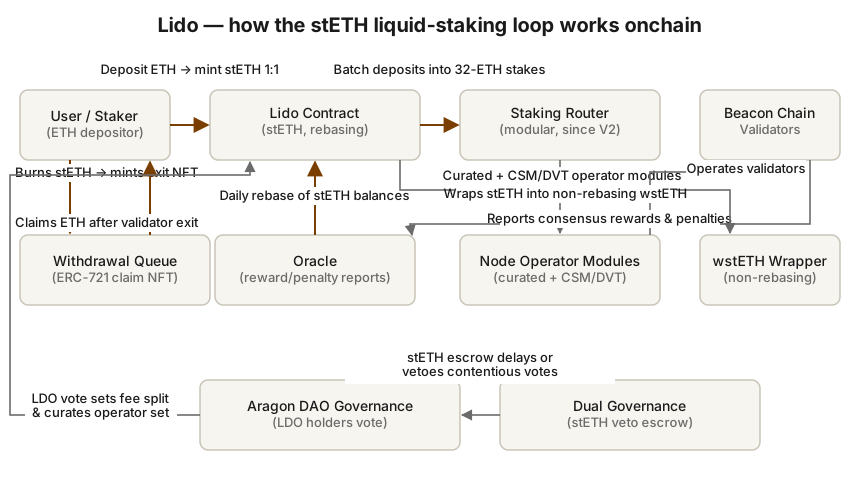 Open full-size diagram
Summary
Lido is the canonical liquid staking experiment: it lets anyone stake any amount of ETH into a pooled contract and receive stETH, a token that rebases daily to reflect accrued validator rewards, remaining liquid and usable in DeFi while the underlying ETH is locked in Ethereum's consensus layer. Introduced via blog post in October 2020 and launched on 2020-12-18 — weeks after the Beacon Chain went live, when staking required 32 ETH, technical operation of a validator, and an indefinite lockup with no withdrawals — Lido dissolved all three frictions at once. Governance runs through Lido DAO, an Aragon-based organization controlled by the LDO token. The bet paid off enormously: Lido became the largest protocol in DeFi by TVL (roughly 9.3M ETH, ~$18–27B depending on ETH price, per lido.fi and 2025–26 reports) and stETH became one of the most integrated collateral assets in the ecosystem — while also becoming the focal point of Ethereum's most persistent decentralization debate.
Design (Mechanism)
- Pooled deposits, receipt token. Users deposit ETH into the Lido contract (0xae7ab...fE84) and receive stETH 1:1. The contract batches deposits into 32-ETH validator stakes assigned to node operators. stETH is a rebasing token: balances adjust daily via an oracle-reported accounting of consensus-layer rewards and penalties, socialized across all holders. A non-rebasing wrapper, wstETH, exists for DeFi composability.
- Curated operator set → modular Staking Router. Originally, a DAO-curated registry of professional node operators (starting with fewer than a dozen) ran validators without holding user funds; withdrawal credentials point to protocol contracts. The 2023 Lido V2 upgrade introduced the Staking Router, a modular system into which new operator modules plug — notably the Community Staking Module (CSM), which opened permissionless, bonded solo-operator entry, and DVT-based modules.
- Fee split. 10% of staking rewards are taken as protocol fee, split between node operators and the DAO treasury (insurance was part of the early split).
- Withdrawals. After Ethereum's Shapella upgrade (April 2023), Lido V2 added a Withdrawal Queue (ERC-721 claim NFTs), making stETH redeemable for ETH at the protocol level rather than only via secondary markets.
- Governance and Dual Governance. LDO holders vote through Aragon apps. In 2025 Lido activated Dual Governance, a mechanism giving stETH holders a dynamic timelock/veto path: if enough stETH is escrowed in opposition, the LDO decision is delayed or blocked until dissenters can exit — a two-token check designed to protect stakers from tokenholder capture.
- Lido V3 (2025–26): stVaults. Isolated vaults decouple validator selection from liquidity, letting institutions and strategy designers run customized stakes (DVT, restaking sidecars, compliance constraints) that still mint stETH, rolled out cautiously under a small initial TVL cap.
Outcome
Major success. Lido won the liquid staking market decisively: for years it was DeFi's largest protocol, at times approaching one-third of all staked ETH — large enough to trigger sustained debate about whether a single LDO-governed operator set nearing 33% of validators threatened Ethereum's consensus neutrality; several operators and community members endorsed self-limiting proposals that the DAO declined. The protocol survived its worst stress test in May–June 2022, when Terra's collapse pushed bridged bETH back into stETH, and Celsius and Three Arrows Capital drained the Curve stETH/ETH pool; stETH traded at a ~5–7% discount but the protocol itself functioned exactly as designed, and the "depeg" resolved as withdrawals became credible. Multichain forays (Solana, Polygon, Polkadot-adjacent deployments) were sunset in 2023–24 to refocus on Ethereum. By late 2025 Lido's share of staked ETH slipped below ~25% — pressured less by rival LSTs than by restaking and yield-strategy products — prompting the V3/stVaults pivot, CSMv2, institutional ETPs (e.g., WisdomTree), and treasury buyback plans under the GOOSE-3 strategy. As of mid-2026 the protocol is live, revenue-generating, and still the category leader.
Why it worked
- Perfect timing against a real constraint. At Beacon Chain launch, staking meant an indefinite, illiquid lockup with a 32-ETH minimum. Lido converted a multi-year lockup into a liquid token on day one, capturing demand no one else served at scale.
- Liquidity begets liquidity. Deep Curve pools and aggressive LDO incentives made stETH the Schelling-point collateral (Aave, Maker, etc.); integrations compounded into a moat no later entrant matched.
- Socialized, professional validation. Pooling across curated operators smoothed rewards and slashing risk, giving retail users index-like exposure to validation without operational burden.
- Institutional adaptation. Withdrawals (V2), permissionless operators (CSM), staker veto rights (Dual Governance), and isolated vaults (V3) each answered the era's sharpest criticism, keeping the protocol legible to both Ethereum culture and institutions.
Limitations and criticisms
- Dominance externality. Lido's success created a systemic critique it has never fully dissolved: an LDO-governed pool that at times approached a third of Ethereum stake concentrates consensus influence, and the DAO's refusal to adopt a self-limit has cost it goodwill among Ethereum researchers.
- Secondary-market fragility pre-withdrawals. Before Shapella, stETH's peg rested entirely on Curve liquidity; the 2022 Celsius/3AC unwind showed that a receipt token without native redemption is only as strong as its thinnest pool — a structural weakness for the years before withdrawals existed.
- One-size-fits-all ceiling. The monolithic pool struggled to express restaking, leverage, or compliance preferences, and market share eroded toward more flexible alternatives until V3's comparatively late response.
- Multichain retreat. Solana and Polygon deployments never reached sustainable economics and were sunset, narrowing the protocol's ambitions back to Ethereum.
Lessons
- A liquid receipt token for locked assets is one of crypto's most powerful primitives — and its peg is a liability until protocol-level redemption exists; incentivized AMM liquidity is a bridge, not a foundation.
- Winner-take-most dynamics in staking create governance externalities for the base layer itself; mechanism designers should expect "too successful" to become a failure mode with its own critics and countermeasures.
- Two-token governance checks (Dual Governance's stETH veto) are a credible way to protect users from governance-token capture — but they were added five years in; building user-side veto power early is cheaper than retrofitting it.
- Modularizing the operator set (Staking Router, CSM bonds) lets a curated system open up incrementally without betting the whole pool on permissionless entry.
Redesign (EDITORIAL — hypothesis, not fact)
This section is editorial hypothesis, not fact. A redesigned Lido would launch with (1) a protocol-enshrined self-limit or progressive fee that rises with share of total network stake, converting the dominance debate into an explicit, priced parameter rather than a social standoff; (2) Dual Governance from day one, so stETH holders' exit-veto disciplines LDO decisions before treasury and operator-set choices ossify; (3) permissionless bonded operators from the start with a curated module as the bootstrap rather than the core; and (4) no incentivized peg pools at all pre-withdrawals — instead a transparent redemption-queue futures market that prices lockup duration honestly, avoiding the illusion of a hard peg that broke in 2022.
Sources
- Lido deployed contracts (official docs) — primary (docs)
- Lido official site (TVL, ETH staked, social links) — primary (docs)
- Lido V3 Whitepaper (stVaults) — primary (docs)
- Recap: Lido Tokenholder Update, February 2026 — primary (retrospective)
- GOOSE-3: Lido's Next Chapter (governance proposal) — primary (governance)
- Lido Explained, Part 1: History & Architecture (Oxorio) (analysis)
- Nansen report: Terra caused the stETH depeg (CoinDesk) (analysis)
- Lido DAO profile (Messari) (analysis)
Related experiments
Last verified: 2026-07-27 · Spot an error? Suggest a correction