WHALE
Pseudonymous NFT mega-collector WhaleShark issued a 10M-supply ERC-20 social token whose value was underwritten by 'The Vault,' a publicly audited multi-million-dollar NFT collection governed by a token-holder DAO.
▶ Run interactive simulation animated mechanism with editable parameters
How it works onchain
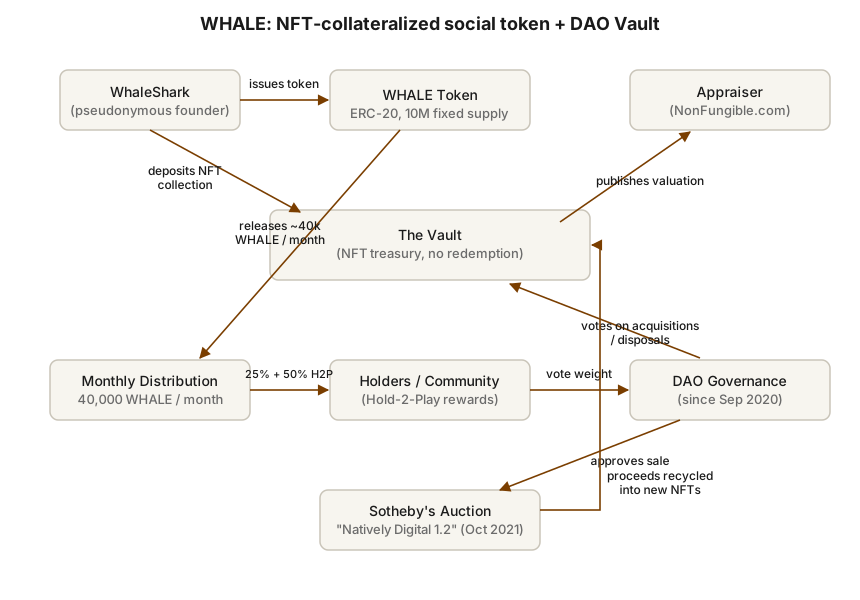 Open full-size diagram
Summary
WHALE, launched on Ethereum on May 18, 2020, was the flagship experiment in "asset-backed" social tokens. Its creator, the pseudonymous collector WhaleShark — an early crypto adopter (2012) who began aggressively accumulating NFTs in 2019 — issued a fixed-supply ERC-20 (10,000,000 WHALE) and pledged a large personal NFT collection, "The Vault," as the token's value floor. The Vault was periodically appraised by the third-party analytics firm NonFungible.com and its holdings were publicly viewable on OpenSea, making WHALE an unusual hybrid: part patronage/membership token, part quasi-fund share on a curated NFT portfolio. In September 2020 governance of the Vault was handed to a token-holder DAO, and at its 2021–2022 peak WHALE claimed roughly 25,000 members, a Vault of 13,000+ NFTs valued in the tens of millions of dollars (over $150M by community claims in January 2022, $47.7M in a September 2021 appraisal cited by Gemini), and a token that hit an all-time high of $52.37 on March 13, 2021. The community later sold Vault pieces through a landmark Sotheby's "Natively Digital 1.2" auction (October 2021). After the 2022 NFT and social-token collapse, WHALE's price fell more than 99% from its high ($0.19 as of mid-2026), and the project persists in greatly diminished form as a digital-art membership club.
Design (Mechanism)
- Fixed supply, vested allocation. 10M WHALE total: 10% founder/team (24-month vesting from May 2020), 10% private sale (20-month vesting), 42.6% for community distribution released at ~40,000 WHALE per month, and 37.4% to a WHALE Foundation on a 120-month vesting schedule.
- NFT-collateralized "intrinsic value." The Vault — gaming NFTs, digital art, and virtual land accumulated by WhaleShark since 2019 (initially ~$500K, growing to 13,000+ assets) — served as backing. Crucially, there was no redemption mechanism: holders could not burn WHALE for Vault assets. The "backing" was a transparency-and-appraisal story (NonFungible.com audits, public OpenSea wallets), not an enforceable claim.
- Monthly distribution flywheel. Each month's 40,000-token community tranche was split: 25% team/partnerships, 25% community rewards, and 50% "Hold-2-Play" rewards for members holding a minimum balance — paying people to stay in the club.
- Revenue recycling. Proceeds from market-making and Vault operations (NFT rentals/sales) were redirected into buying more rare NFTs, compounding the collateral base rather than distributing cash.
- DAO governance (from September 2020). WHALE holders voted on Vault acquisitions and disposals, budgets, and events — including the decision path that led to the October 2021 Sotheby's auction, the first-ever sale out of the Vault.
- Membership utility. Token-gated Discord, NFT rentals and purchases from the Vault, merchandise, and liquidity-mining programs gave the token consumption value beyond the portfolio narrative.
Outcome
WHALE became the largest social token of the 2020–2021 cycle and its most-cited proof of concept: it reached a $52.37 ATH (March 2021), an FDV in the hundreds of millions, and mainstream-visibility moments like the Sotheby's auction. WhaleShark's collection was widely reported as the most valuable NFT portfolio in the world ($40M+ in 2021 press). But the mechanism never decoupled from the NFT market it held: when NFT prices collapsed in 2022, the Vault's appraised value, the token price, and community activity all fell together. WHALE still trades ($0.19, ~$1.9M FDV in 2026) and the club nominally continues, but the "largest social token community" era is over. No exploit, rug, or governance failure was found — the decline was a market-beta and engagement decline, not a technical one. Outcome: partial_success.
Why it worked
- A real, verifiable asset base. Unlike most social tokens backed only by a person's promises, WHALE pointed at public wallets and third-party appraisals — the transparency itself was the innovation, and it bootstrapped trust in a pseudonymous founder.
- Credible curator premium. WhaleShark was genuinely one of the best-known NFT collectors; the token was effectively an index on his taste at the exact moment NFT curation expertise was scarce and valuable.
- Aligned flywheel during the bull market. Rising NFT prices raised Vault value, which raised WHALE, which funded more acquisitions and rewards — a reflexive loop that worked spectacularly on the way up.
- Progressive decentralization. Handing the Vault to a DAO within four months of launch converted a personal brand token into a community institution, extending its life beyond one person's attention.
Where the design broke
- Backing without redemption. With no burn-for-assets or NAV-arbitrage mechanism, the "floor" was purely narrative; WHALE traded far above appraised NAV in 2021 and far below coherent NAV afterward, and nothing forced convergence.
- Undiversified, illiquid, correlated collateral. NFTs are the most reflexive asset class in crypto; appraisals lagged and Vault liquidity vanished exactly when support was needed.
- Appraisal dependence. NonFungible.com valuations were estimates on thin markets — mark-to-model backing invited overstatement at the top.
- Membership value tied to price. Hold-2-Play and token-gating meant community engagement was mercenary at the margin; when rewards lost dollar value, members left, weakening the non-financial utility that might have cushioned the drawdown.
Lessons
- "Asset-backed" is only a floor if there is a redemption or arbitrage path; transparent collateral without claims is a narrative device, not a peg.
- Collateralizing a token with assets from the same hype cycle it trades in (NFTs backing an NFT-community token) produces double-beta on the way down — diversify the treasury or accept full reflexivity.
- Third-party appraisal of illiquid assets is better than nothing but should be paired with realized-sale benchmarks (WHALE's Sotheby's auction was a rare, valuable mark-to-market event).
- Early DAO hand-off of a founder's personal assets is possible and builds durable trust — WHALE avoided the rug accusations that killed many personal tokens (contrast: $ALEX).
- Paying members to hold (Hold-2-Play) buys retention metrics, not loyalty; utility that survives a 99% drawdown must be non-financial.
Redesign (EDITORIAL — hypothesis, not fact)
This section is editorial hypothesis, not a factual account. A modern WHALE would make the backing enforceable and countercyclical: (1) hold the Vault in an onchain vault (e.g., NFTX/Tessera-style fractional wrappers plus a Gnosis Safe under the DAO) with a quarterly optional-redemption window where WHALE can be tendered pro-rata against a designated "liquid sleeve" of the treasury, forcing a soft NAV floor; (2) diversify the treasury — cap NFTs at ~50%, hold the rest in ETH/stables earning yield, so rewards and buybacks are fundable in bear markets; (3) replace appraisal-based marks with realized-price marks (rolling auctions of small Vault tranches, Sotheby's-style, published as an onchain NAV oracle); (4) shift membership value toward non-financial goods — curation credentials, exhibition access, artist funding votes — so the club retains members when the token doesn't pay; and (5) formalize the curator role as a renewable, DAO-elected mandate with performance fees paid in long-vesting WHALE, keeping WhaleShark's taste in the loop without single-person dependency.
Sources
- WHALE (WHALE) Token Tracker — Etherscan — primary (contract)
- WHALE Members — official Medium publication — primary (docs)
- Sotheby's To Auction Off The First $WHALE Vault NFTs (WHALE Members Medium) — primary (governance)
- Whale Coin: Whale Crypto NFT Market & Social Token — Gemini Cryptopedia (analysis)
- Whale Shark's NFT Collectors Playbook — CoinDesk (news)
- WhaleShark: Social tokens will boom after NFTs — TheStreet (news)
- WHALE — CoinGecko (analysis)
Related experiments
Last verified: 2026-07-26 · Spot an error? Suggest a correction