Fei Protocol
A decentralized, ETH-backed stablecoin (FEI) that pioneered 'direct incentives' (mint rewards / burn penalties on DEX trades) and Protocol Controlled Value, but launched into a peg crisis and eventually wound itself down after a merger with Rari Capital and an $80M exploit.
▶ Run interactive simulation animated mechanism with editable parameters
How it works onchain
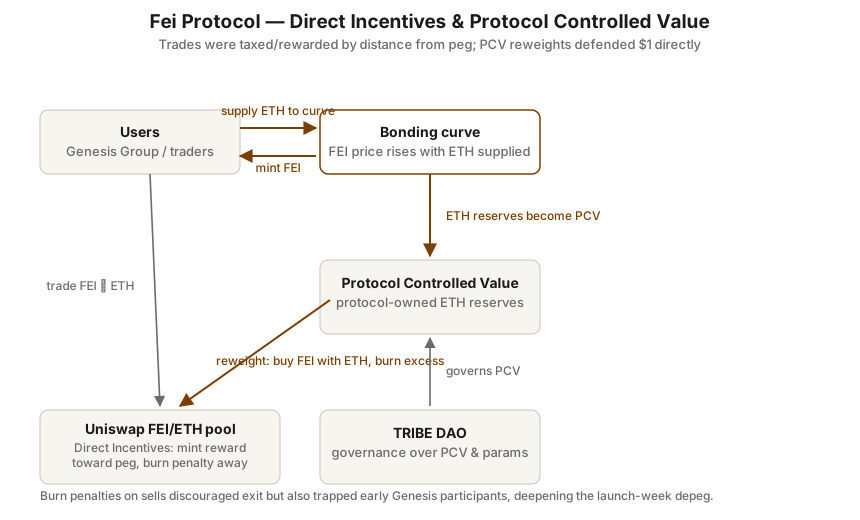 Open full-size diagram
Summary
Fei Protocol was a decentralized stablecoin on Ethereum whose token, FEI, was designed to trade at $1 without relying on fiat custody or over-collateralization. Its distinguishing idea was "direct incentives": rather than defending the peg only through arbitrage or collateral ratios, the protocol applied dynamic mint rewards and burn penalties directly to DEX trades, rewarding buys that pushed FEI toward the peg and penalizing sells that pushed it away. Reserves supplied by users (initially ETH) were held by the protocol itself as "Protocol Controlled Value" (PCV), a concept Fei popularized and which reframed the industry's later shift toward protocol-owned liquidity.
Built by Fei Labs (Joey Santoro and team), the protocol launched via a "Genesis Group" event beginning 3 April 2021 that attracted roughly 639,000 ETH (~$1.3B) from more than 17,000 participants — one of the largest DeFi launches ever at the time. Governance ran through the TRIBE token. Despite the strong start, FEI depegged almost immediately, the incentive design trapped early participants, and the project never fully recovered its narrative. After merging with Rari Capital into "Tribe DAO" in late 2021 and suffering an ~$80M exploit of Rari's Fuse pools in April 2022, Fei Labs ultimately proposed winding the protocol down in August 2022.
Design (Mechanism)
- Direct incentives: On the FEI/ETH Uniswap pool, trades away from the peg incurred a burn penalty while trades toward the peg earned a mint reward, both scaled by distance from peg and time since peg was last restored. This tried to make the market itself defend $1.
- Bonding curve: New FEI was minted by supplying ETH along an ETH-denominated bonding curve, with FEI's price rising relative to ETH as more was purchased (increasing the protocol's capital factor).
- Protocol Controlled Value (PCV): Reserves from the bonding curve were owned by the protocol, not by liquidity providers. PCV was deployed (e.g., as protocol-owned liquidity) and could be used to defend the peg.
- Reweights: When FEI traded below peg for a sustained period, the protocol executed a reweight — withdrawing its ETH and FEI from Uniswap, buying FEI with ETH to push price back to $1, re-depositing at a 1:1 value ratio, and burning excess FEI.
- Governance: TRIBE (1B fixed supply forked from Uniswap's UNI token) governed the DAO. Allocation split across the DAO treasury (
40%), an IDO (20%), the core team (~13%), plus staking, investors, and grants.
FEI (0x956F47F50A910163D8BF957Cf5846D573E7f87CA) and TRIBE (0xc7283b66Eb1EB5FB86327f08e1B5816b0720212B) are both Etherscan-verified and labeled as Fei Protocol contracts. OpenZeppelin performed multiple audits before and around launch.
Outcome
Status: failed (technically functional, but the core stablecoin thesis did not hold and the protocol chose to unwind).
- Depeg at launch: Within days of Genesis (early April 2021) FEI fell well below $1 (trading around $0.94–0.95, with reports of ~20% deviation intraday). The very penalties meant to protect the peg discouraged selling, effectively locking capital and amplifying dissatisfaction. A vulnerability in the incentive calculation was patched around 6 April 2021.
- Merger: In late 2021, Fei Protocol and Rari Capital combined into "Tribe DAO."
- Exploit: On 30 April 2022, an ~$80M reentrancy exploit drained several Rari Fuse pools (a check-effects-interactions failure allowing collateral withdrawal without updating borrow records). Fei offered the attacker a ~$10M bounty.
- Wind-down: A DAO vote to reimburse hack victims passed but repayment proposals were later blocked. In August 2022 Fei Labs proposed shutting Tribe DAO down: FEI redeemable ~1:1 for DAI, TRIBE holders receiving pro-rata residual PCV, and governance ending. This drew sharp criticism (e.g., from Frax's founder) as a "new low for DeFi." Redemptions were later offered via tribedao.xyz.
Why it worked
- Genuine mechanism innovation: Direct incentives and PCV were novel, intellectually influential contributions. PCV/protocol-owned liquidity ideas propagated widely across DeFi afterward.
- Enormous cold-start liquidity: The Genesis Group model bootstrapped ~$1.3B and a large holder base in days, proving demand for a credibly decentralized dollar.
- Serious engineering and audit posture: Multiple OpenZeppelin audits and a substantial reserve treasury gave it real staying power and, ultimately, the assets to offer FEI holders a ~1:1 DAI redemption at shutdown.
Where the design broke
- Incentives fought the market instead of guiding it: Burn penalties on sells created a "roach motel" dynamic — easy to enter, painful to exit — which produced panic, reputational damage, and a persistent below-peg price early on.
- Peg fragility at launch: A live incentive-calculation bug plus a peg that broke almost immediately undermined confidence during the most critical window.
- Governance paralysis and non-binding votes: After the Rari/Fuse exploit, the DAO voted to make victims whole, but the protocol had no mechanism that made a passed vote binding on subsequent action — the wind-down proceeded on different terms than the vote had set, with no enforcement layer between "the DAO decided" and "the DAO's decision executes."
- Macro timing: The 2022 stablecoin crisis (Terra/UST collapse) poisoned sentiment toward all non-fiat-backed "algorithmic-ish" stablecoins, reducing appetite to keep experimenting.
Lessons
- Exit friction is not the same as peg stability. Penalizing sellers can hold a nominal price temporarily, but it converts a liquidity problem into a trust problem; participants remember being trapped far longer than they remember a brief peg hold.
- Launch mechanics dominate first impressions. A record-setting raise means little if the token depegs in the first days; large cold-start events raise the stakes of any launch-window bug or design flaw enormously.
- Governance credibility is a protocol asset. Passing a vote to reimburse victims and then not honoring it — and later overriding community sentiment to wind down — can destroy more long-term value than the original exploit did.
- PCV/protocol-owned value was the durable idea. Even as the stablecoin failed, the treasury-owns-its-own-liquidity concept survived and shaped later designs; mechanisms can outlive the products that first shipped them.
Redesign (EDITORIAL — hypothesis, not fact)
This section is the researcher's opinion, not established fact.
If rebuilt today, a Fei-style decentralized dollar would likely drop the punitive burn-on-sell mechanic entirely. The core error was making the peg defense hostile to the very users whose confidence the peg depends on. A modern redesign would keep Protocol Controlled Value — Fei's most valuable legacy — but pair it with a transparent, over-reserved backing floor and a hard, permissionless redemption right at (or just below) $1, so the peg is defended by credible convertibility rather than by trading penalties. Redemptions to a diversified reserve basket (ETH LSTs, high-grade stablecoins, tokenized T-bills) would give arbitrageurs a clean lower bound without trapping anyone.
Direct incentives, if retained at all, should be symmetric and mild (small fees/rebates that nudge, never lock) and fully disclosed pre-launch with adversarial audits of the incentive math specifically, since that is exactly where Fei's launch bug lived. Rather than a single mega-Genesis that concentrates risk into one moment, a capped, staged bootstrap would let the peg mechanism prove itself at small scale before scaling TVL.
Finally, governance would need pre-committed, on-chain crisis playbooks: automatic victim-reimbursement waterfalls and time-locked wind-down rules agreed before any exploit, removing the discretion that let Tribe DAO's post-hack governance implode. In short — keep PCV and decentralization, delete coercive peg defense, and make redemption and crisis response mechanical and non-discretionary.
Sources
- Fei USD (FEI) ERC-20 token contract (verified) — primary (contract)
- Tribe (TRIBE) ERC-20 governance token contract (verified) — primary (contract)
- What you should know about Fei (official Fei Protocol Medium, Brianna Montgomery) — primary (docs)
- Fei Protocol Audit (Phase 1) — primary (audit)
- Fei Protocol Audit - Phase 2 (OpenZeppelin) — primary (audit)
- Fei Protocol Incident Analysis (CertiK, Apr 30 2022 exploit) (audit)
- DeFi Lender Rari Capital/Fei Loses $80M in Hack (CoinDesk) (news)
- Fei Protocol founder proposes ghosting Tribe DAO following hack repayment (Cointelegraph) (news)
- Fei Roils Early Adopters As Stablecoin and Token Tumble After $1.3B Sale (The Defiant) (news)
- Fei Labs Raised Almost $1.3 Billion for Decentralized Stablecoin (Decrypt) (news)
Related experiments
Last verified: 2026-07-26 · Spot an error? Suggest a correction