OpenBazaar
A fee-free, peer-to-peer decentralized marketplace using Bitcoin multisig escrow, Ricardian contracts, and (in v2.0) IPFS — technically pioneering but shut down in 2021 after failing to find a revenue model or mainstream demand.
▶ Run interactive simulation animated mechanism with editable parameters
How it works onchain
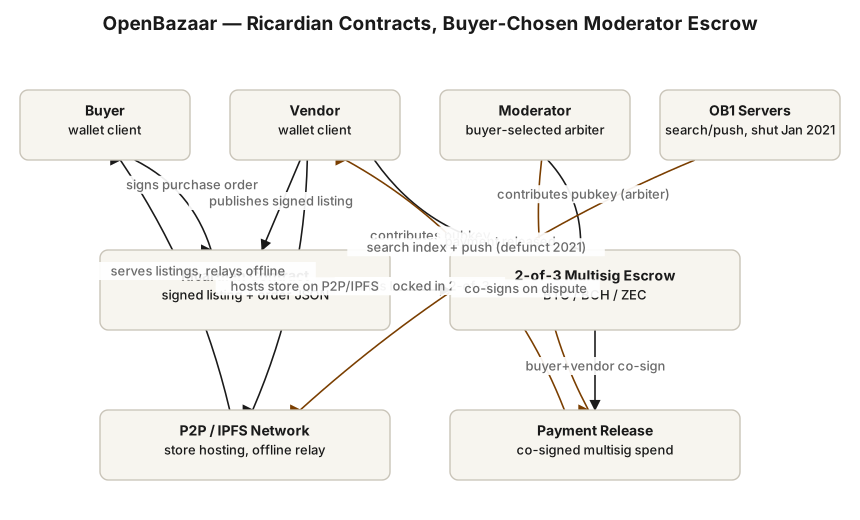 Open full-size diagram
Summary
OpenBazaar was the flagship attempt to build "eBay without eBay": a fully peer-to-peer marketplace with no company in the middle, no listing fees, no take rate, and no ability to censor sellers or reverse transactions. It began as "DarkMarket," a proof-of-concept built by Amir Taaki and Airbitz programmers at a Toronto hackathon in April 2014 as a response to the Silk Road seizure. The original creators abandoned the prototype, and Brian Hoffman forked and rebranded it as OpenBazaar, later founding the company OB1 (2015) with Sam Patterson and Washington Sanchez to develop it full-time. OB1 raised $9.25 million from Union Square Ventures, Andreessen Horowitz, and Digital Currency Group — making OpenBazaar one of the first VC-backed "dapps" before the term existed. Version 1.0 shipped April 4, 2016 with Bitcoin payments; version 2.0 (November 2017) re-architected the network on IPFS; version 2.1 (February 2018) added Bitcoin Cash and Zcash, and a mobile app, Haven, followed. Despite 250,000+ installs, OB1 exhausted its funding, and on January 4, 2021 announced it would cease supporting OpenBazaar's wallets, APIs, search engine, and website, effectively ending the project.
Design (Mechanism)
OpenBazaar's core design goal was trust-minimized commerce between strangers with no platform operator:
- P2P network, not a website. Every user ran a node (Go server + JavaScript/Electron client). Stores were hosted by their owners; there was no central server holding listings or funds. In v2.0 the data layer moved to a modified IPFS node, so listings were content-addressed and could be re-served by other peers — crucially allowing vendors to receive orders while offline via the network caching signed order messages.
- Ricardian contracts. Each listing and order was a digitally signed, human- and machine-readable contract (JSON), hash-chained through the trade lifecycle (listing → purchase → fulfillment). This made every step attributable and tamper-evident without any chain writes: the blockchain was used only for payment.
- 2-of-3 multisig escrow with buyer-chosen moderators. For moderated purchases, buyer, vendor, and a moderator each contributed a public key to a Bitcoin 2-of-3 multisig address. Happy path: buyer + vendor sign the release. Dispute: the moderator sides with one party and co-signs, taking a moderator fee. Moderators were an open, competitive market — anyone could offer moderation services and build reputation — rather than a platform-appointed arbiter. Buyers who trusted a vendor could pay directly (with a 1-of-2 arrangement used when the vendor was offline).
- Zero platform fees. No listing fees, no take rate, no token. This was ideological (censorship-resistant free trade) and, in hindsight, the project's economic Achilles' heel: the only monetization experiments (OB1-operated services, later Haven) never produced a business.
- Multi-coin payments. BTC at launch; BCH and ZEC added in v2.1 as fees on Bitcoin made small purchases impractical; later releases and the Haven app extended wallet support further. Notably, OpenBazaar had no native token and no smart-contract dependency — an Ethereum escrow contract was specced but the shipped product remained UTXO-multisig based.
Outcome
Technically, it worked: a fully decentralized marketplace ran for roughly five years, with over 250,000 desktop installs, 100,000+ Haven downloads, and (per the project) tens of thousands of nodes after the 2.0 release. Hoffman noted the platform "never had to remove users or reverse transactions." Commercially, it never found sustained demand: real transaction volume stayed small, no fee revenue existed by design, and after burning through the $9.25M raised, OB1 turned to community donations in September 2020, then announced shutdown on January 4, 2021, with servers (search, push nodes, APIs) going dark mid-January. The code remains open source (MIT), and community forks (e.g., Mobazha) attempted revivals, but the original network effectively died with OB1's infrastructure.
Why it worked
- The escrow design was genuinely sound: 2-of-3 multisig with a market of freelance moderators solved buyer/seller trust without custodians, and it was exercised in production for years without a systemic exploit.
- Ricardian contracts gave disputes an evidentiary backbone — signed, hash-linked records of exactly what was agreed — a pattern still underused in Web3 commerce.
- The IPFS re-architecture solved a real P2P commerce problem (offline vendors), and the project shipped working software across desktop and mobile.
- Strong censorship-resistance credentials attracted a passionate niche (privacy advocates, users in payment-restricted markets).
Where the design broke
- No revenue mechanism, by design. Zero fees meant no path to sustainability; Hoffman said this "limited our revenue options and made it hard to operate at a profit or raise additional venture capital." A donation appeal in late 2020 failed.
- Bitcoin stopped being spending money. The 2017 fee spike and BTC's shift to "digital gold" made small e-commerce payments irrational; the protocol had no stablecoin support when it mattered most, and remained tied to UTXO-multisig settlement (rather than smart-contract escrow) as the dapp ecosystem consolidated on Ethereum.
- UX drag of full decentralization. Users had to run a "complicated, high-maintenance desktop application... always clunky and unreliable" (Hoffman). Hosting your own store node is a demand most sellers never had.
- No real market pull. Most goods are bought fine on Amazon/eBay/Shopify; censorship-resistant retail was a solution seeking a mainstream problem, while the users who most valued it (grey-market trade) were ones a VC-backed company could not court.
- Chicken-and-egg liquidity: few buyers meant few serious sellers, and no fee pool existed to subsidize either side.
Lessons
- Decentralization is a cost users must be paid for: if the decentralized version is harder to use and the censorship threat is abstract, mainstream users choose convenience every time.
- "No fees" is not a moat, it is a missing business model; protocols that intend to persist need either a sustainable fee/token flywheel or credibly minimal infrastructure that survives its company's death (OpenBazaar's search/push servers did not).
- Payment rails must match the use case: volatile, fee-spiking BTC broke small-ticket commerce; commerce dapps need stable units of account (stablecoins) first, not as an afterthought.
- Buyer-selected moderator markets + 2-of-3 multisig + Ricardian contracts remain a validated dispute-resolution stack worth reusing, independent of OpenBazaar's fate.
- A P2P protocol that still depends on one company's seed/search/API servers is only nominally decentralized — the shutdown of OB1's infrastructure ended the "unstoppable" marketplace.
Redesign (EDITORIAL — hypothesis, not fact)
This section is editorial hypothesis, not historical fact. A modern OpenBazaar would likely: (1) settle in stablecoins on cheap L2s or Solana, keeping the 2-of-3 escrow as a small audited contract with buyer-chosen arbiters staking reputation; (2) run stores from always-online light infrastructure (hosted-but-exportable nodes, or Nostr/IPFS relays) so sellers never run desktop software; (3) fund itself with a small optional protocol fee on moderated escrow releases routed to a treasury that pays for indexing/search — making discovery infrastructure community-owned rather than one startup's server bill; and (4) target a wedge market that actually needs censorship-resistance and cross-border settlement (e.g., freelance services or regions with broken payment rails) instead of general retail. The 2020s stack (stablecoins, cheap blockspace, smart wallets) removes most of what killed OpenBazaar; the unsolved part remains demand-side liquidity.
Sources
- OpenBazaar protocol documentation (Ricardian contracts, moderator escrow) — primary (docs)
- OpenBazaar docs overview (v2.0 IPFS architecture) — primary (docs)
- OpenBazaar smart-contracts escrow spec (experimental Ethereum) — primary (docs)
- OpenBazaar Co-Founder Explains Why Web 3's Answer to eBay Folded Its Tents (Hoffman retrospective) — primary (retrospective)
- OpenBazaar 2.1 released: Bitcoin Cash & Zcash integrated (official blog) — primary (docs)
- Wikipedia: OpenBazaar (DarkMarket origin, v1.0 launch, shutdown timeline) (archive)
- Crypto-Fueled Market OpenBazaar to Close Shop Unless OB1 Raises Community Funding (news)
- Decentralized Marketplace OpenBazaar Now Accepts Bitcoin Cash (CoinDesk) (news)
Related experiments
Last verified: 2026-07-27 · Spot an error? Suggest a correction