Catalog
Catalog turned songs into 1/1 'digital records' on Ethereum — artists kept 100% of primary sales and set their own royalties — routing $3M+ to independent musicians before the team sunset the platform in March 2024.
▶ Run interactive simulation animated mechanism with editable parameters
How it works onchain
 Open full-size diagram
Summary
Catalog was the archetypal "music NFT" experiment of the 2021 cycle: a platform where independent musicians pressed songs as unique, one-of-one onchain "records" on Ethereum and sold them to collectors, keeping 100% of the primary sale and setting their own secondary royalty. Founded by Jeremy Stern and Mike McKain (who had previously built Loft Radio, a live internet radio project with micro-tipping), Catalog launched in beta in early March 2021 on top of the Zora protocol and reportedly attracted $100,000 in bids within 24 hours. It raised a $2.2M seed led by 1confirmation in August 2021 (a further round of roughly $7.5M was reported in March 2022, though not confirmed by primary sources). Over its life the platform facilitated more than $3M in payments to independent artists — a figure the team itself cited in its farewell note. After pivoting its final iteration toward a simpler digital-download/direct-support product, the team concluded the project "had reached its natural completion point" and shut it down on March 9, 2024, open-sourcing the code and providing tools to permanently preserve every record's media on Arweave.
Design (Mechanism)
- 1/1 records, not editions. Each track was minted as a unique ERC-721 — a scarce "record" analogous to a master pressing — rather than open editions. Scarcity plus provenance was the core value proposition: patronage framed as record collecting.
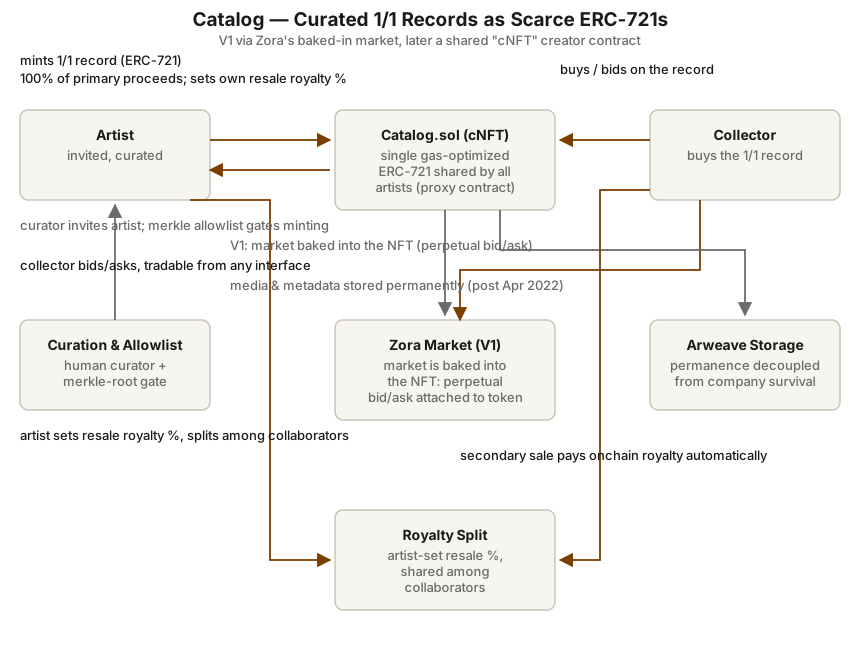
- Built on Zora, then a shared creator contract. V1 records were minted through Zora's protocol, where "the market is baked into the NFT itself" (perpetual bids/asks attached to the token, tradable from any interface). Catalog later deployed its own shared creator contract, the "cNFT" (
Catalog.sol, proxy0x0bC2A24ce568DAd89691116d5B34DEB6C203F342on mainnet) — a single gas-optimized ERC-721 for all artists, with onchain royalty info, creator-updatable content URIs, and a merkle-root allowlist gating who could mint (Catalog was curated/invite-based, not permissionless). - Artist-first economics. Artists received 100% of primary sale proceeds (no platform take on mints), set their own resale royalty percentage, and could split earnings among collaborators.
- Curation as a moat. Rather than open listing, Catalog leaned on human curation (notably hiring a former Spotify/Twitch music curator) to keep supply high-quality — closer to a boutique label than a marketplace.
- Permanence guarantees. Media and metadata for records minted after April 19, 2022 were stored on Arweave; at shutdown, Catalog shipped a migration portal so older records could be moved to Arweave permanently, decoupling the NFTs' survival from the company's.
Outcome
Catalog became the canonical 1/1 music-NFT venue of 2021–22, hosting drops from artists such as EPROM, Richie Hawtin, Boys Noize, SALVA, Vérité, and Laxcity, and routing over $3M to independent musicians. But volume tracked the broader NFT cycle: as speculative demand for 1/1 collectibles evaporated in 2022–23, Catalog pivoted to a fee-free digital-download and direct-support product. On March 9, 2024, after disabling uploads and purchases the week prior, the team sunset the platform, writing that the final iteration "ultimately didn't reflect the magic or innovation" they had set out to build and that no explored path matched their original conviction. The contracts remain live and the records remain collectible (viewable via Zora and other indexers); the codebase is open-sourced at github.com/catalogworks/catalog-contracts. Verdict: technically successful and genuinely artist-enriching, commercially unsustainable as a standalone business.
Why it worked
- Clear cultural metaphor. "A 1/1 record" was legible to musicians and collectors alike; it imported the vinyl-collecting mental model rather than inventing a new one.
- Aggressively artist-aligned economics. 100% of primaries, self-set royalties, and collaborator splits made Catalog an easy yes for artists burned by streaming payouts — a real, quantifiable improvement ($3M+ delivered).
- Curation created scarcity of quality, not just of tokens, sustaining collector confidence longer than open-listing competitors.
- Credible neutrality on exit. Arweave storage plus open-sourced contracts meant the artifacts outlived the company — a rare, well-executed shutdown.
Where the design broke
- Demand was cyclical, not structural. 1/1 music sales depended on a small pool of crypto-native patrons; when NFT speculation cooled, there was no durable second buyer base. Streaming remained where actual listening happened.
- 1/1 scarcity caps revenue and reach. One collector per song maximizes prestige but minimizes fan participation; editions platforms (e.g., Sound.xyz) captured the broader "many small collectors" market.
- Curation limits scale. The invite/allowlist model kept quality high but throughput low — boutique economics on venture funding.
- The pivot diluted the thesis. A fee-free download store competes with Bandcamp without the onchain magic; by the team's own admission the end-state no longer justified the effort.
Lessons
- Artist-aligned economics (100% primaries, self-set royalties) are necessary but not sufficient; a platform also needs a durable, non-speculative buyer base.
- 1/1 scarcity is a patronage mechanism, not a music-distribution mechanism — it monetizes status among a few collectors and structurally excludes the fanbase.
- Storing media on Arweave and open-sourcing contracts is the gold standard for shutting down an NFT platform: the company died, the records didn't.
- Curated supply preserves quality and brand but caps growth; the choice between boutique and marketplace should be made deliberately and priced into the funding model.
- Building atop a protocol whose "market is baked into the NFT" (Zora) let assets remain liquid and visible after the frontend disappeared — platform-independence is a real feature, not marketing.
Redesign (EDITORIAL — hypothesis, not fact)
This section is editorial hypothesis, not established fact. A redesigned Catalog might keep the 1/1 "master record" as a prestige/patronage layer but attach it to a cash-flowing or participatory base: each record could carry a bounded open edition (fans) beneath the unique master (patron), with edition proceeds split programmatically between artist and master-holder, giving the 1/1 an income rationale beyond resale speculation. Minting on an L2 with fees in the cents would let curation loosen without gas-driven quality floors, while retaining a merkle-gated "Catalog Pressing" tier for the boutique brand. Finally, the shutdown-proofing Catalog did at the end (Arweave media, open contracts, protocol-native markets) should be a launch-day invariant, credibly committed onchain — an experiment's exit design is part of its mechanism design.
Sources
- Catalog official site (shutdown notice) — primary (docs)
- Catalog sunset announcement (fin.catalog.works) — primary (retrospective)
- catalogworks/catalog-contracts (open-sourced contracts, deployed addresses) — primary (contract)
- Catalog cNFT proxy on Etherscan — primary (contract)
- Catalog Seeks to Revolutionize the Music Industry — ZORA ZINE (analysis)
- 1confirmation backs new NFT startup built for music artists in $2.2 million round — The Block (news)
- Catalog Is Looking To Revolutionize The Music Industry With NFTs [Interview] — FUXWITHIT (news)
- Decentralizing Curation: How Web3 Startup Catalog Attracted a Former Spotify and Twitch Music Curator — Forbes (news)
Related experiments
Last verified: 2026-07-26 · Spot an error? Suggest a correction