NFTfi
Pioneer peer-to-peer NFT-collateralized lending marketplace on Ethereum (first on-chain NFT loan, May 2020) that originated ~$737M in loans before winding down in 2026 as the NFT lending market collapsed.
▶ Run interactive simulation animated mechanism with editable parameters
How it works onchain
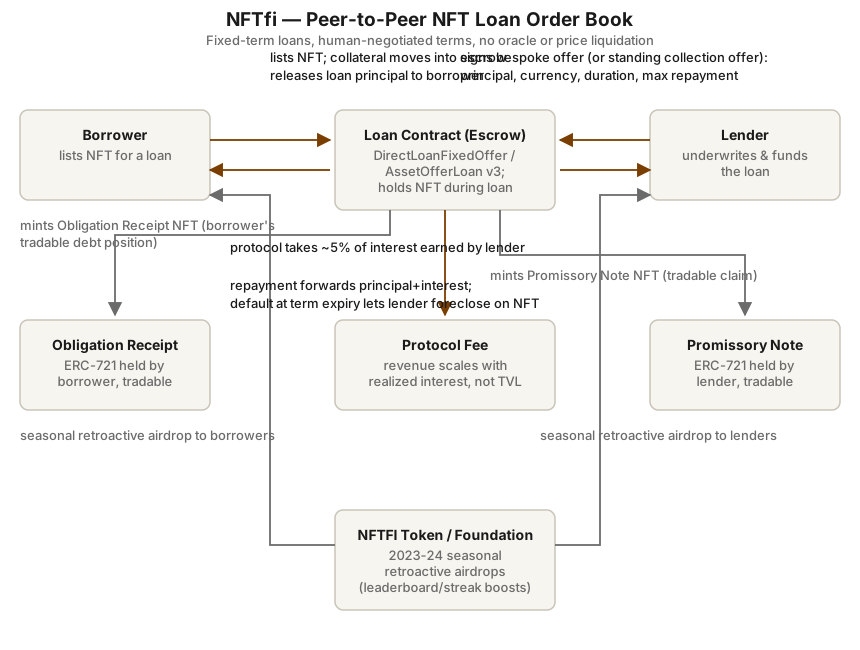 Open full-size diagram
Summary
NFTfi was the first peer-to-peer NFT-collateralized lending marketplace and effectively created the "NFT finance" category. Built by Stephen Young and Jonathan Gabler from Cape Town, South Africa starting February 2020, it executed the first on-chain NFT-backed loan on May 15, 2020, and later facilitated landmark deals such as a $1.42M loan against Autoglyph #488. Borrowers escrowed an NFT in a smart contract and received a fixed-term loan in wETH, DAI, or USDC from a matched lender; if they failed to repay, the lender claimed the NFT. Over six years the protocol originated more than $737M in loan volume across tens of thousands of loans with no reported security incidents, raised ~$5M (2021, investors including Ashton Kutcher's Sound Ventures) and a $6M Series A1 (March 2024), and launched a NFTFI governance token via retroactive "Earn Season" airdrops (2023–2024). But the NFT market's contraction — sector-wide lending volume fell ~97% from its January 2024 peak — made the business unsustainable. On June 11, 2026, NFTfi announced it would stop new loan originations immediately and shut its front-end on August 31, 2026, with the immutable contracts remaining usable on-chain for repayment and collateral withdrawal.
Design (Mechanism)
- Peer-to-peer order-book, not a pool. Borrowers listed NFTs; lenders made bespoke offers specifying principal, currency (wETH/DAI/USDC), duration, and a fixed
maximumRepaymentAmount. Acceptance moved the NFT into contract escrow and the principal to the borrower. Every loan's price was set by human negotiation, not an oracle. - Fixed-term, no price-based liquidation. Unlike Aave-style lending, there was no health factor and no oracle-triggered liquidation. Default occurred only at term expiry without repayment, at which point the lender could foreclose and withdraw the NFT. This made illiquid, hard-to-price collateral (art, 1/1s, long-tail collections) financeable and shielded borrowers from mid-loan price crashes.
- Fixed repayment ("Fixed" loan type). The borrower owed the full
maximumRepaymentAmounteven on early repayment, giving lenders a guaranteed return per loan (contracts:DirectLoanFixedOfferv2/v2.3, laterAssetOfferLoanv3). - Collection offers.
DirectLoanFixedCollectionOffer/CollectionOfferLoanlet lenders post standing offers valid for any NFT in a collection — a partial automation of underwriting that made lending scalable for floor-price assets. - Transferable loan positions. Lenders received a Promissory Note NFT and borrowers an Obligation Receipt NFT representing their side of the loan, making both positions tradable. Renegotiation/refinancing and NFT bundling (bundler contracts) were added over time.
- Fee model. No borrower fee; the protocol took ~5% of interest earned by lenders on successful repayments — i.e., revenue scaled with realized interest, not TVL.
- Token layer (2023–24). The NFTfi Foundation's NFTFI token (2B supply, ERC-20) was distributed via seasonal retroactive airdrops to borrowers and lenders, with leaderboard/streak/staking multipliers to defend market share against points-driven rivals.
Outcome
Category-defining but ultimately unprofitable. NFTfi dominated NFT lending in 2020–2022 and cumulatively originated $737M in loans (roughly 60,000+ loans by 2025) with zero exploits of its core contracts. From May 2023, Blur's Blend — zero-fee, perpetual, marketplace-integrated — captured 80–90%+ of monthly volume, relegating NFTfi to a low-single-digit share ($13M/month, 2.2% in March 2024). As the whole NFT lending sector collapsed ($1B monthly volume in January 2024 to ~$50M by May 2025; borrowers −90%, lenders −78%), fee revenue could no longer cover operating costs. NFTfi announced its wind-down June 11, 2026: no new loans immediately, refinancing until July 31, front-end offline August 31, 2026; contracts persist on-chain. Outcome: technically successful, commercially unsuccessful.
Why it worked
- Oracle-free design matched the collateral. Fixed-term loans priced by human lenders was the only honest way to underwrite illiquid, idiosyncratic NFTs; it sidestepped the oracle-manipulation and cascade-liquidation failure modes that plagued pooled NFT-lending competitors.
- First-mover trust. Being the first and running for years without a security incident (audited by ChainSecurity) made NFTfi the default venue for high-value collateral like Autoglyphs and BAYC.
- Aligned, simple fee model. Charging only on lender interest from successful loans meant the protocol earned when both sides won, and borrowers faced no platform fee.
- Composably structured positions. Promissory notes and obligation receipts as NFTs made credit positions transferable — a genuinely novel primitive later imitated across NFT-fi.
Where the design broke
- The underlying asset class evaporated. NFTfi's revenue was a percentage of interest on NFT-backed loans; when NFT prices and mid-tier collections collapsed, the addressable market shrank ~97% and no fee model could compensate.
- Outcompeted on distribution and cost. Blend bundled zero-fee perpetual lending into the dominant marketplace with aggressive token incentives; NFTfi's standalone, fee-charging P2P venue lost ~90% of market share within months and its own token seasons never reversed that.
- P2P matching is slow capital. Bespoke offer negotiation gives better pricing on unique assets but higher friction and worse capital velocity than pooled or perpetual designs — a disadvantage once the market concentrated in floor-priced blue chips where oracle pricing was "good enough."
- No viable pivot. Per the shutdown reporting, the team evaluated alternatives and found none; the protocol was a single-category business fully levered to NFT market health.
Lessons
- A protocol can be flawlessly engineered and still die: revenue is a function of the underlying asset class, and a category-pioneer captures no moat if the category itself contracts 97%.
- Oracle-free, fixed-term, human-priced loans are the right mechanism for illiquid/idiosyncratic collateral; oracle-based perpetual designs win only where collateral is liquid and floor-priced — mechanism choice should follow collateral liquidity.
- Distribution beats mechanism: a vertically integrated competitor (Blend inside Blur) with zero fees and token subsidies took ~90% share from a better-trusted incumbent in weeks.
- Fee-on-interest aligns incentives but concentrates fragility — income falls superlinearly in a downturn (fewer loans × smaller loans × lower rates).
- Immutable contracts allow a graceful death: because loans settle on-chain, NFTfi could shut its front-end without stranding user collateral — an underrated design property for wind-downs.
Redesign (EDITORIAL — hypothesis, not fact)
The following is editorial analysis and hypothesis, not established fact. A redesigned NFTfi might have survived by (1) generalizing the collateral engine beyond NFTs — the escrowed, fixed-term, human-priced loan machinery works for any illiquid tokenized asset (RWAs, vesting positions, LP NFTs, tokenized invoices), which would have diversified away from a single asset class's beta; (2) becoming infrastructure rather than a venue: licensing the audited loan contracts and transferable-note primitive as a white-label credit layer to marketplaces and wallets, so distribution partners (the Blurs) become customers instead of competitors; (3) building a protocol-owned or third-party underwriting layer atop collection offers — delegated credit vaults where passive LPs fund standing offers priced by staked underwriters who are slashed on defaults — capturing pooled-capital velocity without oracles; and (4) making the token buy something real (fee discounts, underwriter bonding) instead of retroactive volume rebates, which mostly subsidized mercenary flow. None of this guarantees survival through a 97% market contraction, but a multi-asset, B2B credit layer plausibly had positive expected revenue where a consumer NFT-loan venue did not.
Sources
- NFTfi Documentation — Introduction — primary (docs)
- NFTfi Documentation — Contract addresses — primary (docs)
- DirectLoanFixedCollectionOffer contract on Etherscan — primary (contract)
- NFTfi on X — first loan May 15, 2020 (pioneer days) — primary (retrospective)
- NFTfi (Medium) — We are funded! (building since Feb 2020) — primary (retrospective)
- ChainSecurity — NFTfi security audit — primary (audit)
- Chainwire — NFTfi raises $6M Series A1 (March 2024) (news)
- NFTfi Foundation Blog — NFTFI airdrop token claim explained — primary (docs)
- CoinGecko Research — NFT lending volume Q1 2024, Blend dominance (analysis)
- crypto.news — NFT lending volume collapses 97% from peak (May 2025) (news)
- PANews — NFTfi to shut down front-end on August 31, 2026 (news)
- cryptonews.net — NFTfi shuts down after $737M in loans (June 2026) (news)
Related experiments
Last verified: 2026-07-26 · Spot an error? Suggest a correction