Nina
A Solana + Arweave self-publishing protocol that let independent musicians sell limited-edition tokenized releases directly to fans and keep 100% of primary sales — technically sound, beloved by its niche, but shut down in 2026 for lack of a sustainable revenue model.
▶ Run interactive simulation animated mechanism with editable parameters
How it works onchain
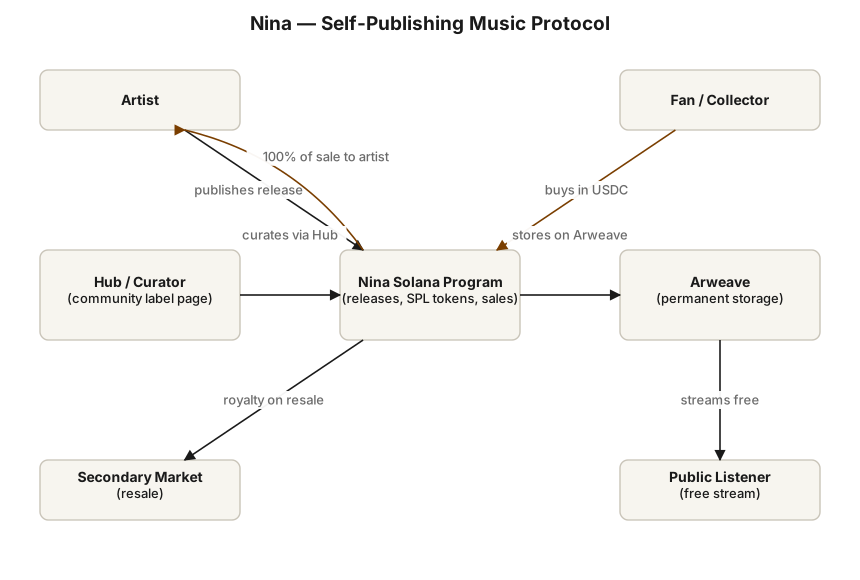 Open full-size diagram
Summary
Nina (Nina Protocol) was a self-publishing protocol for musicians built on Solana with permanent audio storage on Arweave. Founded in New York in 2021 by three musicians from the DIY/experimental scene — Mike Pollard (founder of the Arbor label), Jack Callahan, and Eric Farber — its marketplace launched on November 19, 2021 with artists such as Ryley Walker, Aaron Dilloway, C. Spencer Yeh, and Cloud Nothings. The pitch was "Bandcamp for web3": artists sell limited-edition tokenized releases priced in USDC, keep 100% of primary sales, set their own secondary royalty, and pay only a small upload fee covering permanent storage. Nina deliberately downplayed NFT branding ("the benefits of blockchain... without fully drinking the Kool-Aid," per Pollard) and, in a fall 2023 v2, removed the crypto requirement entirely by accepting card payments. Despite genuine cultural traction — releases from artists like dBridge, Yung Lean, ML Buch, Purelink, and Surgeon, plus labels like Warp and Hyperdub — the economics never worked: only about $50,000 was reportedly spent on the platform across its lifetime. Nina announced shutdown on May 28, 2026, went offline July 15, 2026, and its archive and artist migration path were acquired by SoundCloud (announced July 22, 2026; terms undisclosed; the team did not join).
Design (Mechanism)
- Onchain publishing primitive. An Anchor/Rust Solana program (mainnet ID
ninaN2tm9vUkxoanvGcNApEeWiidLMM2TdBX8HoJuL4, per the project's Anchor.toml) let artists mint a "release": a limited set of semi-fungible SPL tokens (e.g., an edition of 25) representing a track or album, with supply and price set by the artist. - USDC pricing. Primary sales were denominated in the USDC stablecoin rather than a volatile token, keeping prices legible to non-crypto fans.
- 100% primary revenue to artists. Nina took no cut of primary sales (minus network transaction costs); its fee model relied on secondary-market resales and a small per-upload fee that covered permanent Arweave storage of the audio.
- Artist-set secondary royalties. Musicians earned a self-chosen percentage of resale transactions; Nina's own take came from resales rather than from artists.
- Permanent, open storage. Audio files lived on Arweave, so releases were streamable by anyone and (in principle) outlived the company; purchased tokens acted, in Pollard's phrase, as "a kind of modular loyalty program" rather than speculative NFTs.
- Hubs (v2 era). Community/label pages ("The Hub") let curators publish and co-sign releases, functioning as onchain micro-labels and a discovery layer built around scenes rather than algorithms.
- Progressive de-crypto-ing. From fall 2023, Nina no longer required users to hold SOL or manage wallets to buy or publish; traditional payments were accepted alongside USDC.
- Code was published open-source but explicitly unaudited ("use at your own risk").
Outcome
Technically the protocol worked as designed for roughly 4.5 years: thousands of releases were published permanently to Arweave, sold in editions, and streamed freely, with no known exploit of the Solana program (no audit either). Culturally it earned real legitimacy in underground electronic and experimental music (coverage in Rolling Stone and The FADER; Nina Nights events; partnerships with outlets like no bells). Commercially it failed: the team said it "was unable to find a revenue strategy that would give Nina a path to sustainability at its current size" and reportedly never reached even 10% of Bandcamp's daily volume; total lifetime spend on the platform was reported at only about $50,000, and roughly 77% of releases were never collected (purchased) at all. A seed round closed in October 2022 (amount undisclosed; investors reported to include Greenfield and Noise DAO) was not followed by a path to sustainability. Shutdown was announced May 28, 2026; the marketplace and streaming went offline July 15, 2026; SoundCloud then acquired the editorial archive and offered artists an opt-in migration with 100% royalty retention.
Why it worked
- Scene-first credibility. Founders were genuine participants in DIY music (labels, shows, releases), so respected artists and labels trusted the platform in a way most "music NFT" projects never achieved.
- Sane token design. USDC pricing, artist-set supply, 100% primary revenue, and anti-NFT framing removed most speculative and volatility footguns for both artists and fans.
- Right infrastructure choices. Solana's sub-cent fees made $5 editions viable where Ethereum gas could not, and Arweave gave releases credible permanence independent of the company.
- Free streaming + paid collecting separated discovery from patronage, mirroring the Bandcamp behavior its users already understood.
Where the design broke
- No sustainable revenue capture. Giving artists 100% of primaries left Nina dependent on secondary-market fees, but a non-speculative, collector-scarce market generated almost no secondary volume — ~77% of releases were never collected even once.
- Tiny addressable spend. ~$50k of total lifetime sales cannot support even a five-person company; the underground scenes Nina served are passionate but small and cash-poor.
- Blockchain as adoption tax. Per commentary at shutdown, the crypto substrate was "complicated to explain" and read as "scammy" to everyday listeners; v2's de-crypto-ing came after the 2021–22 attention window had closed.
- VC funding vs. anti-scale values. A venture-backed company serving an intentionally niche, anti-commercial culture faced a structural contradiction: the ethos that won trust precluded the growth investors needed.
Lessons
- A marketplace that takes 0% of primary sales must prove secondary/ancillary volume exists before building a company on it; "we monetize resales" fails when users are collectors, not traders.
- Cultural legitimacy and mechanism quality are necessary but not sufficient — the size of the niche bounds revenue no matter how well the protocol serves it.
- Storing content on Arweave meaningfully changed the failure mode: when the company died, the music and its provenance survived, making acquisition/migration (SoundCloud) tractable. Design for graceful death.
- Removing crypto friction (fiat payments, embedded wallets) works best at launch, not as a v2 retrofit after the mainstream has already categorized you as "a crypto thing."
- Serving anti-commercial scenes with venture capital embeds a contradiction; a co-op, patronage, or protocol-fee-at-scale model may fit such communities better than equity-funded growth.
Redesign (EDITORIAL — hypothesis, not fact)
This section is editorial hypothesis, not a description of anything Nina built or planned. A redesigned Nina might (1) charge a small protocol fee (2–5%) on primary sales from day one — artists at Nina's scale would likely have accepted 95% economics, and it converts every sale into revenue rather than betting on nonexistent secondary volume; (2) make Hubs the economic core: curators/labels stake a small amount to run a Hub, take a disclosed curation cut on releases they publish, and pay protocol rent — turning the discovery layer into the business; (3) sell permanence as a subscription (annual storage endowment top-ups) instead of a one-time upload fee, aligning ongoing costs with ongoing revenue; (4) launch fiat-first with invisible wallets, exposing the chain only as an export/portability guarantee ("your catalog outlives us"), which was Nina's most durable, provable promise; and (5) structure as an artist co-op or foundation with revenue-based financing rather than venture equity, so a sustainable-at-small-scale outcome counts as success instead of failure.
Sources
- nina-protocol/nina — a self-publishing protocol for musicians, on Solana (Anchor.toml with mainnet program ID) — primary (contract)
- Nina Protocol official site — primary (docs)
- Music Marketplace Nina Wants to Be a Bandcamp for Web 3.0 (launch coverage, founder quotes) (news)
- Nina Protocol — Wikipedia (archive)
- Nina Protocol didn't change the world, but it still built something worthwhile — The FADER (analysis)
- Music platform Nina Protocol is closing down: 'We saw no viable paths forward' — DJ Mag (news)
- Nina Protocol to shut down — Resident Advisor (news)
- SoundCloud acquires independent-focused music service Nina Protocol after shutdown — Music Ally (news)
- Nina Protocol funding rounds — Tracxn (seed, Oct 2022, undisclosed amount) (analysis)
Related experiments
Last verified: 2026-07-26 · Spot an error? Suggest a correction