Regen Network
A Cosmos-SDK app-chain (Regen Ledger) that issues, trades, and retires ecological credits — soil carbon, biodiversity, and other 'ecocredits' — as native chain assets governed by an on-chain registry.
▶ Run interactive simulation animated mechanism with editable parameters
How it works onchain
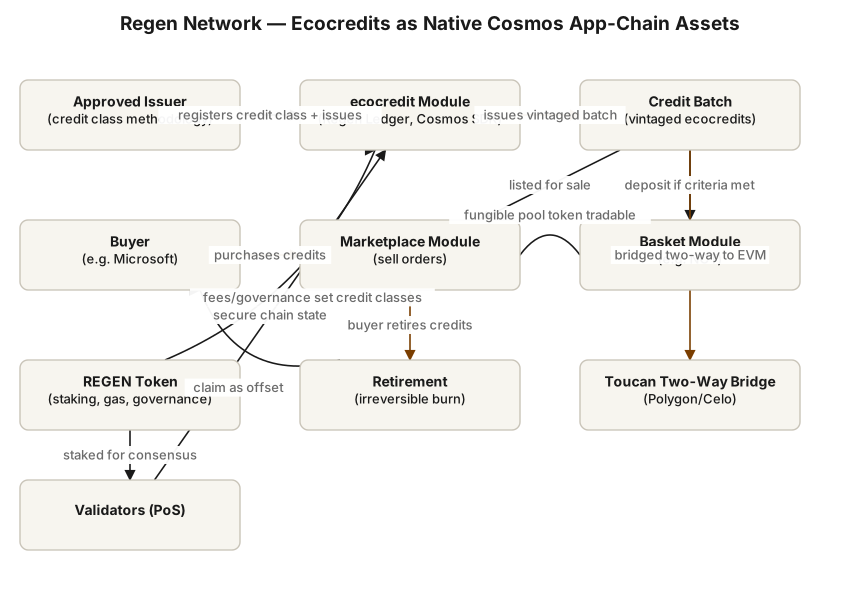 Open full-size diagram
Summary
Regen Network is one of the longest-running experiments in putting ecological assets natively on-chain. Conceived in 2017 by Gregory Landua and Christian Shearer (soon joined by CTO Aaron Craelius and Will Szal), it grew out of regenerative-agriculture supply-chain work at Terra Genesis International and was first presented publicly at DevCon-adjacent events in late 2017. Rather than tokenizing legacy registry credits, the team built a sovereign proof-of-stake blockchain — Regen Ledger, on the Cosmos SDK — whose core state machine is an ecological-credit registry: credits are first-class chain assets that can be issued by approved issuers under governed "credit classes," transferred, pooled into baskets, sold on a marketplace module, and permanently retired. Mainnet launched April 15, 2021 with 50 validators, shortly after the project closed a $10.5M private token sale from 216 investors and brokered a headline soil-carbon deal: Australia's Wilmot Cattle Co selling 40,000+ tonnes of CarbonPlus Grassland credits ($500K) to Microsoft. The project structured itself as a for-profit developer (Regen Network Development, Inc.) plus a non-profit (Regen Foundation), and remains active through 2024–2026, including a "Registry 2.0" expansion beyond credits to broader ecological claims.
Design (Mechanism)
- App-chain as registry. Regen Ledger is a Cosmos-SDK PoS chain whose differentiating logic lives in native modules rather than smart contracts. The
ecocreditmodule (base functionality in Ledger v2.0; project support in v4.0) defines credit classes (methodology + approved issuers + measurement unit), projects, credit batches with vintages, and operations to issue, transfer, and retire credits. Retirement is an irreversible state change — the on-chain equivalent of registry cancellation. - Governed quality control. Credit classes are created under on-chain governance/allowlist controls, so "who may issue what kind of credit under which methodology" is an explicit, chain-level permission — a hybrid of open protocol and gated registry. Off-chain, Regen Registry maintained peer-reviewed methodologies (e.g., AEI soil-organic-carbon for rangelands, Ecometric GHG protocols).
- Basket submodule. Heterogeneous, non-fungible credit batches can be deposited into criteria-governed baskets that mint fungible tokens — the mechanism behind Nature Carbon Ton (NCT, launched with Toucan and Moss in early 2022), where each NCT is backed 1:1 by nature-based credits meeting the basket's inclusion criteria. Baskets make illiquid, vintage-specific assets DeFi-composable.
- Marketplace submodule for on-chain sell orders/purchases of ecocredits (Regen Marketplace launched October 2022).
- Cross-chain carbon plumbing. A two-way Toucan–Regen bridge connected Regen Ledger to Polygon (and Celo) so tokenized credits could move between the Cosmos registry and EVM DeFi.
- REGEN token provides staking security, fees/gas, and governance; the design thesis was that value accrues from fees on ecological-asset origination and transactions. A bridged REGEN later listed on Base via Aerodrome (trading from February 2025).
- Two-entity structure. RND Inc. (development, commercial deals) and Regen Foundation (non-profit, community staking allocations) split commercial and commons functions.
Outcome
Ongoing, with real but modest traction relative to ambition. Concrete wins: the 2021 Wilmot–Microsoft soil-carbon sale (first-of-its-kind, ~$500K, 25-year deal framework); mainnet operation since April 2021 with a healthy validator set; a functioning end-to-end pipeline from methodology to on-chain issuance, sale, and retirement; NCT co-launched with Toucan/Moss; reported sales such as 100,000 Ecometric ecocredits to corporate buyers. But the 2021–22 ReFi wave (Toucan/KlimaDAO era) collapsed alongside crypto-carbon skepticism from legacy registries, and volumes across the sector cratered. REGEN token value fell steeply (the Base-listed REGEN traded >90% below its local all-time high by mid-2025). In September 2024, RND announced Registry 2.0, broadening from credits to general ecological claims — a tacit acknowledgment that pure credit issuance was too narrow a market. The company continues shipping (Regen App, Builder Lab rebrand, guides) as of 2025–26. Total on-chain issuance/retirement aggregates: Unknown / not found (not published in reviewed sources).
Why it worked
- Registry-as-chain was architecturally honest. Building credits as native assets with governed credit classes and irreversible retirement mapped the real institutional functions of a registry (accreditation, vintages, cancellation) onto chain primitives, instead of wrapping legacy credits of contested provenance — the failure mode that got Toucan/Klima blacklisted by Verra.
- Real supply-side relationships. The founders came from regenerative agriculture, not crypto; the Wilmot–Microsoft deal proved they could originate novel, science-based credits and find blue-chip demand.
- Mission-aligned patience. The team deliberately avoided 2017-era hype dynamics, split commercial and commons entities, and survived multiple crypto winters — rare longevity in ReFi.
Limitations and criticisms
- The market it serves barely exists on-chain. Voluntary carbon demand is driven by corporate procurement, which buys through brokers and legacy registries; on-chain settlement solves a problem most buyers don't have. Microsoft bought Wilmot's credits in a brokered private deal — the blockchain was not the demand driver.
- ReFi sector collapse hit adjacent composability. After Verra's 2022 crackdown on tokenized credits and the Klima unwind, crypto-carbon liquidity and credibility evaporated sector-wide, denting the basket-token composability (NCT's raison d'être) that depended on it.
- App-chain overhead. A sovereign validator set, token, and governance apparatus is heavy infrastructure for what is, economically, a niche registry business; token value has decoupled from registry activity and fallen >90% from its local peak.
- Origination is slow and scientific. Peer-reviewed methodologies and MRV pipelines take years per credit class; supply growth struggles to match infrastructure build-out.
Lessons
- Native issuance beats wrapping: designing credits as first-class chain assets with governed issuers and irreversible retirement avoided the provenance and double-counting fights that killed bridged-credit projects — institutional legitimacy is a protocol design constraint, not an afterthought.
- Infrastructure cannot conjure demand: an elegant registry chain does not change who buys carbon or why; without crypto-native or regulatory demand, on-chain environmental assets remain supply-side experiments.
- Fungibility via governed baskets is a reusable primitive: the basket module (criteria-gated pooling of heterogeneous NFT-like batches into fungible tokens) is a genuinely general mechanism for any vintaged/graded asset class.
- Two-entity (for-profit + foundation) structures buy longevity but blur accountability for token holders when the commercial entity pivots (e.g., Registry 2.0) without token-value linkage.
Redesign (EDITORIAL — hypothesis, not fact)
This section is editorial hypothesis, not fact. A redesign today would likely drop the sovereign app-chain: issue ecocredits as an audited module or contract suite on a shared low-fee L2, cutting validator/token overhead and letting REGEN-style governance apply only to credit-class accreditation rather than chain security. Demand-side, integrate directly with compliance-adjacent buyers: durable procurement (e.g., advance market commitments, Frontier-style offtakes) escrowed on-chain against future issuance, so origination is financed by demand rather than token sales. Keep the basket primitive but add continuous quality oracles (remote-sensing MRV feeds updating batch ratings), making basket inclusion dynamic instead of static criteria. Finally, decouple the equity-like exposure (RND's business) from governance explicitly — a fee-sharing structure tied to issuance/retirement volume would give the token the cash-flow linkage the original design promised but never delivered.
Sources
- Regen Network official site — primary (docs)
- Ecocredit Module — Regen Ledger Documentation — primary (docs)
- regen-network/regen-ledger (GitHub) — primary (contract)
- Regen Network Whitepaper (Booman, Craelius, Deriemaeker, Landua, Szal, Weinberg) — primary (docs)
- Regen Network Retrospective — Will Szal — primary (retrospective)
- Regen Network Closes Private Token Sale Round; Raises $10.5 Million — primary (retrospective)
- Regen Network Announces Historic Carbon Credit Sale in Australia (Wilmot / Microsoft) — primary (retrospective)
- Introducing Nature Carbon Ton (NCT) — primary (retrospective)
- Regen Network Launches Bridge to Polygon With Toucan Protocol (news)
- Regen Network reveals Registry 2.0 plan for ecological claims beyond credits (Carbon Pulse, Sept 2024) (news)
- Regen Network — A Platform for Ecological Finance (Chorus One) (analysis)
- REGEN price data (CoinGecko) (analysis)
Related experiments
Last verified: 2026-07-27 · Spot an error? Suggest a correction