Toucan Protocol
Carbon-credit tokenization infrastructure that bridged ~20M+ Verra offsets onto Polygon as fungible pool tokens (BCT/NCT), was banned by the Verra registry after quality controversies, and pivoted to two-way bridged biochar removal credits (CHAR).
▶ Run interactive simulation animated mechanism with editable parameters
How it works onchain
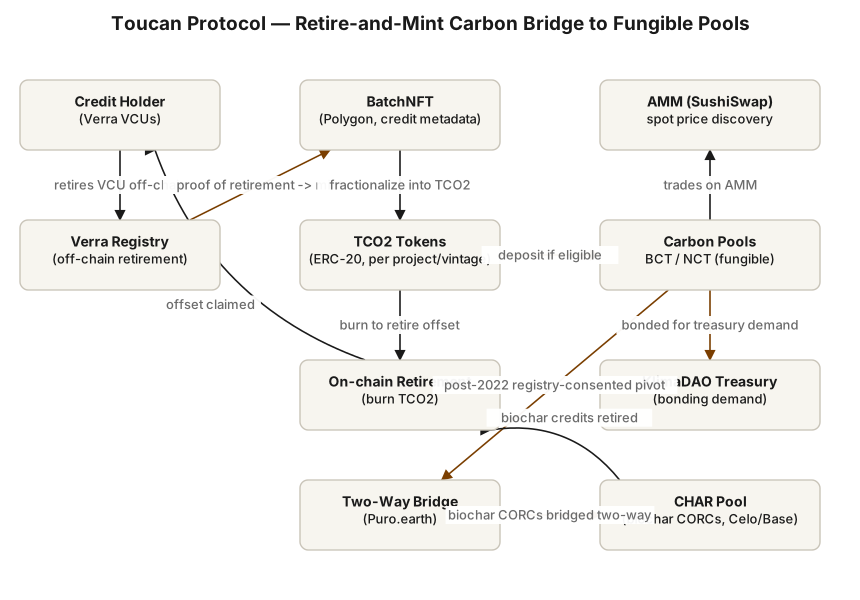 Open full-size diagram
Summary
Toucan Protocol is the canonical experiment in tokenizing real-world carbon credits. Born from the CO2ken proof-of-concept at the ETHLondon hackathon in early 2020 and incubated through a research stint at Deep Science Ventures, Toucan launched its Carbon Bridge and the Base Carbon Tonne (BCT) pool token on Polygon on October 18, 2021, in tandem with KlimaDAO's launch. Adoption was explosive: over a million credits were tokenized on day one, and within six months more than 20 million tonnes of Verra-registered carbon credits had flowed through Toucan's infrastructure, with the project later claiming roughly 85% of all digital carbon credits and ~$4B in trading volume. The experiment then hit two walls: independent researchers (CarbonPlan) showed that a large share of bridged credits were low-quality "zombie" offsets, and in May 2022 the Verra registry — source of the underlying credits — prohibited tokenization of its retired credits, forcing Toucan to close the bridge. Toucan survived by pivoting to higher-integrity carbon removals: a two-way bridge with Puro.earth and the CHAR biochar pool on Celo and later Base.
Design (Mechanism)
Toucan's core primitive was a one-way "retire-and-mint" bridge. A user holding Verified Carbon Units (VCUs) on the Verra registry would retire them off-chain (marking the tokenization intent and serial numbers in the retirement memo), then submit proof to mint a BatchNFT on Polygon carrying the credits' metadata. The BatchNFT could be fractionalized into TCO2 tokens — project- and vintage-specific ERC-20s (e.g., TCO2-VCS-1529-2012), one token per tonne.
Because thousands of distinct TCO2 tokens are individually illiquid, Toucan added carbon pools: deposit any TCO2 meeting a pool's gating criteria and receive a fungible reference token 1:1. The Base Carbon Tonne (BCT) accepted any Verra credit with vintage 2008 or later; the later Nature Carbon Tonne (NCT) applied stricter, nature-based criteria. Pool tokens traded on AMMs (SushiSwap on Polygon), creating for the first time a liquid, transparent spot price for a carbon commodity. Redemption was asymmetric by design: anyone could redeem pool tokens for the cheapest TCO2 in the pool, while selective redemption of specific projects charged a fee — making each pool a de facto quality floor and price index. End-of-life is on-chain retirement: burning TCO2 to claim the offset. KlimaDAO's bonding treasury acted as the initial demand sink that pulled tens of millions of tonnes through the bridge.
The post-2022 redesign inverted the architecture: with Puro.earth, Toucan built a registry-integrated two-way bridge, so credits move between registry and chain without being retired first, and the CHAR pool holds only durable biochar removal credits (CORCs) from named suppliers, with settlement and retirement handled onchain.
Outcome
By raw throughput, the first phase was a runaway success: 22M tonnes bridged, a functioning onchain carbon spot market, and 60+ integrating startups. BCT peaked around $2.63 in early 2022. But CarbonPlan's "Zombies on the blockchain" analysis found ~28% of bridged credits (6M tonnes) came from projects with essentially no conventional-market demand — the Dayingjiang-3 hydro dam alone converted 2M+ credits, >99% of everything it ever sold. On May 25, 2022, Verra announced it would no longer permit tokenization of retired credits, calling the practice incompatible with retirement's meaning; Toucan complied and shut the Carbon Bridge. BCT's price and volume collapsed alongside the broader voluntary carbon market, and pooled low-quality credits became stranded (the one-way bridge meant they could not return to the registry). Toucan tightened pool criteria, banned zombie categories, and relaunched around Puro.earth biochar credits (CHAR, 2024, on Celo and then Base) with named project developers (Oregon Biochar Solutions, Exomad, BC Biocarbon, and others). The company continues to operate as digital carbon-market infrastructure; the original BCT experiment is effectively legacy.
Why it worked
- It solved a real market-structure problem. Voluntary carbon was opaque, broker-mediated, and illiquid; TCO2 + pools created transparent pricing and instant settlement that legacy rails could not offer.
- The pool abstraction was clever mechanism design. Converting a heterogeneous commodity into gated fungible baskets (with cheapest-to-redeem economics) is a genuine contribution, since reused across RWA designs.
- A committed demand sink. KlimaDAO's bonding created immediate, massive buy pressure, proving the bridge at scale within days.
- Composability. Once carbon was an ERC-20, DeFi tooling (AMMs, treasuries, retirement aggregators) worked out of the box.
Why it failed or underperformed
- Adverse selection at the bridge. The bridge paid the same for any eligible credit, so the cheapest, least-wanted credits flowed in first — Gresham's law for carbon. The "quality floor" was set too low (any Verra credit ≥2008).
- Dependency on a permissioned upstream registry. Toucan built on Verra's data and rules without Verra's consent to the retire-and-mint hack; one announcement from Verra terminated the core mechanism overnight.
- One-way bridge irreversibility. Retiring credits to mint tokens meant stranded assets and, per critics, a semantic abuse of "retirement."
- Demand was reflexive, not fundamental. Most buy pressure came from KlimaDAO's tokenomics rather than corporate offset buyers; when that flywheel stalled, price discovery collapsed.
Lessons
- Tokenizing an off-chain asset class inherits its governance: if a centralized registry controls issuance semantics, your bridge exists at their pleasure — negotiate integration (two-way bridges) before scaling, not after.
- Uniform-price pools for heterogeneous assets are adverse-selection machines; gating criteria are the real product and must be strict enough that the marginal deposited asset is one you want.
- Throughput metrics (tonnes bridged, TVL) can signal failure, not success, when the bridged supply is what the legacy market had already rejected.
- Reflexive tokenomics (KlimaDAO-style demand) can bootstrap liquidity fast but cannot substitute for end-user retirement demand.
- Surviving teams treat a mechanism ban as a pivot signal: Toucan's move from undifferentiated avoidance offsets to registry-partnered durable removals (biochar) preserved the infrastructure while replacing the flawed supply side.
Redesign (EDITORIAL — hypothesis, not fact)
This section is editorial hypothesis, not fact. A redesigned Toucan would start with the registry partnership it ended with: a two-way, registry-consented bridge as a launch prerequisite, with the registry co-signing mint events. The pool mechanism should price quality rather than gate it binarily — e.g., deposits scored by an oracle/curator panel with pool tokens minted at a quality-weighted ratio, or multiple quality tranches (as NCT began to do), so cheap credits earn fewer pool tokens instead of poisoning the basket. Bridge intake could use batch auctions in which the pool bids for credits, letting the market reveal quality discounts rather than accepting all comers at par. Finally, demand should be anchored in verifiable retirement by end buyers (APIs for corporate offsetting, per-transaction retirement) before adding any reflexive treasury-token demand; a KlimaDAO-like amplifier is safest as a secondary buyer of last resort with quality-weighted bonding, not the primary bid.
Sources
- Toucan history (official retrospective) — primary (retrospective)
- Base Carbon Tonne (BCT): a new Web3 building block — primary (docs)
- Toucan Protocol: BCT Token — PolygonScan — primary (contract)
- Zombies on the blockchain — CarbonPlan (analysis)
- As Verra halts tokenization of carbon credits, Toucan vows to 'keep Web3 ethos alive' — S&P Global (news)
- Toucan and carbon market integrity (response to criticism) — primary (retrospective)
- Two-way bridge to Puro.earth | Biochar credits — primary (docs)
- CHAR | Liquid market for biochar credits — primary (docs)
- Climate Action, Now on Base — primary (docs)
- The Biggest Crypto Effort to End Useless Carbon Offsets Is Backfiring — Bloomberg (news)
Related experiments
Last verified: 2026-07-27 · Spot an error? Suggest a correction