Rumour.app
AltLayer's platform that turns unverified crypto market rumours into credibility-scored, tradable, and pay-per-access signals, integrated with Hyperliquid for one-click execution.
▶ Run interactive simulation animated mechanism with editable parameters
How it works onchain
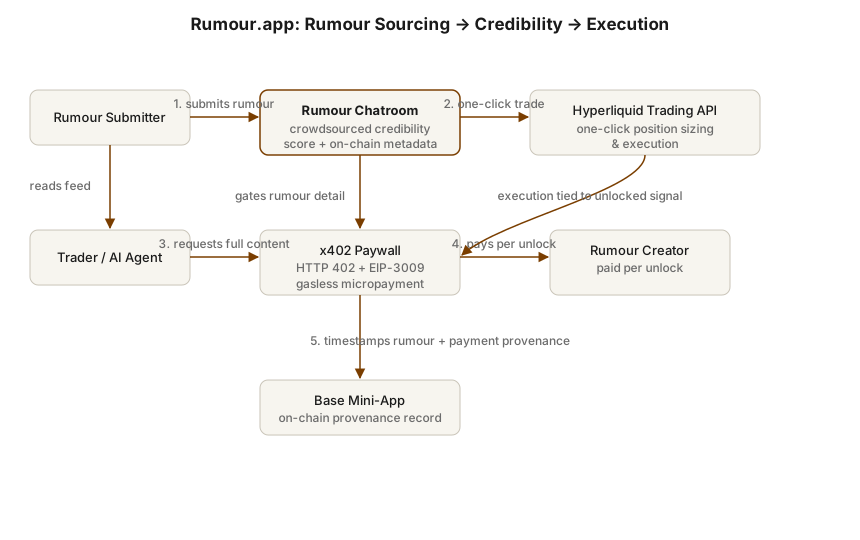 Open full-size diagram
Summary
Rumour.app is a trading-and-social platform launched by AltLayer (a rollup/restaking infrastructure team) that formalizes the oldest trope in crypto trading — "buy the rumour, sell the news" — into a structured product. Users submit, discuss, and rate unverified market rumours (e.g. a possible exchange listing, partnership, or token unlock) inside real-time chatrooms. Each rumour is packaged as a discrete unit with a headline, description, a crowdsourced credibility score, and on-chain metadata meant to timestamp and authenticate its provenance. Crucially, the platform is wired directly into Hyperliquid's trading API, so a user who spots a promising rumour can execute a position without leaving the app. It debuted around Korea Blockchain Week and Token2049 Singapore in September 2025 with a $40,000 prize pool for a rumour-submission and trading contest, and has since layered on "x402 Rumour," a pay-per-signal micropayment model built on the HTTP 402 standard.
Design (Mechanism)
Rumour.app's core loop has three pieces:
- Sourcing and scoring — Community members post rumours they've picked up from Telegram groups, conference hallways, or on-chain activity. Other users and the platform's scoring logic assign a credibility score, turning noisy, unverifiable chatter into a ranked feed rather than a raw firehose.
- Discussion-to-execution pipeline — Rumours live in chatrooms where users debate plausibility. Because Rumour.app is built on top of Hyperliquid's trading infrastructure (and later expanded as a mini-app on Base), a user convinced by a rumour can size and place a trade directly from the chat interface, collapsing the traditional gap between "hearing something" and "acting on it."
- x402 pay-per-signal layer — Rather than a subscription paywall, AltLayer added the x402 protocol: browsing teasers is free, but unlocking full rumour content triggers an HTTP 402 "Payment Required" response settled via a gasless, one-time EIP-3009 wallet authorization. This is designed to let both humans and autonomous AI trading agents pay per piece of information rather than per month, with creators of high-value rumours compensated per access rather than through ads or flat fees.
The design explicitly treats "information about what might move a market" as itself a tradable, priced asset — an on-chain information market layered directly on top of an execution venue.
Outcome
Rumour.app launched in September 2025 alongside a marketing push at two major industry conferences and has continued to add functionality (the x402 micropayment layer, a Base mini-app) through late 2025. Public reporting describes user activity and trading around Token2049-adjacent rumours, but there is no independently verified data available on daily/monthly active users, cumulative trading volume routed through the platform, revenue from x402 micropayments, or retention. Given the short time since launch and the lack of audited usage metrics in available sources, the outcome is best classified as too early to judge rather than a confirmed success or failure.
Why it worked
- It targets a real, pre-existing behavior (rumour-driven trading via private Telegram/Discord groups) and gives it structure, timestamping, and a credibility layer instead of trying to invent new demand.
- Bundling discovery, discussion, and execution into one interface removes friction that previously required jumping between a chat app and a separate exchange.
- Conference-timed launches (KBW, Token2049) with a prize pool are a proven low-cost user-acquisition tactic in crypto, generating an initial cohort of engaged rumour submitters and traders.
- The x402 micropayment design is forward-looking: it targets not just human traders but AI trading agents as a customer segment, aligning with the broader 2025 narrative around agentic on-chain payments.
Why it failed or underperformed
- No independent, verifiable usage or financial metrics are available in public sources as of this writing, making it impossible to confirm the platform achieved meaningful sustained adoption beyond its launch window.
- A credibility-scoring system for anonymous, crowdsourced rumours is inherently gameable — coordinated groups can manufacture consensus on a false rumour to move a market before it's debunked, and no independent audit of the scoring mechanism's manipulation-resistance is available.
- The product sits in a regulatory gray zone: a platform that scores and monetizes unverified market-moving claims tied directly to trade execution invites scrutiny resembling market manipulation or unlicensed investment-advice concerns, which could constrain growth or invite enforcement attention (risk flagged in third-party commentary, not confirmed as having occurred).
- Reliance on Hyperliquid as the execution backend ties Rumour.app's usefulness to Hyperliquid's own liquidity and asset coverage rather than a broad multi-venue market.
Lessons
- Packaging an existing informal social behavior (rumour trading in private chats) into a structured, on-chain product can be a faster path to product-market fit than inventing a wholly new mechanism.
- Collapsing "signal discovery" and "trade execution" into a single interface is a powerful UX pattern, but it also collapses the natural due-diligence pause between hearing a claim and acting on it — a design choice with real manipulation and harm risk that deserves explicit safeguards.
- Pay-per-access micropayment protocols like x402 are an emerging alternative to subscriptions for information markets, particularly ones meant to serve autonomous AI agents as first-class customers, not just humans.
- Launch marketing tied to major conferences can generate an initial spike of activity, but without transparent, verifiable metrics published afterward, outside observers cannot distinguish a durable product from a conference-week novelty.
Redesign (EDITORIAL — hypothesis, not fact)
If rebuilding Rumour.app, a stronger design might separate the credibility-scoring and execution layers with an explicit "cooling-off" mechanism: require a minimum time window or a minimum number of independent, reputation-weighted validators before a rumour can be one-click-traded, reducing the window for coordinated manipulation. Reputation for rumour submitters and scorers could be made an on-chain, slashable stake (submitters post a bond that's forfeited if their rumour is later proven fabricated), converting the credibility score from a soft social signal into an economically backed one. Finally, publishing aggregate, privacy-preserving on-chain statistics (volume routed through the platform, resolution accuracy of past rumours, x402 revenue) would let the market itself judge whether the mechanism is producing genuine alpha or simply monetizing noise — turning the platform's own track record into the strongest evidence for or against its value.
Sources
- AltLayer Launches Rumour Platform for Tradable Market Signal (Phemex News) (news)
- AltLayer launches Rumour platform to integrate market rumors and transactions (PANews) (news)
- x402 rumour | AltLayer Documentation — primary (documentation)
- AltLayer launches Rumour platform to integrate market rumors and transactions (MEXC News) (news)
- Rumour.app 'Rumour Trading' Platform Combines Chat, Signal Validation and Execution (Blockchain.News) (news)
Related experiments
Last verified: 2026-07-27 · Spot an error? Suggest a correction