btc/acc
A TokenWorks experiment that skims a 1–10% swap fee via a Uniswap v4 hook and auto-converts it into cbBTC, so trading memecoins passively accumulates Bitcoin.
▶ Run interactive simulation animated mechanism with editable parameters
How it works onchain
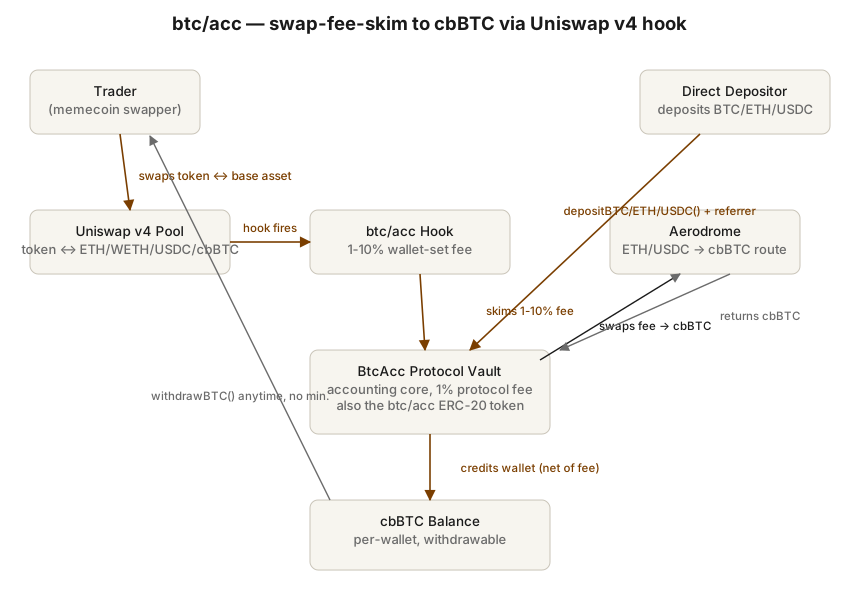 Open full-size diagram
Summary
btc/acc ("Bitcoin Accumulation") is the fifth experiment from TokenWorks, a two-person "onchain financialized ideas" studio run by developer Adam Lizek (Rhynotic) and designer Teto. Launched on Base on 21 February 2025, btc/acc reframes the memecoin trading treadmill as a Bitcoin-DCA engine: every swap through an opted-in pool skims a small fee in the base asset and automatically converts it into cbBTC (Coinbase's wrapped Bitcoin on Base), which is credited to the trader's wallet. Its thesis, stated plainly in the docs, is a test — whether traders will accept an extra fee in exchange for automatic Bitcoin accumulation, and whether embedding accumulation into trading infrastructure beats manual dollar-cost-averaging. The project ships as an ERC-20 token (symbol btcac, 1B supply on Base) plus two supporting contracts: a protocol vault and a custom Uniswap v4 hook. TokenWorks is candid that the contracts are unaudited and "untested in production," framing the whole thing as an experiment rather than a product.
Design (Mechanism)
There are two coupled pieces.
The protocol vault (0x08734424d04bEa277F29572fF1E25f6924D5954C, contract name BtcAcc, Solidity 0.8.26, verified on Basescan) is the accounting core. Users accumulate via three entrypoints: depositBTC() (direct cbBTC), depositETH() (ETH swapped to cbBTC via Aerodrome), and depositUSDC() (USDC swapped via Aerodrome). Each function takes a beneficiary wallet and an optional referrer for attribution. A 1% protocol fee is taken to fund development. Accumulated cbBTC is tracked per wallet and withdrawable at any time with no minimum via withdrawBTC(). This contract doubles as the btc/acc token itself (1,000,000,000 supply, 18 decimals).
The Uniswap v4 hook (0x704268Ac7043AeeF50F47B6a03AE68ccf808E044) is the novel part and the reason this belongs to the v4-hooks design lineage. The hook can be attached to any v4 pool that pairs an arbitrary token against a supported base asset (ETH, WETH, cbBTC, or USDC). On each swap the hook levies an additional fee — 1% by default, taken in the base token — and routes it into the btc/acc protocol, where it becomes cbBTC for the trader. A setWalletSwapFee function lets a wallet dial its own accumulation aggressiveness anywhere from 1% to 10%. In effect, the hook turns liquidity-pool trading into an involuntary-but-opted-in Bitcoin DCA: "passive bitcoin accumulation while also trading your favorite memecoin."
Tokenomics / incentive design. At launch 70% of supply went to the v4 liquidity pool. The remaining 30% was reserved: 10% for tokenized communities that integrate the hook, 10% for protocols/dapps that add btc/acc fees, and 10% for direct users accumulating BTC. Critically, these reserves are explicitly not distributed up front — they release "upon sufficient protocol momentum," a deliberately adoption-gated emission meant to reward genuine integration rather than mercenary farming.
Outcome
btc/acc is best described as technically successful but commercially unsuccessful. The contracts deployed, verified, and function as designed; the mechanism (fee skim → base-token → cbBTC → per-wallet credit) is coherent and shipped. But traction was thin: the token contract showed roughly 205 holders and effectively zero recent transfer activity when checked in mid-2026, and no meaningful third-party integrations of the hook surfaced in public sources. The reserved 30% of supply is gated on "momentum" that, by available evidence, never materialized. It sits in the TokenWorks archive as project 005, dated 02-21-25 — consistent with TokenWorks' portfolio pattern of rapid experiments, most of which are launched, observed, and shelved. No exploit or rug is associated specifically with btc/acc (a July 2026 Chainlink-callback exploit hit a different TokenWorks product line, not this one). Precise volume, TVL, and cbBTC-accumulated figures were not found and should be treated as Unknown.
Why it worked
- A genuinely good primitive. Uniswap v4 hooks are purpose-built to insert custom logic into the swap lifecycle, and "skim a fee, convert it, credit it" is exactly the kind of composable behavior hooks unlock. Technically the design is clean and the base-asset restriction (ETH/WETH/USDC/cbBTC) keeps conversion routes simple.
- A resonant narrative. "Every trade quietly stacks sats" is a memorable, emotionally-aligned pitch that turns the guilt of memecoin gambling into a Bitcoin savings story — good product-market storytelling, whatever the adoption.
- Honest, low-stakes framing. By labeling itself an experiment with unaudited contracts and adoption-gated emissions, it avoided over-promising and the reputational blowups of hype-launched tokens.
Where the design broke
- The integration cold-start problem. The value only compounds if many external pools and dapps attach the hook or set a btc/acc fee. That requires other builders to accept a fee-drag on their users to benefit btc/acc — a hard sell with no strong reciprocal incentive, and the reserved tokens (the intended incentive) were gated behind the very momentum they were meant to bootstrap. Classic chicken-and-egg.
- Fees fight trader psychology. Memecoin traders are hyper-sensitive to swap cost and slippage; a 1–10% additional skim is a large, visible tax against a speculative, thin-margin activity. The users most targeted are the least likely to tolerate the drag.
- Single-asset, single-chain, unaudited. Base-only, cbBTC-only, and explicitly unaudited limited the addressable surface and gave cautious integrators reason to wait.
- Portfolio velocity. TokenWorks ships many experiments; attention and dev time move on quickly, so even a sound design gets little sustained distribution push.
Lessons
- A composable hook is worthless without a distribution flywheel. The hard part of fee-skim/redistribution mechanisms is not the contract — it's convincing other protocols to route their users' fees to you. Incentives to integrators must be paid before momentum, not gated behind it, or the cold start never resolves.
- Aligning a mechanism with a habit ≠ aligning it with an incentive. btc/acc aligned beautifully with the narrative of the degen-who-should-be-stacking-Bitcoin, but the mechanism added cost to the exact behavior it taxed. Emotional alignment doesn't overcome fee sensitivity.
- Experiment framing is a double-edged sword. Being upfront ("unaudited, untested, experimental") builds trust and limits downside, but also signals to would-be integrators that the project may not be maintained — dampening the adoption it needs.
- On-chain provenance is a research gift. The deployer wallet's Basename (rhynotic.base.eth) tied the contract cleanly to the named founder, and verified source on Basescan made the mechanism auditable without trusting marketing copy.
Redesign (EDITORIAL — hypothesis, not fact)
The following is the researcher's editorial hypothesis, not established fact.
The core flaw is that btc/acc asked traders and integrators to pay first and hope for network effects later. A redesign should invert that.
Pay integrators, don't tax them. Flip the model so the btc/acc protocol subsidizes the accumulation from its own token reserves for a bootstrap window — e.g., a pool that adds the hook has its users' cbBTC accumulation matched or topped up in btc/acc tokens. This converts the reserved 30% from a dormant carrot into an active acquisition budget with measurable CAC.
Make the fee optional and defaulted-off, opt-in per trader. Rather than a pool-wide skim that repels fee-sensitive degens, expose a one-click "stack sats on this trade" toggle (leveraging the existing
setWalletSwapFee) surfaced directly in front-ends. Self-selected accumulators tolerate the fee; unwilling traders aren't driven away from the pool entirely, preserving pool liquidity and volume.Give the token a reflexive reason to exist. Route a share of all protocol-wide accumulation fees into buy-and-burn or LP-backing of btc/acc itself, so holding the token is a claim on protocol-wide Bitcoin flow — turning it from a launch artifact into an index of adoption.
Multi-asset, multi-front-end, audited. Support WBTC/tBTC alongside cbBTC, pursue an audit to unlock cautious integrators, and prioritize one flagship high-volume front-end integration (a trading terminal or memecoin launchpad) over broad-but-shallow reach. One pool doing real volume proves the flywheel better than fifty idle integrations.
The redesign's bet: btc/acc's mechanism was right and its go-to-market was backwards. Move the cost from the user to the treasury during bootstrap, make participation self-selected, and the "trade memecoins, stack Bitcoin" story might actually compound.
Sources
- btc/acc official site — primary (docs)
- btc/acc documentation (overview) — primary (docs)
- btc/acc docs — The Hook — primary (docs)
- btc/acc docs — The Token — primary (docs)
- btc/acc docs — The Protocol — primary (docs)
- BtcAcc token/contract (verified source) on Basescan — primary (contract)
- Deployer address (rhynotic.base.eth) on Basescan — primary (contract)
- TokenWorks studio site — primary (docs)
- TokenWorks project archive (btc/acc = project 005, dated 02-21-25) — primary (docs)
- Teto launch tweet: 'btc/acc token is now live. Designed by yours truly' — primary (archive)
- The Monty Report — interview with Adam Lizek (Rhynotic) (analysis)
Related experiments
Last verified: 2026-07-26 · Spot an error? Suggest a correction