Tensor
Pro-trader Solana NFT marketplace whose concentrated-liquidity NFT AMM and Blur-style trading rewards flipped Magic Eden's dominance, before its team pivoted to memecoin trading and handed the protocol to a token-governed foundation.
▶ Run interactive simulation animated mechanism with editable parameters
How it works onchain
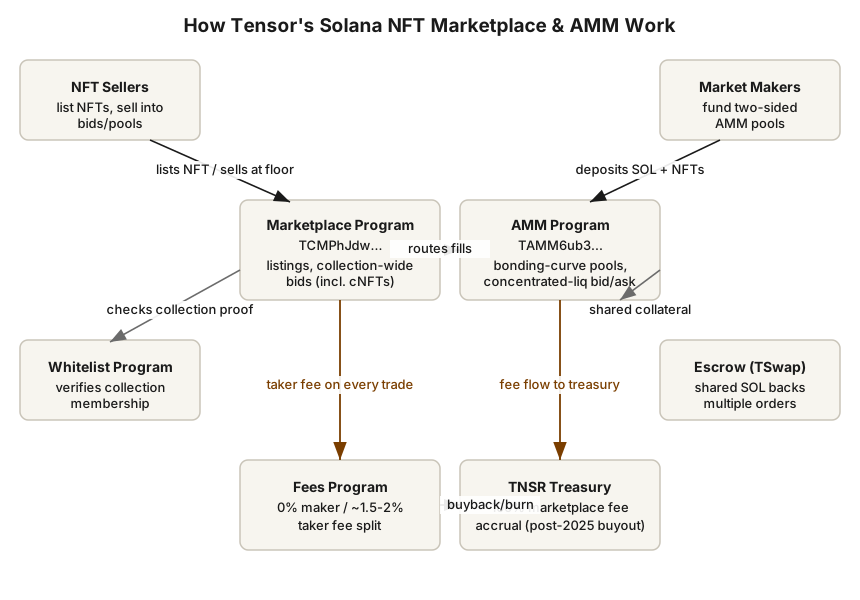 Open full-size diagram
Summary
Tensor is a Solana NFT marketplace built for professional traders, founded in 2022 by Ilja Moisejevs and Richard Wu after the pair won roughly $70k across two Solana hackathons. Where incumbent Magic Eden offered a retail "gallery" experience, Tensor shipped an exchange-like terminal: real-time price charts, collection-wide bids, sweeping, and — most distinctively — an on-chain concentrated-liquidity AMM for NFTs, letting market makers quote two-sided liquidity along bonding curves. Backed by Placeholder, Solana Ventures, and Solana's founders (a $3M seed announced March 2023), Tensor coupled its mechanism design with Blur-style seasonal trading rewards and flipped Magic Eden to become Solana's dominant NFT venue during the 2023–24 cycle. It launched the TNSR governance token via airdrop in April 2024. The founding team then pivoted to Vector, a social memecoin-trading app (acquired by Coinbase in late 2025), and in November 2025 the Tensor Foundation bought the marketplace from Tensor Labs, redirecting 100% of protocol fees to the TNSR treasury and burning ~21.6% of unvested supply. The marketplace remains Solana's NFT volume leader; the token has fallen ~98% from its launch highs.
Design (Mechanism)
Tensor's core wager was that NFT trading should look like token trading. Its stack is a set of composable Solana programs (per the official developer hub): a Marketplace program (TCMPhJdw...) for listings and bids across token standards (including compressed NFTs, where Tensor was an early mover with the 10k-piece Tensorians cNFT collection); an AMM program (TAMM6ub3...) that creates NFT liquidity pools tied to bonding curves; a Whitelist program for verifying collection membership; an Escrow program (TSWAPaqy..., the original TensorSwap) letting the same collateral back multiple orders; and a Fees program.
Key mechanisms:
- Concentrated-liquidity NFT AMM. Market makers create single-sided (buy or sell) or double-sided pools with a chosen starting price, curve type (linear or exponential delta), and fee. A double-sided pool bids below and lists above its spot price, earning the spread each time it flips an NFT — an NFT-native analogue of Uniswap v3 ranges, which Tensor claimed made liquidity far more capital-efficient than floor-wide bids.
- Collection-wide bids and shared escrow. Bids apply to any NFT in a verified collection, and escrowed SOL can back many orders at once, concentrating effective depth at the floor.
- Maker/taker asymmetry. 0% maker fees with a taker fee (~1.5–2%) subsidized liquidity provision, mirroring CEX microstructure.
- Royalty pragmatism. During the 2022–23 royalty war Tensor made royalties optional on legacy collections while enforcing them on enforceable standards (pNFTs/MIP-1) — a hybrid stance that tracked what the base layer could actually enforce.
- Points-for-airdrop loyalty. Seasonal trading rewards (Seasons 1–4) accrued points convertible to TNSR airdrops, directly importing Blur's vampire playbook against Magic Eden.
- Token-governed endgame. TNSR launched April 8, 2024 under a Tensor Foundation; the November 2025 buyout moved fee accrual from 50% to 100% of marketplace fees to the TNSR treasury, burned ~171M unvested tokens, and relocked founder tokens for three years.
Outcome
Tensor executed one of the cleanest incumbent flips in NFT history: from a minority share against Magic Eden's ~78% dominance in late 2022 to roughly 60% of Solana NFT volume by late 2023, powered by trading rewards and the AMM's depth. It processed billions in cumulative volume across 30,000+ collections and became the default venue for pro traders, with Magic Eden and Tensor thereafter trading the lead. TNSR's launch was a liquidity event (>$640M traded in its first hours) but the token bled persistently — down ~83% within a year and ~98% from 2024 highs by mid-2026 — as Solana NFT volumes collapsed post-cycle and the team's attention shifted to Vector, its memecoin social-trading pivot, which 10x'd revenue and was acquired by Coinbase in late 2025. The November 2025 Foundation acquisition of the marketplace (100% fee accrual, 21.6% supply burn) was an explicit attempt to give TNSR real cash-flow backing. As of 2026 the marketplace still routes a majority of Solana NFT volume, but in a market a fraction of its former size.
Why it worked
- Product-market fit with the marginal user. Volume in NFT markets is concentrated in a small cohort of pro traders; building the terminal they wanted (charts, sweeps, bids, market making) captured disproportionate flow.
- Mechanism, not just UI. The AMM and shared escrow genuinely deepened floor liquidity, tightening spreads and making Tensor the best execution venue — a structural moat beyond incentives.
- Well-timed incentive warfare. Blur had already proven points-for-airdrop could flip an incumbent; Tensor ran the same play on Solana before Magic Eden could respond, during a Solana renaissance that supplied fresh volume.
- Pragmatic royalty positioning let it serve fee-sensitive traders without fully alienating creators, enforcing royalties exactly where enforcement was technically credible.
Limitations and criticisms
- Token value has lagged protocol success. TNSR launched at cycle-peak expectations into a shrinking NFT market; 50% initial fee accrual and heavy emissions via four airdrop seasons left the token down ~98% from launch highs even while the marketplace led its category — a real disconnect between usage and holder returns that the 2025 restructuring only partially addresses.
- Points-driven volume is partly mercenary. Rewards-chasing traders inflate reported activity; when seasons end or a hotter opportunity appears, that flow migrates — as it did when speculation rotated into memecoins, including the founders' own Vector.
- No mechanism bound builder attention to the protocol. TNSR's initial structure gave Tensor Labs no binding, ongoing obligation to the marketplace, so when development effort shifted toward Vector (later acquired by Coinbase), the marketplace went a period without dedicated building; a 2025 foundation buyout was required to re-anchor fee accrual and incentives directly to TNSR holders.
- Category beta. The marketplace has no mechanism to offset the secular decline in NFT trading volumes since 2024; its share of a shrinking pie has grown, but the pie itself is much smaller.
Lessons
- Serving the small cohort of professional traders who generate most volume beats optimizing for the median retail user; market microstructure (maker rebates, AMMs, collection bids) is the product.
- Points-for-airdrop campaigns can flip an incumbent but rent volume rather than own it; the moat must be execution quality once emissions stop.
- Launching a governance token with partial fee accrual and no clear claim on the operating company invites divergence between protocol success and token performance; Tensor needed a buyout-and-burn restructuring to retrofit alignment.
- AMM designs from fungible tokens (concentrated liquidity, bonding curves) port surprisingly well to floor-level NFT liquidity, where NFTs near the floor behave like fungible assets.
- Governance and fee-accrual structures built around one cycle's asset class (NFTs) don't automatically bind builders whose attention shifts to the next one (memecoins); succession mechanisms need to be designed in at launch, not retrofitted after the fact.
Redesign (EDITORIAL — hypothesis, not fact)
This section is editorial speculation. A redesigned Tensor would launch the token with 100% of protocol fees accruing to the treasury (or to stakers) from day one, plus programmatic buyback-and-burn, rather than retrofitting alignment via a 2025 restructuring after a 98% drawdown. Airdrop seasons would vest rewards over time and decay multipliers for wash-like churn, converting mercenary flow into sticky positioning. The AMM could be opened as a permissionless liquidity layer with a fee switch shared with LPs, making Tensor the liquidity backend for all Solana NFT frontends (including competitors) instead of a vertically integrated venue — hedging marketplace-share wars. Finally, an explicit succession mechanism — foundation ownership of the protocol from launch, with Labs as a replaceable contracted developer — would have neutralized the founder-pivot risk that left the marketplace orphaned when Vector took off.
Sources
- Tensor Developer Hub — Program Overview (program IDs) — primary (docs)
- Tensor Trade official documentation — primary (docs)
- Tensor raises $3M for Solana-focused NFT trading platform (TechCrunch) (news)
- Tensor Snatched Magic Eden's Solana NFT Crown. But for How Long? (Decrypt) (news)
- Solana's NFT marketplace booms, with Tensor in top spot (Blockworks) (news)
- Top Solana NFT Marketplace Tensor Confirms $TNSR Airdrop for April 8th (SolanaFloor) (news)
- Coinbase to acquire Vector.fun, the Tensor-built Solana trading platform (The Block) (news)
- Tensor Foundation acquires Tensor Marketplace and Tensorians from Tensor Labs (Bitget News) (news)
- Tensor project profile — funding, token, metrics (Messari) (analysis)
- Tensor on Solana: Project Review, Programs, Token, Metrics (Solana Compass) (analysis)
Related experiments
Last verified: 2026-07-27 · Spot an error? Suggest a correction