Erasure
Numerai's Ethereum protocol that made information markets credible by forcing sellers to stake NMR that buyers could burn ('grief') if the information was bad.
▶ Run interactive simulation animated mechanism with editable parameters
How it works onchain
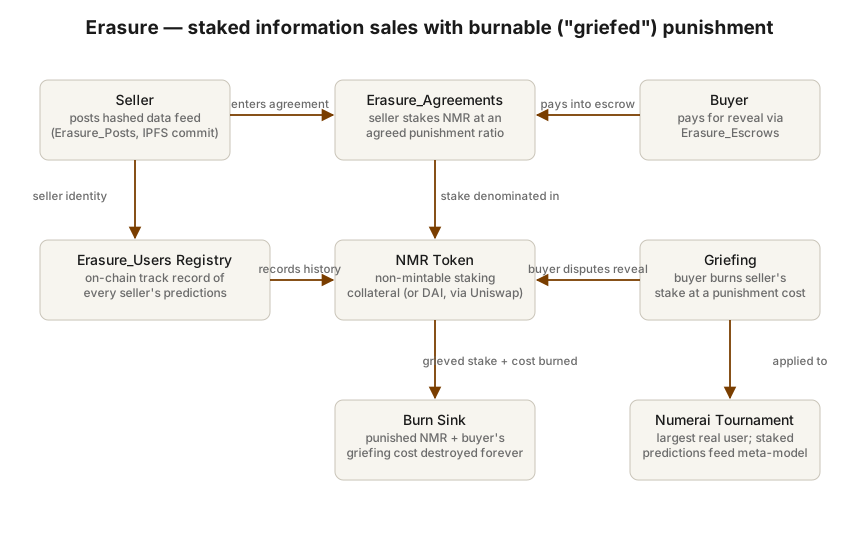 Open full-size diagram
Summary
Erasure was a general-purpose "information wants to be expensive" protocol built by Numerai, the crowdsourced quant hedge fund founded by Richard Craib. Announced in 2018 and launched on Ethereum mainnet on August 27, 2019 (launch post by protocol lead Stephane Gosselin, "thegostep"), Erasure generalized the staking mechanism Numerai had pioneered in its data-science tournament: anyone selling information had to stake NMR (Numeraire) behind it, buyers could destroy that stake if the information was bad, and every prediction left an immutable on-chain track record. Three applications ran on it: the migrated Numerai tournament staking, Erasure Quant (a Russell 3000 signals tournament announced at ErasureCon, September 2019, which evolved into Numerai Signals), and Erasure Bay (March 2020), an open marketplace for requesting any information from strangers with financial skin in the game. The core idea — staked, burnable predictions — remains alive and successful inside Numerai's tournament today; the general-purpose protocol and Erasure Bay quietly faded and are no longer actively developed.
Design (Mechanism)
Erasure composed three economic primitives:
- Track record. Sellers published data feeds as sequences of posts — hashes of encrypted content (stored on IPFS) committed on-chain — creating an unfalsifiable, timestamped history of predictions before revealing them.
- Payment. Buyers paid for access to revealed information, escrowed via
Erasure_Escrowscontracts. v1.3.0 added support for staking and payment in DAI as well as NMR, with DAI stakes converted to NMR on Uniswap for burns. - Recourse ("griefing"). The signature mechanism. Seller and buyer entered an agreement in which the seller staked NMR at an agreed punishment ratio. If the buyer judged the information fraudulent or worthless, they could burn the seller's stake — but burning was mutually costly: at ratio 0.5, destroying 10 NMR of the seller's stake cost the buyer 5 NMR. Both the punishment and its cost were burned from NMR supply forever. This made punishment credible but spiteful-attack expensive, a deliberately crude approximation of subjective-quality arbitration without any oracle or court.
Architecturally, every feed, agreement, and escrow was spawned as an EIP-1167 minimal-proxy clone of audited templates, tracked in four registries (Erasure_Posts, Erasure_Agreements, Erasure_Users, Erasure_Escrows) that served as the protocol's source of truth. NMR itself (contract 0x1776e1F26f98b1A5dF9cD347953a26dd3Cb46671) is non-mintable beyond its cap; burning is the protocol's only sink. The NMR 2.0 upgrade for Erasure was audited by Trail of Bits (July 2019), following New Alchemy's 2017 audit.
Erasure Bay wrapped this in a consumer UX: post a request ("find me X") with a reward, fulfiller stakes collateral, requester can punish at the advertised ratio, all coordinated through a Twitter-linked identity bot and fiat-friendly onboarding.
Outcome
Partial success. Roughly $1M NMR was staked around Erasure Bay's launch (Numerai AMA, March 2020), and the launch drew prominent backing narratives from USV (Fred Wilson) and Placeholder. The staking primitive proved durable where it had a captive, repeated game: Numerai's tournament — the origin and largest user — still runs on staked NMR with burns for bad predictions, and Erasure Quant became Numerai Signals, which remains part of Numerai's live products. But as a general-purpose protocol, Erasure did not take off: no meaningful third-party ecosystem materialized, Erasure Bay activity dwindled after the 2020 novelty phase, erasure.world went offline, and the erasureprotocol repos went dormant (no formal shutdown announcement was found — the wind-down was quiet rather than declared). Gosselin left to co-found Flashbots. NMR survives as Numerai's tournament token, not as fuel for an open information economy.
Why it worked
- Real skin in the game beat cheap talk. Requiring sellers to stake burnable collateral filtered spam and produced honest track records — validated for years inside Numerai's tournament, where it measurably improved the meta-model's signal quality.
- Burning, not transferring, punishment removed the incentive to punish for profit; griefing ratios made vindictive punishment costly, a genuinely novel solution to subjective disputes without oracles.
- Credible core customer. Numerai dogfooded the protocol with its own hedge fund capital and tournament, so the mechanism launched with real usage rather than speculative TVL.
- Sound engineering hygiene: audited token upgrade (Trail of Bits), template/registry architecture with cheap clones, open ABIs and SDK.
Why it failed or underperformed
- Demand for adversarial information markets was thin. Outside quant-signal tournaments, few buyers wanted to purchase information from anonymous strangers, even collateralized; Erasure Bay's use cases (find a dataset, source a contact) competed with free alternatives and ordinary freelance markets.
- Griefing is a blunt instrument. Mutually costly burning deters fraud but gives honest sellers no positive assurance of payment fairness and gives buyers no recovery — burned value helps no one directly. Many users found "everyone loses" resolution unintuitive.
- Single-token friction. Requiring NMR (a thin, volatile asset) for staking added price risk and onboarding friction; the DAI bridge came late and still burned via Uniswap conversion.
- 2020 attention shifted to DeFi yield. Erasure's negative-incentive design offered no yield-farming loop, so liquidity and developer mindshare flowed to protocols with positive-sum token emissions.
- Team refocus. Numerai's hedge fund and tournament were the business; when Bay didn't compound, effort returned there, and the protocol's champion (Gosselin) departed for Flashbots.
Lessons
- A mechanism that thrives in a repeated game with a single credible counterparty (Numerai tournament) does not automatically generalize to one-shot, peer-to-peer markets — repeated-game reputation was doing more work than the protocol itself.
- Burn-based punishment solves credibility but not restitution. Buyers of bad information still lose money; markets for subjective quality likely need arbitration or insurance layers on top of pure griefing.
- Protocol tokens as mandatory staking collateral tax adoption. Volatility and acquisition friction of NMR discouraged casual participation; collateral-agnostic designs with a burn/fee conversion would lower the barrier.
- Negative incentives don't bootstrap ecosystems. Without a positive-sum reward loop for early participants, an open protocol struggles to attract builders against yield-bearing competitors.
- Quiet wind-downs destroy institutional knowledge. Absent a formal postmortem, later builders (e.g., in DeSci and data DAOs) re-derived Erasure's lessons from scratch.
Redesign (EDITORIAL — hypothesis, not fact)
The following is the Atlas editor's hypothesis, not a statement of fact or of Numerai's plans. A modern Erasure would keep the two proven pieces — commit-reveal track records and burnable seller collateral — and change everything around dispute resolution and distribution. Replace pure griefing with a tiered system: small disputes resolved by mutually costly burning (preserving the elegant spite-deterrent), large disputes escalated to an optimistic arbitration layer (Kleros/UMA-style) so honest buyers can obtain partial restitution rather than scorched earth. Make collateral asset-agnostic (staked ETH or stablecoins) with a protocol fee routed to burns or an insurance pool, decoupling mechanism health from one token's liquidity. Deploy on a low-fee L2 so micro-stakes on individual posts are economical, enabling track records for pseudonymous analysts, AI-agent outputs, and forecast feeds — a demand category that barely existed in 2019 but is large in the LLM era, where "who stands behind this claim, with how much at stake?" is exactly the missing metadata. Finally, bootstrap with a repeated-game anchor tenant (as Numerai's tournament was) before opening the general marketplace, and publish explicit sunset criteria so a failure produces a documented postmortem instead of a silent fade.
Sources
- The Erasure Protocol Awakens on Ethereum Mainnet (launch post) — primary (docs)
- An Unstoppable Predictions Marketplace — Introducing Erasure (Richard Craib) — primary (docs)
- erasureprotocol/erasure-protocol (contracts, registries, releases) — primary (contract)
- erasureprotocol/NMR (Numeraire token contract; New Alchemy 2017 & Trail of Bits 2019 audits noted) — primary (contract)
- Introducing Erasure Bay (Max Novendstern, Numerai) — primary (docs)
- Erasure Bay Launch — $1M Staked — Community AMA — primary (docs)
- NMR token on Etherscan — primary (contract)
- Placeholder VC — Erasure Thesis (analysis)
- Fred Wilson (USV) — The Erasure Protocol (analysis)
- CoinDesk — This USV-Backed Startup Has a Solution for Buying Information With Confidence (news)
- Gemini Cryptopedia — Data and Prediction Markets on Erasure Protocol (analysis)
Related experiments
Last verified: 2026-07-26 · Spot an error? Suggest a correction