Sanctum Infinity
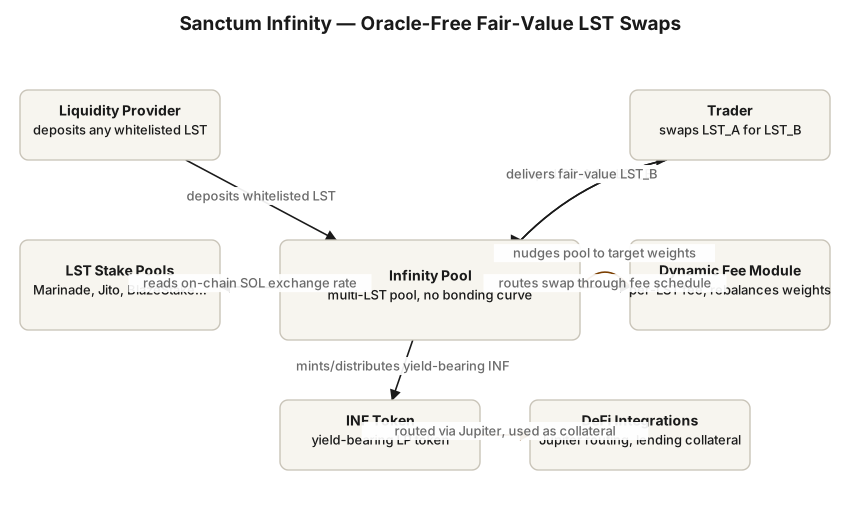
A Solana multi-LST liquidity pool that lets any liquid staking token swap against any other at fair (stake-account-derived) value without a bonding curve, unifying fragmented LST liquidity behind a single INF token.
▶ Run interactive simulation animated mechanism with editable parameters
How it works onchain
 Open full-size diagram
Summary
Sanctum Infinity is a Solana liquidity protocol that solves a structural problem in liquid staking: every liquid staking token (LST) issuer — Marinade, Jito, BlazeStake, and dozens of smaller validator-branded LSTs — creates its own isolated token with thin, fragmented secondary-market liquidity. Instead of building yet another isolated pool, Sanctum launched Infinity on February 12, 2024, as a single "multi-LST" pool designed to hold and swap between an unbounded number of LSTs. Liquidity providers deposit any whitelisted LST and receive INF, a yield-bearing token that itself functions as an LST, accruing both underlying staking rewards and pool trading fees. Infinity is Sanctum's flagship product, sitting alongside its LST-issuance tooling (Reserve) and routing infrastructure (Router) as part of a broader push to make Solana's ~$/billions in staked SOL more liquid and composable.
Design (Mechanism)
Infinity's core innovation is pricing without a bonding curve. Traditional AMMs (constant-product, stableswap) infer price from pool reserve ratios, which works poorly for an asset class where the "correct" exchange rate is already known on-chain: every LST is redeemable 1:1 (minus unstaking delay) for a specific amount of SOL via its underlying stake pool. Because "all LSTs can be converted into a stake account," Infinity reads each LST's SOL-denominated exchange rate directly from its stake pool's on-chain state and prices swaps at that fair value, regardless of trade size — eliminating the slippage that would otherwise occur trading a small-cap LST against a large one in a conventional pool.
To keep the pool balanced and prevent LPs from being stuck holding illiquid or de-pegged assets, Infinity applies dynamic, per-LST fees: swapping into an over-represented LST costs more, swapping into an under-represented one costs less (or is subsidized), nudging the pool back toward target allocations set by governance/whitelisting. Because pricing is derived from on-chain stake-pool state rather than an external oracle, the design avoids typical oracle-manipulation attack surfaces, though it depends on the correctness and freshness of each constituent stake pool's own accounting. LPs receive INF, which is tradeable and integrated into wider Solana DeFi (lending markets, Jupiter routing since a May 2024 integration), letting depositors earn staking yield plus trading fees while retaining a liquid position.
Outcome
Infinity has operated continuously since its February 2024 launch and grown into one of Solana's most-used liquid-staking-adjacent products. Reported figures include TVL growing roughly 247% to $171 million by late April 2024 (from Binance/Solana Compass reporting) and, per Sanctum's own later blog post, cumulative trading volume north of 9.6 million SOL ($1.4 billion at contemporary prices) with close to 8,000 SOL ($1 million) in fees distributed to INF holders. By early 2026, third-party trackers cited INF's yield (~6.4% APY) as competitive with or ahead of major single-issuer LSTs like JitoSOL, JupSOL, and mSOL. Sanctum has since expanded into a broader "V2" positioning around transaction delivery and liquid-staking strategy infrastructure, and INF remains its flagship yield-bearing token. No exploits, depegs, or governance failures affecting Infinity were found in available sources as of this research.
Why it worked
- It targeted a real, structural inefficiency: LST liquidity fragmentation was a known, acknowledged pain point across Solana DeFi, not a speculative or invented problem, so there was organic pull from both LST issuers (who want distribution for their token) and users (who want to swap or use any LST without slippage).
- Pricing model matches the asset class: using on-chain stake-pool exchange rates instead of curve-implied pricing is a genuine mechanism-design fit — LSTs are fundamentally redeemable claims on SOL, so fair-value pricing is calculable rather than estimated, sidestepping the capital-inefficiency and slippage tradeoffs of general-purpose AMMs.
- Composability and incentive alignment: INF being itself a yield-bearing, tradeable LST (rather than a passive receipt token) let it plug into lending markets and DEX routing, compounding utility and giving LPs a reason to hold rather than immediately exit.
Limitations and criticisms
Structural risks and limits are worth noting even though the protocol is functioning as designed: the pool's fair pricing depends on the correctness of every constituent LST's on-chain accounting, so a bug or manipulation in a smaller, less-audited LST's stake pool could in principle mis-price swaps or let bad actors extract value at the expense of INF holders. Onboarding of new LSTs is whitelist-gated (a centralization/trust tradeoff against Sanctum's team or governance), and dynamic fees, while designed to rebalance the pool, can make swaps into currently-favored LSTs more expensive during imbalance — a UX friction some users may not expect from a "fair value" pool. Documented public sources did not surface any major incident, exploit, or TVL collapse for Infinity specifically as of this research.
Lessons
- Pricing mechanisms should exploit domain-specific information (here: on-chain-verifiable redemption rates) rather than defaulting to generic AMM curve math designed for assets with no canonical fair value.
- Liquidity fragmentation across near-identical assets (e.g., dozens of LSTs all representing staked SOL) is a solvable coordination problem when a neutral aggregation layer can price all of them against a common reference (SOL) instead of against each other pairwise.
- Making the LP receipt token itself a first-class, composable yield-bearing asset (rather than an inert LP share) meaningfully increases the incentive to provide and retain liquidity, since the token can be used elsewhere in DeFi while still earning.
Redesign (EDITORIAL — hypothesis, not fact)
A more decentralized version of Infinity might replace whitelist-gated LST admission with a permissionless, bonded on-ramp: any stake-pool program meeting a minimal safety standard (audited program, minimum stake age, slashing/rug bond posted by the LST issuer) could self-list into the pool, with the bond slashed if the pool's exchange-rate assumptions are later found to be manipulated or incorrect. This would trade some curation-driven safety for broader coverage and reduce Sanctum's role as a gatekeeper, while keeping bad actors economically deterred rather than merely excluded by discretion.
Sources
- Introducing Infinity: Enabling The Infinite-LST Future — primary (official blog)
- Sanctum's Infinity: The Ultimate Guide (2025) — primary (official blog)
- What is Sanctum? | Sanctum Docs — primary (official docs)
- Sanctum on Solana: Project Review, Programs, Token, Metrics | Solana Compass (third-party analytics)
- Infinity (INF) Stake Pool Statistics (third-party analytics)
- Sanctum TVL grows 247% to $171 million since early April, Infinity Pool holds nearly 1.1 million SOL (news)
Related experiments
Last verified: 2026-07-27 · Spot an error? Suggest a correction