UMA Optimistic Oracle
An optimistic ('innocent until proven guilty') oracle that lets smart contracts import arbitrary real-world data, settling most requests off a bonded proposal and escalating only disputes to a token-holder vote.
▶ Run interactive simulation animated mechanism with editable parameters
How it works onchain
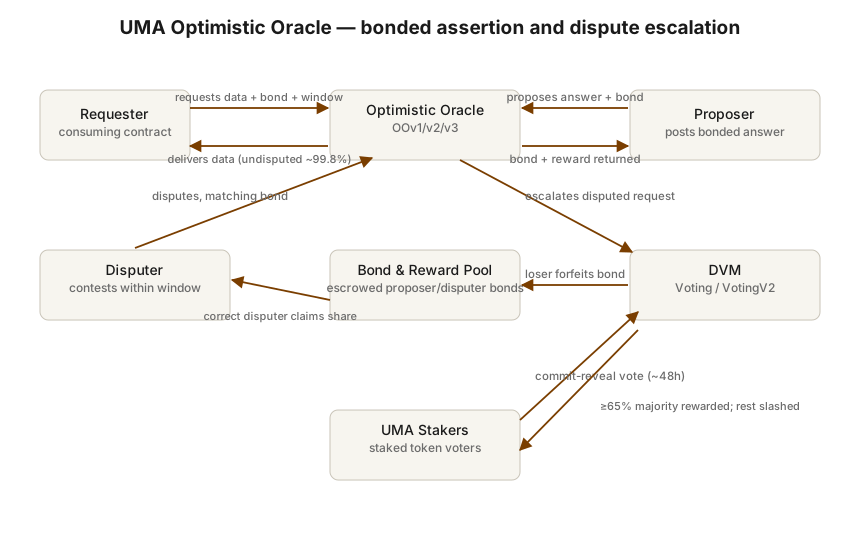 Open full-size diagram
Summary
The UMA Optimistic Oracle (OO) is an on-chain oracle designed around an "optimistic" (innocent-until-proven-guilty) verification game rather than a continuous price feed. Any smart contract can request an arbitrary piece of data — a price, an event outcome, the result of an off-chain computation — and the network assumes the first bonded answer is correct unless someone disputes it. Because most requests are never disputed, the OO resolves data cheaply and flexibly, and only the contested minority escalates to UMA's token-holder court, the Data Verification Mechanism (DVM). The design was introduced by UMA co-founder Hart Lambur on 13 May 2021, building on UMA's earlier synthetic-asset ("priceless" financial contract) work developed by Risk Labs since 2018–2019. UMA later became the dominant settlement oracle for prediction markets, most notably Polymarket, making it one of the canonical examples of optimistic/escalation-game mechanism design.
Design (Mechanism)
There are three roles. A requester (a contract) posts a data request specifying the question/identifier, a proposer reward, a required bond, and a challenge (liveness) window. A proposer submits an answer and posts a refundable bond. A disputer may, during the challenge window, contest the answer by posting a matching bond. Each request admits exactly one proposal and one dispute.
Two paths follow:
- Undisputed (the common case): if the challenge window elapses with no dispute, the proposal is accepted as truth, the proposer reclaims the bond plus reward, and the data is delivered to the requester. No token vote occurs. UMA reports this "happy path" settles roughly 99.8% of requests.
- Disputed: the request escalates to the DVM. UMA token holders who have staked vote using a commit–reveal scheme — a 24-hour commit period of secret (hashed) votes followed by a 24-hour reveal period, i.e. a ~48-hour resolution. A dispute resolves when a supermajority of at least 65% of participating staked UMA converges on one outcome. The commit–reveal design turns the vote into a Schelling point: voters cannot copy others (commits are secret) and cannot easily coordinate on a lie, so the game-theoretic focal point is the objective truth.
Economic incentives close the loop. The loser of a dispute forfeits their bond; a correct disputer earns a portion of the proposer's forfeited bond, which pays for policing bad proposals. On the DVM side, stakers who abstain or vote against the resolved majority are slashed, and the slashed UMA is redistributed to majority voters — rewarding participation and honesty. Unstaking carries a one-week lockup, which raises the "cost of corruption": bribing or 51%-attacking the vote requires acquiring and locking large amounts of UMA whose value would collapse if the oracle were seen to lie. Contracts are deployed as multiple versions on Ethereum mainnet (OptimisticOracle V1/V2/V3) plus Polygon, Optimism, Arbitrum and Base, with the DVM (Voting/VotingV2) living on Ethereum.
Outcome
Outcome status: major_success (with a persistent, well-documented governance-attack tail risk).
UMA's optimistic model shipped after roughly a year of production use of its "priceless" contracts, during which — per Lambur's launch post — there were "fewer than 5 legitimate disputes" despite volatile markets, with code audited by OpenZeppelin and ~$200M secured at the time. The OO went on to become core infrastructure: it is the resolution oracle behind Polymarket, the largest crypto prediction market, and underpins UMA products like KPI options and cross-chain "assertion" use cases. As a mechanism-design template, the optimistic/bonded-assertion pattern popularized here influenced a broad class of optimistic systems (bridges, rollup fraud proofs, other oracles). By that measure it is one of the most consequential onchain oracle experiments.
Why it worked
- Generality: because truth is asserted-then-challenged rather than fed from a fixed data source, the OO can answer nearly any verifiable question — event outcomes, off-chain computation, insurance triggers — not just crypto prices. This unlocked prediction markets and long-tail data use cases that continuous price oracles could not serve.
- Cost efficiency at scale: the vast majority of requests never touch a vote, so the expensive dispute-resolution machinery is only paid for on the small contested tail.
- Layered crypto-economic security: bonds punish bad proposals/disputes locally, while slashing plus a one-week unstake lockup create a global cost-of-corruption for the DVM. The Schelling-point commit–reveal vote gives honest voters a coordination advantage.
Limitations and criticisms
The OO's weak point is precisely its final backstop: when a dispute reaches the DVM, "truth" is whatever a plurality of staked UMA says it is, and stake can be concentrated. In the March 2025 Polymarket "Ukraine mineral deal" market (~$7M), reporting attributed the premature "Yes" resolution to a large UMA holder — described as controlling on the order of 5M tokens across accounts (roughly a quarter of participating votes) — who allegedly also held a betting position, i.e. a conflict of interest between voting for truth and voting for profit. Similar credibility complaints recurred (e.g. a 2025 UFO-declassification market resolving "Yes" absent released documents). Lambur publicly pushed back on some "UMA whale manipulation" framing, but the episodes expose a structural limit: for subjective or ambiguous questions, or when vote-holdings and bet-holdings overlap, the Schelling point can drift from ground truth toward whoever holds the most stake. The oracle is a technical and commercial success, but its dispute layer has a real, recurring governance-capture surface.
Lessons
- Optimism scales, adjudication doesn't automatically. Deferring to a happy-path assertion is cheap and general, but the security of the whole system is only as strong as the rarely-used court behind it — and that court is a governance system with all of governance's capture risks.
- Align the judges and separate them from the bettors. The most damaging incidents involved parties who both voted in the DVM and held positions in the market being resolved. Conflict-of-interest between "judge" and "trader" roles is a first-order design problem, not an edge case.
- Subjective questions break Schelling points. The commit–reveal focal-point argument works when there is an objective answer everyone expects others to converge on; for ambiguous or contested real-world events, "the obvious answer" can be manufactured by concentrated stake.
- Cost-of-corruption depends on token distribution, not just token value. Lockups and slashing raise attack cost in theory, but if stake is concentrated the practical bar to swinging a single high-value market can be far lower than the token's market cap implies.
Redesign (EDITORIAL — hypothesis, not fact)
The following is the researcher's editorial analysis, not established fact.
If rebuilding the dispute layer, the highest-leverage change would target the judge/trader conflict of interest. One hypothesis: make DVM votes on a given market ineligible or heavily penalized for addresses with a net position in that same market, using on-chain position data (feasible for Polymarket-style markets) — turning the oracle into something closer to a recused jury. A second lever is escalating adjudication tiers: cheap single-round votes for routine data, but for high-notional or high-controversy markets, an automatic escalation to a longer, higher-quorum round (or an appeal window in the style of Kleros' subcourts/appeals) that makes it progressively more expensive to hold a wrong answer — the SchellingCoin idea taken to multiple rounds. Third, outcome-conditioned bonding: scale required proposer/disputer bonds (and voter stake-at-risk) with the market's open interest, so the security budget tracks the value being decided rather than a fixed parameter. Finally, for genuinely subjective questions, the cleaner answer may be refusing to resolve (returning "too early / unresolvable" or "p=50") rather than forcing a binary, since much of the reputational damage came from confidently-wrong resolutions of questions that had no objective answer yet. These are hypotheses; each trades off latency, capital efficiency, and permissionlessness, and would need simulation against real dispute history before adoption.
Sources
- Introducing UMA's Optimistic Oracle (Hart Lambur) — primary (retrospective)
- How does UMA's Oracle work? (official docs) — primary (docs)
- UMA core contract network addresses (networks/1.json) — primary (contract)
- Polymarket reports 'unprecedented' governance attack by UMA whale (news)
- Polymarket's $7M Ukraine Mineral Deal Debacle Traced to Oracle Whale (news)
- Hart Lambur public statement on Polymarket dispute (X) (governance)
Related experiments
Last verified: 2026-07-26 · Spot an error? Suggest a correction