Gyroscope
An academically designed 'all-weather' decentralized stablecoin (GYD) that pairs a diversified, segregated reserve and an autonomous Dynamic Stability Mechanism with novel elliptic concentrated-liquidity AMM pools (E-CLPs).
▶ Run interactive simulation animated mechanism with editable parameters
How it works onchain
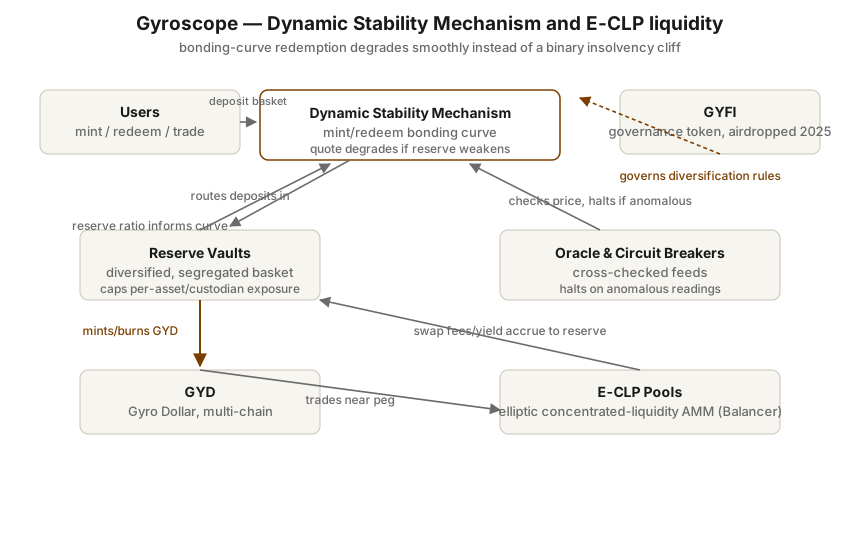 Open full-size diagram
Summary
Gyroscope is a decentralized stablecoin protocol built around GYD ("Gyro Dollar"), designed as an explicitly risk-managed alternative to both fiat-backed stablecoins (censorship/custody risk) and single-collateral or algorithmic designs (concentration and death-spiral risk). It was founded in 2021 by three DeFi researchers — Ariah Klages-Mundt (Cornell), Lewis Gudgeon and Daniel Perez (Imperial College London) — whose academic work had anticipated failure modes later seen in Dai's Black Thursday and Terra's collapse. Development was led by FTL Labs, with a $4.5M seed round (announced March 2023) led by Placeholder and Galaxy, with Archetype, Maven 11, Robot Ventures and Balancer co-founder Fernando Martinelli participating. After a prototype period on Polygon and the May 2023 launch of its E-CLP liquidity pools (which reached ~$29M TVL before the stablecoin itself launched), GYD went live on Ethereum mainnet on December 7, 2023. The governance token GYFI launched in March 2025 with a 15%-of-supply airdrop, at which point the protocol reported ~$62M TVL, ~$24M GYD supply, $4.1B annualized volume and >$2M annualized revenue.
Design (Mechanism)
Gyroscope combines four mechanism layers:
Diversified, segregated reserve. GYD is fully backed by a basket of assets held in segregated vaults, with protocol-level "risk diversification rules" that cap exposure to any single stablecoin, custodian, or yield source. The design goal is that no single collateral failure (a USDC depeg, a lending-market exploit) can cascade into total backing loss.
Dynamic Stability Mechanism (DSM). Minting and redemption run through optimized bonding curves rather than fixed 1:1 redemption. While the reserve is healthy, GYD redeems at (or extremely near) $1. If the reserve ratio deteriorates, the redemption curve autonomously lowers redemption quotes — a graduated, algorithmic circuit breaker that makes a bank run less profitable the harder it is run, buying time for the reserve to recover via yield while disincentivizing peg attacks. This is the core theoretical contribution: replacing the binary "fully redeemable until suddenly insolvent" cliff with a smooth, rule-based degradation.
Oracle and circuit-breaker system. A layered "resilient oracle" design cross-checks price feeds and halts or constrains operations on anomalous readings, addressing the oracle-manipulation vector that felled many CDP and reserve systems.
E-CLPs (Elliptic Concentrated Liquidity Pools). Custom AMM pools (deployed on Balancer) that concentrate liquidity along an elliptical curve, allowing asymmetric concentration around the peg without active management, claimed to be at least 75% more capital-efficient than Stableswap-style pools. E-CLPs both generate reserve yield and give GYD unusually deep liquidity near $1 — marketed as a "superliquid" stablecoin and hub asset across Ethereum, Base, Arbitrum, Polygon and Polygon zkEVM.
Distribution used a SPIN points campaign and founding-member NFTs, converted into the GYFI airdrop (2.1M of 13.7M supply) with optional 9/18-month lockups for 40%/150% bonuses.
Outcome
Ongoing. GYD has held its peg since the December 2023 mainnet launch with no publicly reported depeg incident or exploit found in this research. The E-CLP business line proved genuinely productive: by March 2025 the protocol reported record TVL ($62M), $4.1B annualized volume, and swap-fee revenue growing 550% quarter-over-quarter, supporting the GYFI token launch. However, GYD supply ($24M at the GYFI launch) remains a rounding error next to USDT/USDC and well below DAI/USDS and newer yield-bearing entrants — the mechanism works, but adoption is niche. No major security incident, audit failure, or governance crisis surfaced in the sources reviewed.
Why it worked
- Research-first design. The founders formally modeled stablecoin attack vectors (runs, oracle manipulation, collateral concentration) before building; the DSM is a direct implementation of their published theory, not post-hoc patching.
- Two products, one flywheel. E-CLPs were valuable AMM infrastructure independent of GYD, generating real fee revenue and deep peg liquidity before and after the stablecoin launched — so the protocol wasn't dependent on stablecoin adoption alone.
- Conservative, fully backed reserve with diversification rules avoided the reflexive/endogenous collateral traps that destroyed algorithmic peers (Terra, Iron Finance).
- Timing: launching post-Terra and post-SVB/USDC-depeg, its "all-weather" framing matched exactly the risks the market had just experienced.
Limitations and criticisms
- Distribution, not design, is the stablecoin bottleneck. GYD's ~$24M supply after ~15 months shows that superior risk engineering does not by itself create stablecoin demand; USDC/USDT network effects and, later, yield-bearing T-bill stablecoins dominate distribution channels.
- Complexity tax. The DSM's variable redemption price — its key safety feature — is harder to explain than "1:1 redeemable," and sophisticated integrators may treat a below-par redemption possibility as a risk rather than a safeguard.
- Capped upside of prudence. Diversified, conservative reserves yield less than aggressive strategies, limiting the incentive budget for growth versus competitors subsidizing adoption.
Lessons
- A stablecoin's stability mechanism and its adoption engine are separate problems; solving the first brilliantly (DSM, diversified vaults) buys survival, not market share.
- Graduated, autonomous redemption curves are a credible alternative to binary redemption cliffs: making runs progressively unprofitable is more robust than promising 1:1 until insolvency.
- Shipping standalone infrastructure with independent product-market fit (E-CLPs on Balancer) de-risks a token launch — the AMM revenue carried the protocol's narrative and treasury while the stablecoin grew slowly.
- Founding teams with published, falsifiable research on the exact failure modes of their category tend to build systems that avoid those failure modes — but academic credibility does not substitute for distribution partnerships.
Redesign (EDITORIAL — hypothesis, not fact)
This section is editorial hypothesis, not established fact. A redesigned Gyroscope might attack distribution rather than mechanism. First, make the DSM legible: publish a real-time, contract-verifiable "redemption floor" metric (worst-case redemption quote given current reserves) so integrators can price the tail risk instead of avoiding it. Second, lean fully into the hub-asset strategy: rather than competing for retail stablecoin holders, position GYD purely as inter-pool settlement collateral inside AMMs and restaking/looping venues, where its deep near-peg liquidity is the differentiator and end-users never need to "choose" it. Third, split the reserve into a user-selectable tranche structure — a senior tranche with hard 1:1 redemption backed by the most conservative assets, and a junior tranche absorbing DSM haircuts in exchange for the reserve yield — converting the confusing variable-redemption property into an explicit, priced risk market. The open question is whether any decentralized stablecoin can overcome incumbent network effects without an unsustainable subsidy; Gyroscope's evidence so far suggests engineering excellence alone cannot.
Sources
- Gyroscope Documentation — TL;DR — primary (docs)
- GYD is live on Ethereum Mainnet (Lewis Gudgeon, Gyroscope Medium) — primary (retrospective)
- Gyroscope Explained (Ariah Klages-Mundt, Gyroscope Medium) — primary (docs)
- Gyro Dollar (GYD) token — Etherscan — primary (contract)
- Gyroscope raises $4.5M seed led by Placeholder and Galaxy (FTL Labs, Medium) — primary (retrospective)
- Galaxy-Backed Gyroscope's 'All-Weather' Decentralized Stablecoin Goes Live on Ethereum Mainnet — CoinDesk (news)
- Stablecoin protocol Gyroscope rolls out token and airdrop amid revenue growth — The Block (Mar 18, 2025) (news)
- Gyroscope GYD — DefiLlama stablecoin page (analysis)
- Gyroscope case study — Bonding Curve Research Group Library (analysis)
Related experiments
Last verified: 2026-07-26 · Spot an error? Suggest a correction