Azuro Protocol
A B2B 'predictions layer' that pools betting liquidity in a novel LiquidityTree/vAMM design so dozens of frontend apps can offer onchain sports betting and prediction markets against one shared pool.
▶ Run interactive simulation animated mechanism with editable parameters
How it works onchain
 Open full-size diagram
Summary
Azuro is B2B infrastructure for onchain betting and prediction markets: a shared liquidity and settlement layer ("The Predictions Layer") that many independent frontend apps plug into, rather than a consumer betting site. Founded in 2021 by Paruyr Shahbazyan (previously founder of Bookmaker Ratings, a large betting-media/mediation business) with Rossen Yordanov and Dmitry Globenko, it raised a $3.5M seed in January 2022 led by Gnosis, Flow Ventures and Polymorphic Capital, plus a ~$4M strategic round in mid-2022. The protocol deployed to Gnosis Chain in 2022 and later expanded to Polygon (its main venue), Chiliz and Base. Its core inventions are the LiquidityTree — a singleton liquidity pool whose capital backs thousands of concurrent sports/prediction markets — and a vAMM-style pricing layer where "data providers" seed odds and bettor flow moves them onchain. By late 2024 Azuro had processed roughly $250M+ in betting volume, generated ~$5M in protocol revenue, held ~$9.8M TVL, and powered 30+ apps. Its AZUR token (June 2024 TGE) subsequently lost ~99% of its peak value, and Azuro remained a niche player relative to Polymarket's breakout.
Design (Mechanism)
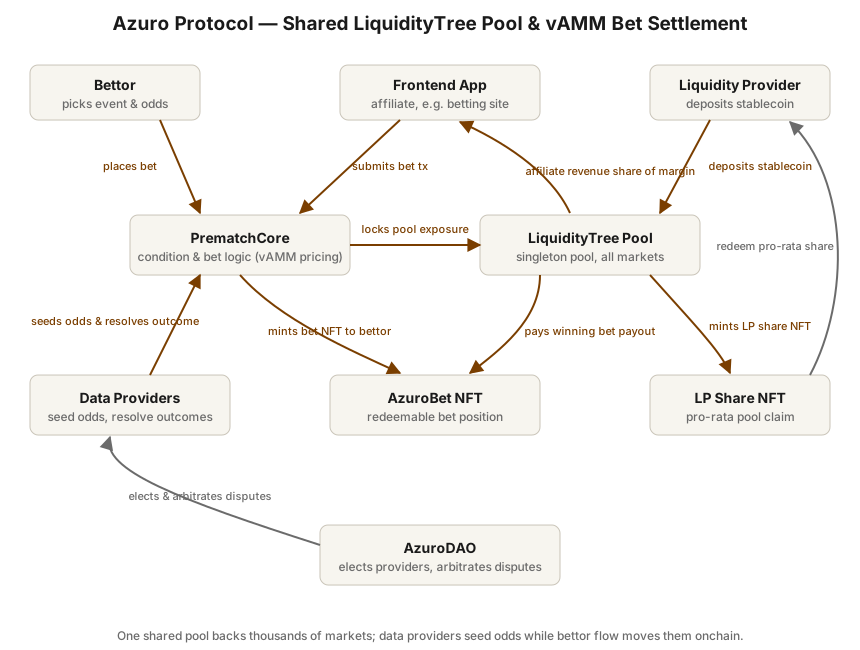
- Singleton pool via LiquidityTree. Instead of per-market liquidity (the Achilles heel of order-book prediction markets), all LP deposits on a chain sit in one pool. The LiquidityTree is a segment-tree-like data structure that tracks each depositor's pro-rata share as the pool continuously wins/loses across thousands of markets, allowing deposits/withdrawals at arbitrary times without per-market accounting. LP positions were represented as NFTs.
- vAMM pricing seeded by data providers. Whitelisted "data providers" (professional odds feeds, elected/overseen by AzuroDAO in the mature design) push initial sell-side odds for events and later resolve outcomes. A virtual AMM then adjusts odds as bets flow in, so the pool's exposure is priced dynamically rather than at static bookmaker odds. The pool profits when its margin (spread) exceeds the mispricing that sharp bettors extract.
- Bets as NFTs. Each bet mints an AzuroBet NFT redeemable for the payout if it wins — making positions transferable and composable.
- B2B frontend layer with revenue share. Anyone can launch a betting frontend using Azuro's SDK/subgraphs; frontends ("affiliates") earn a share of the pool margin on the volume they originate. Azuro itself hosts no consumer product, a structure partly motivated by the regulatory perimeter around gambling.
- Governance/dispute layer. AzuroDAO acts as arbiter for disputed resolutions and elects data providers. The AZUR token (TGE June 2024) carries governance and staking/incentive utilities.
- Key contracts (verified deployments listed in official docs): the LP contract is the entry point holding pool logic and liquidity; Factory deploys pool components; PrematchCore handles condition/bet logic (v2), with a v3 architecture (Vault/ClientCore) rolled out later across Polygon, Gnosis, Base and Chiliz.
Outcome
Real, sustained usage — but modest scale and a failed token market. The protocol worked as designed for years without a known exploit of its core pool: 30+ independent frontends launched on it; cumulative betting volume exceeded $250M with ~$5M protocol revenue (Messari, late 2024); the Polygon USDT pool ($8–9M) paid LPs roughly ~20% unsubsidized APY over 12+ months, and TVL peaked around $9.8M in October 2024. However, AZUR launched into a weak market in June 2024 and by 2026 traded ~99.6% below its all-time high, with thin volume. Strategically, Azuro's sports-betting-first, B2B-infrastructure bet was overshadowed in the 2024–2025 prediction-market boom by consumer-facing, order-book venues (Polymarket, Kalshi) that captured the news-market zeitgeist. Azuro continued shipping (V3, Base deployment, Azuro Sports V2) and remains live — hence "partial success": technically robust and revenue-generating, commercially small with a collapsed token.
Why it worked
- The LiquidityTree genuinely solved liquidity fragmentation for long-tail markets: one pool can quote thousands of simultaneous sports markets that an order book could never bootstrap, and LP returns came from real bettor losses/margin, not emissions.
- Founder-market fit: Shahbazyan's decade in betting media meant realistic odds/margin design and distribution instincts (affiliate revenue share mirrors the gambling industry's proven affiliate economics).
- The B2B posture recruited dozens of frontends as distribution partners and kept the protocol itself at arm's length from consumer gambling regulation.
Where the design broke
- Peer-to-pool betting requires trusted data providers to seed odds and resolve events — a semi-permissioned core that weakened the decentralization story versus Polymarket's UMA-resolved markets, without delivering the UX advantage of a slick consumer app either.
- Sports betting onchain competes with mature, licensed, mobile-first incumbents; the crypto-native audience that did show up for prediction markets in 2024–25 wanted elections and news markets, where Polymarket's order book and media presence dominated.
- Token launch into a downtrend with heavy expectations: AZUR added little demand-side utility beyond governance/staking, and its ~99% drawdown damaged ecosystem credibility and incentive budgets.
- B2B abstraction diluted brand: value and mindshare accrued to frontends and competitors, while Azuro bore infrastructure costs.
Lessons
- Pooled peer-to-pool liquidity (LiquidityTree-style) is the right primitive for long-tail, many-market betting; order books only win where attention concentrates on a few high-volume markets.
- Real yield from bettor margin can sustain double-digit LP APY without emissions — a rare, genuinely sustainable DeFi cash flow — but only at whatever scale bettor demand supports.
- B2B "picks-and-shovels" positioning shifts regulatory risk and distribution cost to frontends, but it also surrenders the consumer relationship; in attention-driven markets the app layer, not the protocol layer, captured the 2024–25 prediction boom.
- Launching a governance token without a hard demand sink, after product-market fit is only partial, converts a technical success narrative into a "down 99%" narrative that overshadows real metrics.
Redesign (EDITORIAL — hypothesis, not fact)
This section is editorial hypothesis, not established fact. A redesigned Azuro might: (1) keep the LiquidityTree pool but open odds-seeding to competitive, bonded market makers (slashing for stale/exploitable odds) instead of whitelisted data providers, moving trust-minimization closer to Polymarket's while retaining pooled liquidity; (2) operate one flagship consumer frontend alongside the B2B network — the Uniswap-interface model — so the protocol brand accrues attention in event-driven surges; (3) route a protocol-revenue share to AZUR staking from day one (fee switch) so the token prices a claim on the ~$5M+ real revenue rather than pure governance; (4) prioritize news/politics/crypto markets, where onchain venues have structural advantage over licensed sportsbooks, using sports as retention rather than as the wedge; and (5) settle on one low-fee chain with native account abstraction to cut the multi-chain liquidity fragmentation it was designed to avoid.
Sources
- Azuro Gem (official docs) — FAQs / protocol overview — primary (docs)
- Azuro Gem — Deployment addresses — primary (docs)
- Azuro-v2-public smart contracts (GitHub) — primary (contract)
- Introducing Azuro's Liquidity Tree (official blog) — primary (docs)
- Azuro closes $3.5m seed round (official blog) — primary (docs)
- Understanding Azuro: A Comprehensive Overview (Messari) (analysis)
- AZUR token page (CoinGecko) (analysis)
- Azuro on DefiLlama (analysis)
Related experiments
Last verified: 2026-07-26 · Spot an error? Suggest a correction