Secret Network
A Cosmos-SDK L1 that runs encrypted 'secret contracts' inside Intel SGX trusted execution environments, betting that hardware enclaves — not cryptography alone — could deliver programmable privacy at smart-contract speed.
▶ Run interactive simulation animated mechanism with editable parameters
How it works onchain
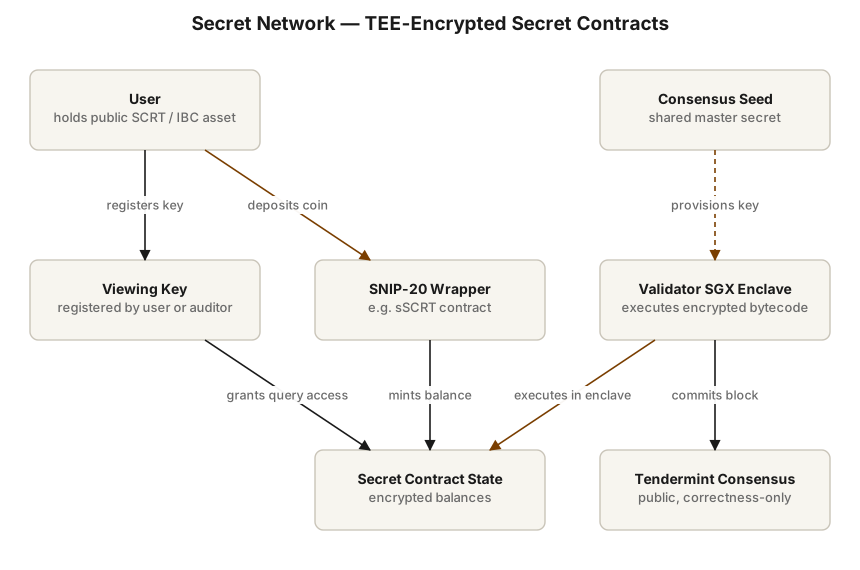 Open full-size diagram
Summary
Secret Network is the continuation of Enigma, an MIT Media Lab spinout (Guy Zyskind, Can Kisagun) that raised roughly $45M in a 2017 ICO to build private computation for Ethereum. Following the resolution of a regulatory matter tied to that sale, the project launched an independent Cosmos-SDK proof-of-stake chain on February 13, 2020 and rebranded from "Enigma blockchain" to Secret Network in May 2020; ENG holders burned tokens to receive the new native coin SCRT. Its core wager: instead of waiting for practical zero-knowledge or fully homomorphic encryption, run general-purpose CosmWasm smart contracts inside Intel SGX enclaves so contract state and inputs stay encrypted even from the validators executing them. "Secret contracts" went live on mainnet in September 2020, making it the first mainnet with general-purpose privacy-preserving smart contracts. The network built a private-DeFi ecosystem (SNIP-20 tokens, SecretSwap, Shade Protocol), had a celebrity NFT moment (Quentin Tarantino's Pulp Fiction NFTs, sold via a Tel Aviv-based SCRT Labs collaboration), survived a devastating hardware-level break of its privacy in 2022 (the xAPIC/ÆPIC attack, which extracted the network's consensus seed), and endured a bitter public governance war between SCRT Labs and the for-profit Secret Foundation in 2022–23. By 2025–26 it had pivoted toward "confidential computing for Web3 and AI" (SecretVM, Secret AI on NVIDIA GPU TEEs), moving to a semi-permissioned node model after further TEE exploits.
Design (Mechanism)
- TEE-based execution. Every validator must run an Intel SGX-capable CPU. Contract bytecode executes inside the enclave; the enclave attests to Intel that it is genuine hardware running the approved code before joining the network.
- Shared consensus seed. At network genesis a master secret ("consensus seed") was generated inside an enclave and provisioned to each new node's enclave during registration. From it, nodes derive the keys that encrypt contract state, transaction inputs, and outputs — so any honest node can execute any contract, but no operator can read the plaintext.
- SNIP-20 private tokens. A public coin (SCRT, or IBC assets) is deposited into a wrapper contract and re-issued as a privacy-preserving fungible token; balances and transfer graphs are encrypted contract state. The first instance, sSCRT (
secret1k0jntykt7e4g3y88ltc60czgjuqdy4c9e8fzek), launched with the secret-contracts upgrade. - Viewing keys / query permits. Selective disclosure: a user signs a transaction to register a random viewing key with a contract; anyone holding key + address (the user, an auditor, a tax authority) can query that account's private data. This made compliance-friendly privacy a design feature rather than an afterthought.
- Public consensus, private compute. Consensus (Tendermint PoS in SCRT) never depends on SGX for correctness — only for confidentiality. This deliberate separation meant an SGX break could leak data but could not mint coins or steal funds.
- Token migration by burn. ENG→SCRT swap required burning Ethereum-based ENG, a clean severing from the original ICO-era asset.
Outcome
Partial success. Technically, the network shipped what it promised and still runs six years later: first-mover general-purpose private smart contracts (Sept 2020), IBC connectivity, a private-DeFi stack, and a January 2022 "Shockwave" push backed by a headline $400M ecosystem-fund announcement near SCRT's price peak. But the bet's central risk materialized: in October–November 2022 academic researchers (sgx.fail) used the xAPIC/ÆPIC CPU bug to extract the network's consensus seed from their own validator's enclave — sufficient, in principle, to decrypt the private state of all contracts, retroactively. Funds were never at risk (correctness never relied on SGX) and the team patched with Intel and ejected vulnerable nodes, but "privacy until the next CPU errata" became the network's permanent asterisk; further TEE breaks (wiretap.fail, tee.fail, Battering RAM, 2025) pushed it to a semi-permissioned node model. Governance also fractured: in early 2023, a public dispute broke out between Guy Zyskind and the Secret Foundation — revealed to be a for-profit entity — over Foundation compensation practices, including a roughly $2.6M payment to Foundation head Tor Bair; the conflict triggered contributor departures. DeFi TVL collapsed with the bear market (SecretSwap and Shade now in the low single-digit millions or below), and SCRT never regained its 2021 highs. The project survives as SCRT Labs' confidential-computing/AI platform (SecretVM, Secret AI, Intel Trust Authority and AMD SEV-SNP integrations announced 2026), with Zyskind stepping back to advisor in 2023 to found Fhenix (FHE) — itself a telling signal about the long-term endgame for TEE-only privacy.
Why it worked
- Pragmatism beat purity on time-to-market. TEEs let Secret ship general-purpose private compute in 2020, years before ZK or FHE systems could run arbitrary contract logic at usable cost. First-mover status was real and durable.
- Correctness/confidentiality separation was excellent engineering. Because consensus never trusted SGX, the worst hardware break in the project's history leaked privacy but lost no funds — a survivable failure mode by design.
- Viewing keys made privacy composable with compliance, differentiating Secret from mixer-style privacy tools that offer no selective disclosure.
- Riding Cosmos/IBC gave a small chain interoperable liquidity and a developer toolchain (CosmWasm/Rust) it didn't have to invent.
Where the design broke
- The trust anchor was Intel, and Intel's silicon kept breaking. xAPIC/ÆPIC (2022) exposed the deepest flaw: a single shared consensus seed replicated into thousands of enclaves meant one broken CPU anywhere compromised everyone's history, retroactively. Privacy that can be silently and retroactively revoked is a weaker product than it appears.
- Privacy demand was thinner than thesis-stage investors assumed. Private DeFi never found sticky product-market fit; TVL and activity tracked speculation, not privacy need, and collapsed with the cycle.
- Governance/entity design failed. A for-profit "Foundation" with opaque finances, a public dispute over founder/executive compensation, and a public rift between the two lead entities burned community trust at the worst possible moment (early 2023).
- Hardware gatekeeping eroded permissionlessness. SGX requirements always limited the validator set; post-2025 exploits forced an explicitly semi-permissioned model, conceding a core decentralization claim.
Lessons
- A shared network-wide secret is a single point of catastrophic, retroactive failure. If TEEs must be used, per-contract or frequently-rotated keys with forward secrecy bound the blast radius of any one enclave break; Secret's global consensus seed maximized it.
- Decide what each trust layer is allowed to break. Secret's rule — SGX for privacy, never for correctness — is the reason an existential exploit didn't kill it. Layered trust budgets should be explicit in any mechanism design.
- Privacy is a feature, rarely a chain. Users showed up for yields and NFT drops, not confidentiality per se; a privacy premium alone did not sustain an L1 economy through a bear market.
- Off-chain entity structure is part of the mechanism. A token economy's credibility can be destroyed by a legal-entity design (for-profit foundation, opaque treasury) that no amount of on-chain governance could reach.
- Selective disclosure (viewing keys) aged well — it anticipated the compliant-privacy direction the whole industry later moved toward.
Redesign (EDITORIAL — hypothesis, not fact)
This section is editorial hypothesis, not established fact. A redesigned Secret would treat TEEs as an accelerator inside a defense-in-depth stack rather than the sole privacy root: (1) replace the global consensus seed with per-contract keys derived via threshold key-generation across a committee of enclaves on heterogeneous hardware (Intel SGX + AMD SEV + ARM CCA), so a vendor-specific errata compromises one vendor's share, not the network; (2) add mandatory epoch-based key rotation with deletion of old shares, converting "retroactive full-history decryption" into "bounded-window exposure"; (3) publish enclave-attestation liveness and a standing exploit-response playbook as protocol-level machinery, since TEE breaks are recurring weather, not black swans; (4) charter all treasury entities as non-profits with on-chain-verifiable treasuries and revocable mandates before token launch; and (5) position ZK proofs for public verifiability on top of TEE-private execution (roughly the direction SecretVM's third-party attestation posting now gestures at), giving a graceful migration path toward FHE/ZK as those mature — the path the founder himself took by leaving to build Fhenix.
Sources
- Secret Network documentation (technology overview, official links) — primary (docs)
- The Secret is Out: Announcing the Secret Contracts Mainnet — primary (docs)
- SecretSCRT: Privacy Tokens are Live on Mainnet — primary (docs)
- SNIP-20 specification (SecretFoundation/SNIPs) — primary (docs)
- scrtlabs/secretSCRT contract repository — primary (contract)
- sgx.fail — academic disclosure of the xAPIC/ÆPIC attack on Secret Network — primary (audit)
- Secret Network Security Update: Intel SGX Vulnerability Response — primary (postmortem)
- Enigma Blockchain Has a New Name and a Privacy Boost in the Works (CoinDesk) (news)
- Privacy blockchain Enigma launches mainnet; settles with SEC over ENG token (news)
- Secret Blockchain Suffers Departures as Foundation Head's $2M-Plus Dividend Sparks Outcry (CoinDesk) (news)
- Secret Foundation Faces Calls for More Transparency, Return of Funds (Decrypt) (news)
- Secret Network resolves network vulnerability following white hat disclosure (Cointelegraph) (news)
- SCRT Labs 2026 Roadmap Update (Alex Zaidelson) (governance)
Related experiments
Last verified: 2026-07-26 · Spot an error? Suggest a correction