BitClout
A 2021 blockchain social network that tokenized personal reputation via bonding-curve 'creator coins,' pre-loading thousands of celebrity profiles without consent, whose pseudonymous founder later revealed himself.
▶ Run interactive simulation animated mechanism with editable parameters
How it works onchain
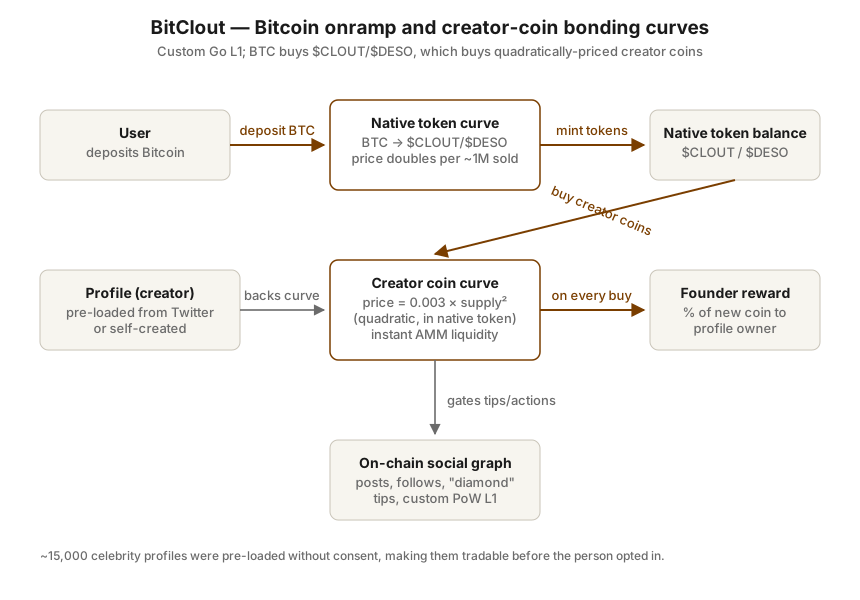 Open full-size diagram
Summary
BitClout was a blockchain-based social network that launched publicly on March 24, 2021 (genesis block January 18, 2021) as the flagship application for a custom Go Layer-1 blockchain later rebranded DeSo (Decentralized Social). Its defining idea was to make personal reputation a tradable asset: every profile had its own "creator coin" priced on an automated bonding curve, so users could speculate on individuals the way one trades a stock. The platform was created by former Google/Basis engineer Nader Al-Naji, who initially operated pseudonymously as "Diamondhands" before revealing his identity on September 21, 2021.
BitClout generated enormous early attention — and immediate controversy — because it pre-loaded roughly 15,000 Twitter profiles of celebrities and influencers without their consent, minting speculative coins tied to real people who had never signed up. The project raised large sums from sales of its native token, marketed as $CLOUT and later renamed $DESO, and was backed by prominent VCs including a16z, Sequoia, Coinbase Ventures, Social Capital, and Winklevoss Capital.
Design (Mechanism)
BitClout's core mechanic was the creator coin bonding curve. Each account had a personal token whose price was a deterministic function of supply. Per Wikipedia's reproduction of the formula, price was quadratic in circulating supply, roughly:
price_in_bitclout = 0.003 × (creator_coins_in_circulation)²
Because the curve was an automated market maker, coins had instant liquidity — anyone could buy or sell at the curve price with no counterparty needed. When you bought someone's coin the price rose for the next buyer; selling pushed it down. A percentage of each creator's coin was allocated as a founder reward to the profile owner, creating an incentive to attract buyers.
Other design elements:
- Native token onramp via Bitcoin. To get the platform currency ($CLOUT/$DESO), users deposited Bitcoin, which was sold along the native token's own bonding curve. The initial native-token price was set around $0.50, doubling for roughly every ~1M tokens sold. Early on, selling the native token back was restricted (routed informally through Discord/Twitter), which drew criticism as a one-way door.
- On-chain social graph. Profiles, posts, follows, likes, and "diamond" tip rewards were all recorded on the custom Layer-1, which was purpose-built to make high-volume social actions cheap — a differentiator from putting social activity on Ethereum.
- Custom PoW Layer-1 written in Go, open-sourced under MIT (originally
bitclout/core, nowdeso-protocol/core). NFT minting was added July 2021; the chain later moved toward proof-of-stake (2024). - "Just coins and code" framing. BitClout was publicly presented as a decentralized protocol with no company behind it, despite Al-Naji's central control of the system.
Outcome
Status: technically_successful_commercially_unsuccessful. The technology worked and scaled — DeSo's own docs claim BitClout supported on the order of ~100k simultaneous daily active users, demonstrating a working on-chain social network. But as a product and market it did not sustain. Creator-coin prices collapsed from launch-hype highs, the non-consensual celebrity profiles drew public objections from those depicted (including Singapore's Prime Minister Lee Hsien Loong), and activity migrated as the project rebranded to DeSo.
In September 2021 the founder unmasked himself and reframed BitClout as merely a demo app for the broader DeSo blockchain, whose foundation touted a ~$200M treasury. DeSo continues to exist as a blockchain, but BitClout as originally conceived did not become a mainstream social product.
Why it worked
- Speculation as a growth engine. Bonding-curve creator coins made "being early" to a person financially rewarding, giving the app a viral, get-rich-quick loop that mainstream social apps lack.
- Genuine technical achievement. A from-scratch Layer-1 optimized for cheap social transactions actually ran at meaningful scale, proving on-chain social feasibility.
- Instant liquidity by construction. The AMM curve meant no order books or matching — every coin was always tradable, lowering friction dramatically.
- Elite backing and buzz. Top-tier VC investment plus the mystery of a pseudonymous founder created a wave of press and early adopters.
Where the design broke
- Non-consensual identity tokenization. Minting coins for ~15,000 real people who never opted in was a structural liability from day one, generating reputational damage.
- Reflexive price dynamics. The quadratic curve priced coins by order of arrival, so the earliest buyers of a given creator coin held the most room to appreciate; founder rewards and restricted early selling reinforced that skew, and prices fell sharply for whoever held when net buying stopped.
- Single-key administrative control. A single founder's keys administered the system throughout the BitClout era, with no on-chain or distributed governance over identity, profiles, or protocol parameters.
Lessons
- Tokenizing people requires consent and exit rights. Minting tradable coins for accounts that never opted in meant the people being tokenized had no input into the process, and restricted early selling meant coin holders had limited exit options until liquidity was made symmetric.
- Bonding curves amplify reflexivity — design for the downside. Quadratic price curves and founder rewards produce steep upside moves and equally steep collapses; mechanisms need dampening (fees, vesting, symmetric liquidity) to bound the size of those swings.
- Single-key administrative control is a structural risk independent of framing. BitClout ran under one founder's keys throughout its early operation; consolidated key custody is a risk factor regardless of how a protocol is described publicly.
- Working tech is necessary but not sufficient. BitClout proved on-chain social can scale, yet product-market fit, trust, and legitimacy — not throughput — determined the outcome.
Redesign (EDITORIAL — hypothesis, not fact)
The following is the researcher's editorial analysis and speculation, not established fact.
A redesigned BitClout would treat consent, symmetry, and honest governance as first-class mechanism constraints. First, no involuntary profiles: creator coins would only exist after a verified opt-in (signed by the person's key), removing the entire non-consensual-tokenization risk that defined the launch. Reserved/placeholder profiles, if any, would be non-tradable until claimed.
Second, dampen the curve. Replace the aggressive quadratic curve with a flatter, fee-bearing invariant that charges a spread on both buys and sells, routing part of the spread to the creator and part to a coin-specific reserve — reducing the "double every N tokens" pump dynamic and guaranteeing symmetric two-way liquidity so there is no one-way exit trap. Founder rewards would vest over time and stream against genuine engagement rather than mint instantly on speculation.
Third, align tokens with consumptive utility, not price exposure alone. Creator coins could gate access, content, or revenue-share (a patronage/subscription primitive) so holding a coin buys utility, not just exposure to the price movement of someone's popularity — shifting the token's primary function toward a creator-economy tool alongside its tradability.
Finally, make the control structure explicit from block one. Either ship on-chain governance, a public issuer entity, and transparent treasury custody with independent controls; or disclose the controlling team and fund use up front. BitClout's control sat with a single founder's keys; an explicit design would make token buyers' rights and the issuer's obligations legible from the start rather than left implicit.
Sources
- BitClout — Wikipedia (analysis)
- BitClout founder 'Diamondhands' reveals himself (Fast Company) (retrospective)
- Nader Al-Naji (fka 'Diamondhands') Unveils Long-Term Plan for BitClout Blockchain (news)
- DeSo Roadmap (official docs) — primary (docs)
Related experiments
Last verified: 2026-07-26 · Spot an error? Suggest a correction