Semaphore
A zero-knowledge protocol from Ethereum's PSE team that lets members of an on-chain group broadcast signals (votes, endorsements, messages) provably as group members without revealing which member they are.
▶ Run interactive simulation animated mechanism with editable parameters
How it works onchain
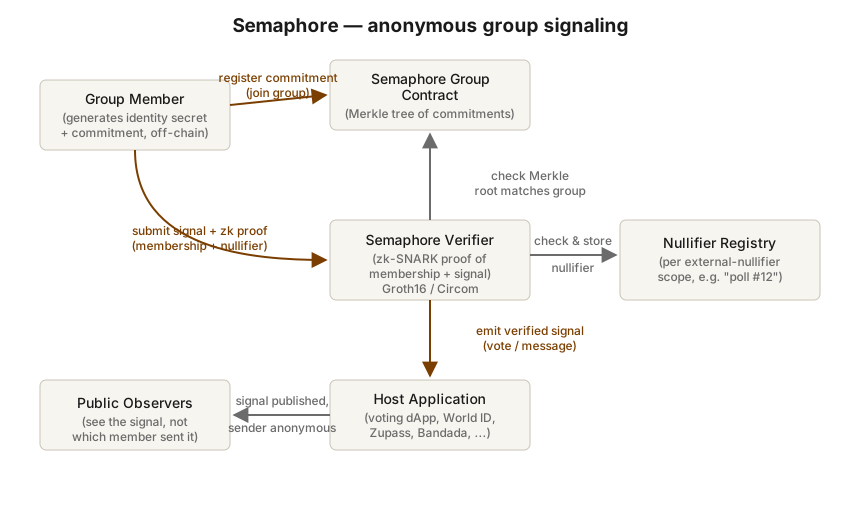 Open full-size diagram
Summary
Semaphore is a zero-knowledge signaling protocol for Ethereum: it lets a user prove they belong to an on-chain group and broadcast an arbitrary message ("signal") — a vote, an endorsement, a whistleblower report — without revealing which group member they are. Originally devised around 2018–2019 by Barry WhiteHat, Kobi Gurkan, and Koh Wei Jie (with early engineering contributions from others, including Harry Roberts per contemporaneous write-ups), it became a flagship public-good project of the Ethereum Foundation's Privacy & Scaling Explorations (PSE) team. Rather than being an end-user application, Semaphore is deliberately a generic privacy primitive — the "base layer for signaling-based applications" per its whitepaper — and it became exactly that: it underpins Worldcoin's World ID, Zupass, Bandada, anonymous voting tools, and a claimed ecosystem of 60+ projects. It is one of the earliest and most durable demonstrations that zk-SNARKs on Ethereum could serve identity and coordination use cases, not just payments privacy.
Design (Mechanism)
The core objects are simple and have stayed stable across four protocol versions:
- Identity. A user generates a private identity (in V1–V3: secrets hashed into a Poseidon/Pedersen commitment; in V4: an EdDSA keypair on Baby Jubjub) and publishes only an identity commitment — a hash that reveals nothing about the secrets.
- Group (Merkle tree). Commitments are inserted into an incremental Merkle tree managed by a smart contract (V4 uses an optimized "LeanIMT" where a parent with a single child takes the child's value instead of padding with zero hashes). Group membership = being a leaf of the tree.
- Signal + proof. To signal, a member generates a zk-SNARK (Groth16 over Circom circuits) proving: "I know secrets whose commitment is a leaf of this Merkle root, and I authorize this exact message." The contract verifies the proof on-chain; observers learn a valid member signaled, but not which one.
- Nullifier. The proof also outputs a nullifier hash derived from the identity secret and an external nullifier (a per-topic scope, e.g. "poll #12"). The contract stores seen nullifiers and rejects repeats — so each member can signal at most once per scope without ever being identified. This is the mechanism-design heart of Semaphore: anonymity with rate-limiting/uniqueness, which is what makes anonymous one-person-one-vote possible.
Security of the SNARK parameters rests on a multi-party trusted setup; V2's ceremony completed in March 2022 with 300+ participants, and V2 was audited (May 2022, two major bugs found and fixed pre-release). V4 (released 2024, not backward compatible) is deployed at identical addresses across Ethereum mainnet and major L2s (Semaphore: 0x8A1f...693D; SemaphoreVerifier: 0x4DeC...31f8).
Outcome
Semaphore never sought fees, tokens, or users of its own — its outcome is measured in adoption as infrastructure, and by that measure it is a major success. The first application, MicroMix (a Kovan-testnet mixer, 2019), was a proof of concept; the durable wins came later: Worldcoin/World ID uses Semaphore to keep verified humans anonymous at global scale; Zupass (Zuzalu's credential wallet), Bandada (group management), Rate-Limiting Nullifier (RLN, used in Waku spam protection) and dozens of voting/identity projects build on it or its descendants. The protocol has shipped four major versions (V1 2019, V2 2022, V3, V4 2024), each audited and re-tooled, and remains actively maintained by PSE with a roadmap (Rust/Noir implementations). It is listed as canonical developer tooling on ethereum.org.
Why it worked
- Right abstraction, minimal surface. "Prove membership + signal once per scope" is a tiny, composable API that maps onto voting, attestation, spam protection, and airdrop claims without modification.
- The nullifier trick. Coupling anonymity to uniqueness (per external nullifier) solved the fundamental tension of anonymous systems — Sybil-resistant anonymity — and became a widely copied design pattern (RLN, World ID).
- Public-good stewardship. EF/PSE funding meant no token, no rent extraction, and a decade-long maintenance horizon; trust accrued via open source, public trusted-setup ceremonies, and published audits.
- Developer experience investment. Solidity contracts + JS libraries + CLI templates lowered the cost of building ZK apps years before general ZK tooling matured.
Limitations and criticisms
Real limits remain despite Semaphore's success as plumbing. Direct end-user visibility is near zero — its early consumer-facing showcase (MicroMix) never left testnet, and mixer mindshare went to Tornado Cash instead. Anonymity is only as strong as the group's size and entry policy (small or curated groups leak information), and the protocol itself cannot solve the hard problem of who gets into the group — Sybil-resistant enrollment has to be outsourced to Worldcoin-style biometrics or social attestation. Groth16's circuit-specific trusted setup remains a recurring ceremony cost per version, and V4's lack of backward compatibility imposes a migration burden on integrators.
Lessons
- Anonymity plus a nullifier equals a governance primitive. One-signal-per-scope under anonymity is the minimum viable mechanism for anonymous voting, quadratic-funding sybil defense, and rate-limited free speech; Semaphore proved it on-chain first.
- Privacy infrastructure wins as a public good, not a product. With no token to defend, Semaphore could be adopted by competitors and successors alike; its value compounded through others' products.
- The group-formation problem is exogenous. ZK proves membership; it cannot decide membership. Any Semaphore-style design must pair with an enrollment mechanism (biometrics, credentials, stake) whose weaknesses become the system's weaknesses.
- Anonymity sets are a mechanism-design resource. Small groups deanonymize; designers must treat group size and churn as first-class parameters, not implementation details.
Redesign (EDITORIAL — hypothesis, not fact)
This section is editorial analysis — a hypothesis, not an account of anything the Semaphore team has done or proposed. A modern redesign would attack the two weakest joints. First, replace Groth16 with a transparent or universal-setup proof system (e.g., a Noir/UltraHonk or STARK backend — directions PSE has publicly gestured at) so protocol upgrades stop requiring fresh ceremonies. Second, make anonymity-set health a protocol concern: expose on-chain metrics for group size and entry entropy, and let integrating contracts require a minimum anonymity-set threshold before accepting signals, preventing naive deployers from shipping "anonymous" apps with five-member groups. Third, standardize a cross-app nullifier registry so that one identity's signals across cooperating scopes can support rate-limiting economics (à la RLN slashing) without cross-scope linkability. The bet is that Semaphore's core objects — commitment, tree, nullifier — are final, and the remaining design space is entirely in setup trust, anonymity-set hygiene, and inter-app composition.
Sources
- Semaphore official site — primary (docs)
- Semaphore documentation (What is Semaphore?) — primary (docs)
- Semaphore whitepaper v1 — 'Community Proposal: Semaphore: Zero-Knowledge Signaling on Ethereum' (Gurkan, Koh, Whitehat) — primary (docs)
- Deployed contracts (V4) — primary (contract)
- Koh Wei Jie — 'To Mixers and Beyond: presenting Semaphore' (2019) — primary (retrospective)
- PSE — 'Semaphore V2 is Live!' (2022) — primary (docs)
- Semaphore 2.0.0 security audit (May 2022) — primary (audit)
- Semaphore v4.0.0 release (GitHub) — primary (contract)
- ethereum.org developer tools listing for Semaphore (docs)
Related experiments
Last verified: 2026-07-26 · Spot an error? Suggest a correction