Holonym
A zero-knowledge identity stack (Zeronym/Human ID) that lets users prove uniqueness, government-ID validity, or compliance on-chain via soulbound tokens without revealing personal data — later expanded into human.tech and acquirer of Gitcoin Passport.
▶ Run interactive simulation animated mechanism with editable parameters
How it works onchain
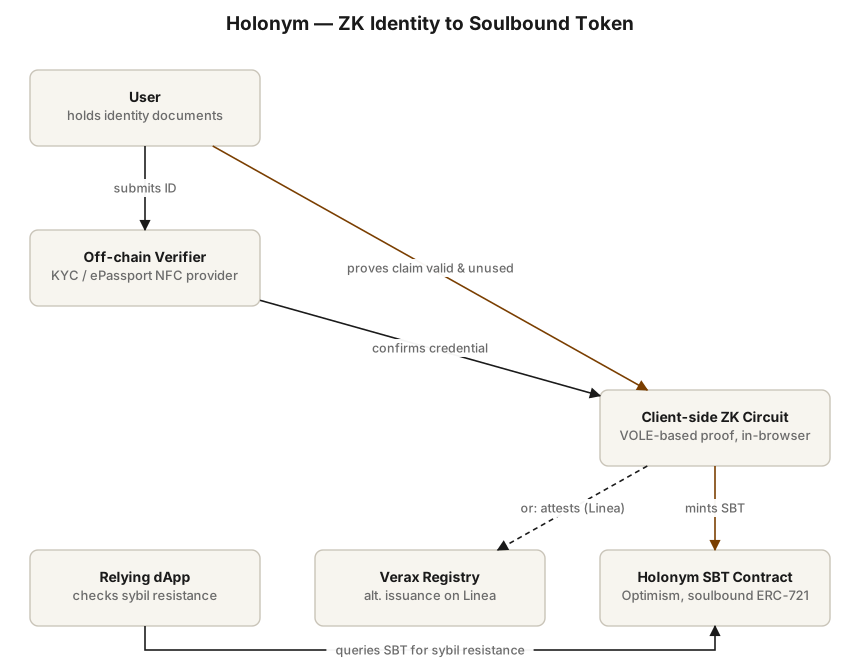 Open full-size diagram
Summary
Holonym is a zero-knowledge decentralized-identity stack built by Holonym Foundation, co-founded by Nanak Nihal Khalsa and Shady El Damaty (who met at a neuroscience hackathon). Introduced publicly in October 2022, its core protocol — Zeronym, later rebranded "Human ID" — lets a person verify a real-world credential (government ID, phone number, ePassport NFC chip, biometric liveness, or a sanctions check) off-chain, then mint a non-transferable soulbound token (SBT) on-chain that proves a fact about themselves ("I am a unique human," "I am not sanctioned") without revealing the underlying personal data. The design's key primitive is a nullifier derived from the credential: proofs can only be performed once per real-world ID, giving applications Sybil resistance without doxxing users.
The project evolved aggressively: an Aug 2024 $5.5M seed round (Finality Capital, Paper Ventures, Draper Dragon, Arrington Capital, and others) funded "Human Keys" — key material derived from biometrics or other personal entropy via a threshold OPRF network (Mishti Network / Human Network) — plus the Silk wallet. In February 2025 Holonym Foundation acquired Gitcoin Passport (~2M users), relaunching it as Human Passport, and consolidated the product line under the human.tech brand (Passport, Wallet, Shield on Aztec, Bridge, Trident government-ID solution). It remains a live, expanding identity infrastructure effort as of mid-2026.
Design (Mechanism)
- Credential-to-SBT pipeline. A user completes verification (e.g., scanning a government ID with a third-party KYC provider, or NFC-reading an ePassport). The identity data never goes on-chain; instead the user generates a zero-knowledge proof that the credential is valid and unused, submits it to a verifier, and receives a soulbound ERC-721 at their chosen address. The SBT embeds the circuit ID, issuer address, expiry, and an action nullifier.
- Nullifiers for Sybil resistance. Each real-world ID can produce only one valid proof per "action ID" (default
123456789). One passport = one unique-personhood SBT = one address, preventing both Sybil attacks and proof resale/bribery, while the ZK layer hides which passport maps to which address. - Multiple credential circuits. Separate SBT contracts exist per credential type on Optimism — e.g., the Holonym V3 hub/SBT contract (0x2AA822...94DFB) and HolonymUniqueGovID (0x7a81f2...dD7cE). Integrators query either the on-chain SBT or (recommended) Holonym's API (
api.holonym.io/sybil-resistance/gov-id/optimism). - Proof-system evolution. Holonym moved from client-side ZK-SNARKs to VOLE-based ZK proofs to make proving practical on consumer devices.
- Human Keys (Mishti/Human Network). A threshold network computes an oblivious pseudorandom function over biometric or low-entropy inputs, letting users derive strong keys from things they cannot lose (e.g., a face scan) without any node seeing the input — the basis for the Silk/Human Wallet and wallet recovery. Economic security was augmented via a partnership with Renzo (restaked ETH).
- Attestation interop. On Linea, Zeronym personhood proofs were issued as attestations on the Verax registry rather than SBTs, showing a registry-agnostic issuance layer.
Outcome
Ongoing and expanding. Holonym found real integration demand where privacy-preserving Sybil resistance mattered: the Linea Voyage campaign used Zeronym on Verax for proof of personhood, and the protocol's SBTs were live on Optimism with public contracts. The foundation raised $5.5M (Aug 2024), acquired Gitcoin Passport and its ~2M users (Feb 2025) to form what it called the largest proof-of-humanity network, and rebranded around human.tech. By 2025 it had launched Human ID on Stellar, piloted "Relay ID" with Refunite in Uganda (peer-trust identity and stablecoin aid rails for refugees via WhatsApp/Face ID), and shipped a private bridge on Aztec. No token launch or exploit of the identity contracts was found. Precise cumulative verified-user counts for Zeronym itself: Unknown / not found.
Why it worked
- Right-sized privacy claim. Instead of building a new biometric hardware network (Worldcoin) or a subjective social graph (Proof of Humanity/BrightID), Holonym piggybacked on existing high-assurance credentials (government IDs, passports, phone numbers) and only added a ZK layer — inheriting the issuing state's Sybil resistance at near-zero marginal cost.
- Nullifier design solved a real integrator pain. Airdrop and quest campaigns needed "one human, one claim" without holding PII; a queryable SBT/API with once-per-ID semantics was a drop-in answer.
- Pragmatic distribution. Supporting API queries, SBTs, and attestation registries (Verax) let it meet integrators wherever they were; acquiring Gitcoin Passport bought distribution (2M users, existing partner network) rather than fighting it.
- Continuous cryptographic upgrading (SNARKs → VOLE-based proofs, threshold OPRF keys) kept the UX viable on ordinary phones — historically the failure point of ZK identity.
Limitations and criticisms
- Trust is not fully trustless: credential validation still routes through off-chain KYC providers and Holonym's verifier/issuer infrastructure, so the "decentralized" identity has centralized issuance chokepoints.
- Proof-of-personhood demand remains campaign-driven (airdrops, quests, grants) rather than a persistent fee-generating market on its own; the pivot through Human Keys, wallets, and the human.tech super-brand suggests identity verification alone was not a sufficient standalone business, and the repeated renamings (Holonym → Zeronym → Human ID → human.tech) have cost brand legibility.
- Government-ID gating excludes the undocumented — the users humanitarian pilots like Refunite target — which is why a separate peer-trust track (Relay ID) had to be invented.
Lessons
- Reuse state-issued Sybil resistance. A ZK wrapper over passports and IDs gets global uniqueness far cheaper than bootstrapping novel biometric or social-graph personhood — the hard part (unique credential issuance) is already done by governments.
- Nullifiers are the workhorse primitive. "One credential, one proof per action" is what applications actually buy; the privacy is a means of making that acceptable to users, not the product itself.
- Identity rails monetize poorly alone; distribution is the moat. Holonym's acquisition of Gitcoin Passport shows that in personhood infrastructure, the scarce asset is integrated relying parties and verified users, not the cryptography.
- Client-side proving performance is adoption-critical. The migration to VOLE-based ZK proofs underlines that circuit UX (seconds on a phone, not minutes) decides whether normal users complete verification.
Redesign (EDITORIAL — hypothesis, not fact)
This section is a hypothesis, not a description of anything Holonym did. A redesign could attack the two centralization chokepoints. First, replace the trusted verifier/KYC intermediary with direct verification of government cryptography: ePassport NFC signatures (ICAO chains) can be checked entirely inside a client-side circuit, so the issuer set becomes "states," not "Holonym plus KYC vendors" — Holonym's free ePassport flow gestures at this and it should be the default path, with document-scan KYC as legacy fallback. Second, decentralize issuance economics: let any staked operator run the verifier, slashing on provably invalid SBT issuance, so relying parties need not trust the foundation. Third, make personhood a recurring revenue primitive rather than a campaign checkbox: expiring SBTs (annual re-proof against the same nullifier lineage) would create renewal fees and handle lost/stolen documents, while an on-chain fee split to circuit authors and operators would fund maintenance. Finally, for populations without documents, formalize the peer-vouching track as a separate, explicitly lower-assurance credential class with its own nullifier namespace, so integrators can price the assurance difference instead of the system overclaiming a single "human" bit.
Sources
- Human ID developer docs — Integrating Human ID (formerly Holonym docs) — primary (docs)
- human.tech official site (products, docs, GitHub links) — primary (docs)
- Holonym Foundation GitHub organization — primary (contract)
- Holonym V3 (H3) token contract, OP Mainnet Etherscan — primary (contract)
- Introducing Holonym thread (project X account, Oct 2022) — primary (archive)
- Redefining KYC: Holonym's Edge with ZK Verification — Shady El Damaty (Holonym Medium) — primary (retrospective)
- Holonym Foundation Emerges with $5.5M Seed Funding (Aug 2024) (news)
- Holonym Foundation Acquires Gitcoin Passport (Feb 2025) (news)
- Holonym acquires Gitcoin Passport in proof-of-personhood expansion — Biometric Update (news)
- Proof of Personhood with Zeronym on Verax for The Linea Voyage — Holonym blog — primary (docs)
- Interview with co-founder Nanak Nihal Khalsa — Pulse2 (analysis)
Related experiments
Last verified: 2026-07-26 · Spot an error? Suggest a correction