Polygon ID
Polygon's zero-knowledge self-sovereign identity stack (built on iden3/Circom) that let users prove claims about themselves on-chain without revealing the underlying data, later spun out as Privado ID.
▶ Run interactive simulation animated mechanism with editable parameters
How it works onchain
 Open full-size diagram
Summary
Polygon ID was Polygon's flagship attempt to make self-sovereign, privacy-preserving identity a native primitive of Web3. Announced on March 29, 2022 as part of Polygon's $1B zero-knowledge strategy, it packaged the iden3 protocol (built by Jordi Baylina, David Schwartz, and Antoni Martin, who began the work in 2017–2018 in Barcelona/Paris) and the Circom zkSNARK toolkit into a product suite: a mobile wallet for holders, an Issuer Node for anyone wanting to attest claims, and verifier SDKs plus on-chain verifier contracts for dApps. After roughly a year of closed development, the full stack was open-sourced and made self-service on March 1, 2023. Users could receive credentials (KYC status, DAO membership, age, country, reputation) and then prove statements about them — "I am over 18," "I passed KYC with issuer X," "I am not on a sanctions list" — via zero-knowledge proofs, either off-chain or verified directly by a smart contract, without disclosing the underlying documents. In June 2024 the team spun out of Polygon Labs as the independent, chain-agnostic Privado ID, later merging with Disco.xyz and launching the "Billions" human-and-AI verification network in 2025 with $30M in funding.
Design (Mechanism)
Polygon ID implemented the classic issuer–holder–verifier triangle with ZK machinery underneath:
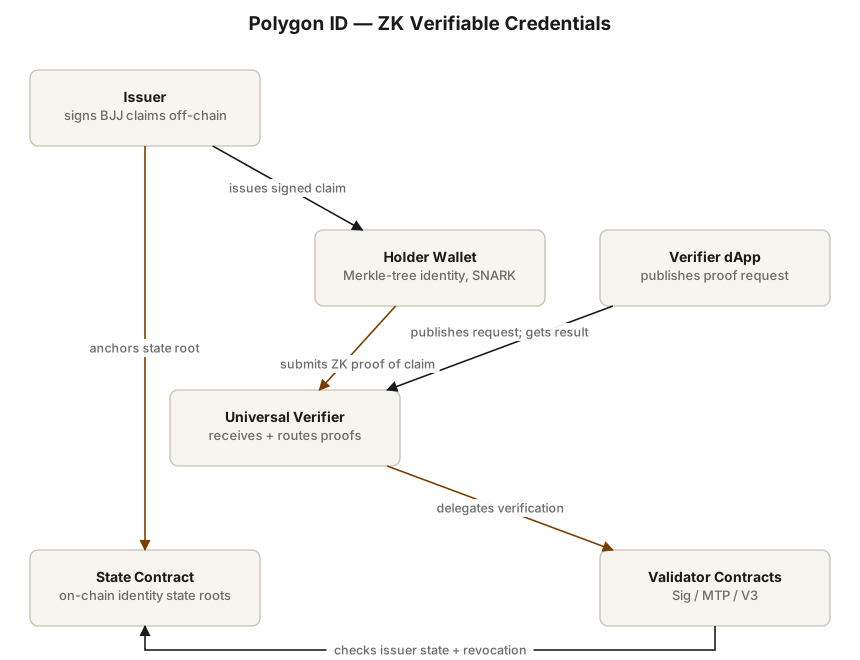
- Identities as Merkle trees. Each identity (user or issuer) is a set of claims stored in sparse Merkle trees; the identity's "state" is a hash committed on-chain in the State contract (0x624ce98D…D79D on Polygon PoS). Only commitments touch the chain — credentials themselves stay on the holder's device.
- Claims and credentials. Issuers sign claims (BJJ signature credentials) or anchor them in their on-chain state (MTP credentials). Claims follow structured schemas, making them composable into compound proofs.
- ZK proof requests. Verifiers publish a proof request in a query language ("prove birthdate < 2005-01-01 from an issuer in this trusted set"). The holder's wallet generates a Circom-compiled zkSNARK locally proving the claim satisfies the predicate, that the issuer's state is valid on-chain, and that the credential is not revoked — all without revealing the credential.
- On-chain verification. Validator contracts (Sig, MTP, and the later Validator V3) plus a Universal Verifier contract let smart contracts gate actions on proofs — airdrops, Sybil-resistant voting, permissioned DeFi — making it one of the first production systems for on-chain private credential checks.
- Revocation and timestamps. Revocation trees and the on-chain state history give verifiers freshness and revocation guarantees without contacting the issuer (a genuine improvement over most W3C verifiable-credential deployments).
The design deliberately positioned itself against both NFT/SBT "identity" (public, unrevocable, no predicates) and vanilla verifiable credentials (hard to verify cheaply on-chain).
Outcome
Technically, Polygon ID shipped what it promised: an audited, open-source, end-to-end ZK identity stack with real on-chain verification, used in proofs-of-concept with institutions including Deutsche Bank and Consensys and integrated by ecosystem projects (Guild, Fractal, Dock, Altme, Kaleido, and others). Commercially and adoption-wise, results were more modest: no killer consumer application emerged, no token existed to bootstrap usage, and identity issuance remained dependent on issuers choosing to participate. In June 2024 Polygon Labs spun the project out as Privado ID under CEO David Schwartz and COO Antoni Martin (with Baylina as technical advisor and Sandeep Nailwal as growth advisor), explicitly to escape single-chain branding and pursue banks, enterprises, and other chains (Optimism, Arbitrum, Base via the Disco merger; Linea). In 2025 the team pivoted its consumer thrust into Billions Network, a non-biometric proof-of-personhood network (passport + phone verification) positioned against Worldcoin, raising $30M. The Polygon-branded experiment therefore ended, but its protocol, contracts, and team continue — hence partial_success: a technical and standards success whose adoption under the original model underperformed.
Why it worked
- Serious cryptography, productized. iden3 + Circom were battle-tested primitives (Circom became an industry standard), and Polygon ID was among the first to make on-chain ZK credential verification actually deployable by ordinary dApp teams.
- Full-stack open source. The 2023 self-service release (Wallet App, Wallet SDK, Issuer Node, Verifier SDK) removed gatekeeping — anyone could become an issuer or verifier.
- Polygon distribution. Polygon's brand, ecosystem, and $1B ZK budget gave the project credibility with enterprises and a large developer funnel that a standalone identity startup would have lacked.
- Right abstractions. Predicate proofs over schema'd claims, plus native revocation, solved real gaps in both SBTs and W3C VCs.
Where the design broke
- Cold-start on both sides. Credentials are only valuable if issuers issue and verifiers require them; neither side had strong incentives to move first, and no token or fee mechanism subsidized bootstrapping.
- No native demand for privacy. Most crypto apps in 2022–2024 either wanted no identity at all or full KYC handled off-chain; the middle ground Polygon ID served (private on-chain eligibility) was a small market.
- Single-chain branding hurt. Enterprises and other L2s hesitated to build on something named "Polygon" — the team cited this explicitly as a reason for the Privado ID spin-out.
- UX friction. Mobile proof generation, wallet installation, and credential management added steps that consumer apps would not impose, while enterprise sales cycles were long.
Lessons
- Identity is a two-sided market; cryptography doesn't solve cold starts. A technically superior credential system still needs subsidies, mandates, or a killer verifier use case to bootstrap issuance.
- Chain-branded infrastructure caps its own TAM. Neutral, chain-agnostic positioning matters for anything meant to be a standard — the spin-out to Privado ID was an admission of this.
- Ship the whole triangle open-source. Polygon ID's self-service issuer/verifier tooling is why the protocol outlived its product; closed identity stacks die with their vendor.
- On-chain anchoring plus off-chain data is the workable privacy pattern. Committing only state roots and revocation trees on-chain gave verifiability without a data-protection nightmare — a pattern now widely copied.
- Regulatory tailwinds (eIDAS 2.0, ZK-friendly KYC) arrive slower than crypto timelines. The team pivoted twice (Privado ID, then Billions) while waiting for the identity market to mature.
Redesign (EDITORIAL — hypothesis, not fact)
This section is editorial analysis and speculation, not a factual account. A redesigned Polygon ID would attack the cold-start directly: pick one verifier-side wedge with existing legal demand — e.g., proof-of-personhood for airdrops or age-gating for regulated consumer apps — and subsidize issuance for it, rather than launching as a general-purpose triangle. Second, make verification revenue-generating from day one: a small on-chain fee per proof verification, split between issuer and protocol, would give issuers a reason to issue (the missing incentive in the original design), possibly coordinated by a token with slashing for faithless issuers. Third, put the wallet inside existing wallets (MetaMask Snaps, WalletConnect-level integration) instead of a standalone app, eliminating the largest UX cliff. Finally, launch chain-neutral and standards-first (W3C VC/DID compatible, as Privado ID eventually did) with an issuer trust registry governed by a neutral consortium — the credibly-neutral positioning that a Polygon-branded product could never achieve. The 2024–2025 pivots suggest the team reached similar conclusions, but two years and a brand change later than the market required.
Sources
- Introducing Polygon ID, Zero-Knowledge Identity for Web3 (official announcement, Mar 29, 2022) — primary (docs)
- Polygon ID Open Source Release (public launch, Mar 2023) — primary (docs)
- Privado ID Documentation — Smart Contracts (deployed addresses) — primary (docs)
- iden3 smart contracts (verified code) — primary (contract)
- 0xPolygonID contracts (on-chain ZK verification) — primary (contract)
- Introducing Privado ID: Moving Beyond Polygon (spin-out announcement) — primary (retrospective)
- Privado ID becomes the latest project to spin out from Polygon Labs — The Block (news)
- Privado ID spinoff takes identity control solution beyond Polygon — Cointelegraph (news)
- Privado ID introduces Billions: The First Global Human & AI Network — primary (retrospective)
- Privado ID and Disco.xyz Announce Merger — primary (retrospective)
Related experiments
Last verified: 2026-07-26 · Spot an error? Suggest a correction