Sismo
Zero-knowledge attestation protocol that let users aggregate identities in a private Data Vault and prove facts about them via non-transferable ZK Badges and the Sismo Connect 'sovereign SSO' — technically admired, but wound down in late 2023 and returned capital to investors.
▶ Run interactive simulation animated mechanism with editable parameters
How it works onchain
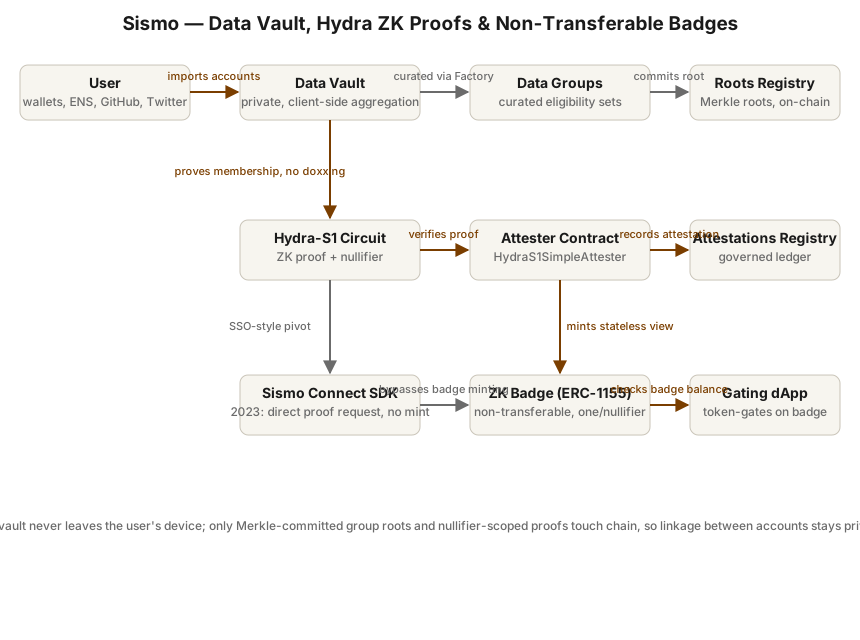 Open full-size diagram
Summary
Sismo was a Paris-based zero-knowledge identity project founded in 2021 by Hadrien Charlanes (previously an Ethereum engineer at Aave; some aggregator databases also list Jimmy Ragosa as a co-founder, which we could not confirm from primary sources). Its core idea: let users aggregate many accounts — Ethereum wallets, ENS names, GitHub, Twitter, Telegram — into a private, local "Data Vault," then prove facts about that aggregate ("I hold a Gitcoin Grants donor account," "I voted in this DAO," "I'm in this data group") without revealing which underlying accounts they own. Proofs were consumed in two forms: non-transferable on-chain ZK Badges (an ERC-1155 "stateless view" of attestations, deployed mainly on Polygon and Gnosis Chain), and later Sismo Connect (soft-launched as "zkConnect" in March 2023), a developer SDK positioned as a "sovereign SSO" — a privacy-preserving alternative to "Sign in with Google/wallet."
Sismo raised roughly $10M in 2022 (investors reported to include Framework, Delphi and crypto-native angels). It shipped working, open-source cryptography (the Hydra proving schemes), attracted strong hackathon adoption (100+ Sismo Connect apps reported), and was widely respected technically. It nonetheless shut down: in November 2023, The Big Whale reported the company was winding down and returning roughly half of investors' capital, citing key-person burnout and difficulty hiring specialized ZK engineers rather than a treasury crisis. The team indicated the code would remain open source. Sismo's design directly influenced the later wave of ZK attestation/credential systems.
Design (Mechanism)
- Data Vault (client-side aggregation). Users imported accounts into an encrypted vault living in their browser/device. The vault, not a server, held the linkage between a user's identities — Sismo never learned which accounts belonged together.
- Data Groups (off-chain sets, on-chain commitments). Eligibility sets (e.g., "addresses that used Aave before X date," "stateful GitHub contributors") were curated via the Sismo Factory and committed as Merkle roots to an on-chain AvailableRootsRegistry. This kept gas costs low while anchoring integrity on-chain.
- Hydra proving schemes. The Hydra-S1 circuits let a user prove, in zero knowledge, that some account in their vault belongs to a data group, using a commitment-mapper plus a nullifier so each eligible account could only mint once per badge — Sybil resistance without doxxing.
- Attestation stack on-chain. An AttestationsRegistry (governed ledger) recorded attestations issued by Attester contracts (HydraS1SimpleAttester, and an "account-bound" variant letting users move a badge between wallets while keeping one-per-nullifier). Badges exposed attestations as non-transferable ERC-1155 tokens any dApp could token-gate against.
- Sismo Connect (2023 pivot). Rather than minting badges, apps embedded a front-end SDK that requested proofs directly ("prove you're in group X, share nothing else"), verified on-chain or off-chain — collapsing the UX from "mint a badge, then use it" to a single OAuth-like flow.
Outcome
Technically successful, commercially unsuccessful; the company was wound down in late 2023 (~2 years after founding, ~8 months after Sismo Connect's launch). Reported details: ~$10M raised in 2022; roughly 51% of investor capital returned; shutdown attributed to the burnout and departure of a key technical lead who was never replaced, and to the scarcity of hireable ZK specialists, rather than to running out of money. Adoption was real but shallow — badges saw meaningful minting on Polygon/Gnosis and 100+ Sismo Connect integrations were reported, mostly from hackathons and early adopters rather than sustained production apps with paying demand. The contracts and circuits remain deployed and open source (MIT), and the docs site has since gone offline. No token was ever launched, and no exploit or user-fund loss is associated with the project.
Why it worked
- Genuinely novel mechanism design. Client-side vault + Merkle-committed data groups + nullifier-scoped ZK proofs solved private-but-Sybil-resistant credentialing elegantly, years before "ZK attestations" became a standard category.
- Credible team and backing. An ex-Aave engineer founder, crypto-native angels (reported to include people from Aave, StarkWare, the Ethereum Foundation orbit), and open-source-first development earned deep respect from the Ethereum research community.
- Right UX instinct in the pivot. Moving from collectible-like badges to an SSO-style SDK (Sismo Connect) correctly identified that developers, not end users, were the adoption bottleneck.
- Honorable failure mode. Winding down with funds remaining and returning ~half of invested capital preserved reputations and left reusable public goods.
Where the design broke
- No urgent demand. Privacy-preserving reputation was a solution ahead of its market: most dApps in 2022–2023 didn't need selective disclosure, and those that needed Sybil resistance (airdrops, Gitcoin) had cheaper, cruder options.
- Two-sided cold start. Badges were only worth minting if apps gated on them; apps only gated on badges users held. Hackathon integrations didn't convert into production usage.
- Key-person and talent fragility. Per The Big Whale's reporting, the roadmap depended on a single critical ZK engineering role with no redundancy, in a labor market where specialized ZK talent was scarce; when that role went unfilled, delivery stalled — a bus-factor risk built into the org structure, separate from the cryptography itself, which continued to function as designed.
- No revenue or token flywheel. Sismo monetized almost nothing and resisted launching a token, but that left no economic engine to justify continued burn once growth plateaued.
Lessons
- Infrastructure without a bleeding-neck use case dies of indifference, not of bugs. Sismo's cryptography worked; the market for private credentials simply hadn't arrived on its funding clock.
- Bus factor is a protocol risk. In frontier-cryptography teams, one irreplaceable circuits engineer can be the single point of failure; redundancy in rare expertise is as important as treasury runway.
- Hackathon adoption is a vanity metric. 100+ integrations built in weekend sprints predicted developer curiosity, not production demand or willingness to pay.
- Shutting down well is a mechanism too. Returning ~51% of capital and open-sourcing everything converted a commercial failure into lasting reputational and public-goods value.
- Nullifier-per-group is a durable primitive. Sismo's account-bound, one-proof-per-nullifier pattern reappears across later Sybil-resistance and airdrop-gating systems; the design outlived the company.
Redesign (EDITORIAL — hypothesis, not fact)
This section is editorial hypothesis, not established fact. A redesigned Sismo would launch as a protocol-first public good with a much smaller company attached: circuits and registries shipped as neutral infrastructure (as they were), but with a single wedge use case owned end-to-end — e.g., privacy-preserving airdrop claiming or proof-of-humanity-weighted governance for two or three flagship DAO partners paying for integration, creating revenue and a demand anchor before generalizing to "SSO for everything." Talent fragility could be hedged by co-developing circuits with an external ZK team (e.g., an audit/research firm on retainer with contractual maintenance duties), turning the bus factor into a contracted service. Finally, timing: the same product launched two years later — into the 2024–2026 environment of ERC-4337 wallets, restaked identity layers, and regulatory pressure for selective disclosure — would plausibly have found the demand that 2022's badge-collecting culture could not supply. The hypothesis is that this design lacked a staged, revenue-generating wedge and a redundancy plan for scarce ZK expertise — not that the underlying cryptography was flawed; a narrower wedge plus externally hedged ZK capacity might have carried it to the market that later materialized.
Sources
- sismo-core/sismo-badges — Contracts of the Sismo Badge Minting Protocol (README) — primary (contract)
- Sismo: Attestations Registry on PolygonScan — primary (contract)
- Sismo tweet: soft launch of zkConnect (sovereign SSO), March 2023 — primary (news)
- Sismo blog (Mirror) — primary (docs)
- Sismo Docs — Deployed Contract Addresses (site now offline) — primary (archive)
- The Big Whale — EXCLUSIVE: Sismo in difficulty, could soon be shut down (Nov 16, 2023) (news)
- Tracxn — Sismo company profile (analysis)
- Dune — Sismo ZK Badges dashboard (analysis)
Related experiments
Last verified: 2026-07-26 · Spot an error? Suggest a correction