Tokemak
A DeFi protocol that turned liquidity itself into a directable, tokenized asset — pooling single-sided deposits and letting TOKE holders vote on where protocol-controlled liquidity is deployed across DEXs.
▶ Run interactive simulation animated mechanism with editable parameters
How it works onchain
 Open full-size diagram
Summary
Tokemak was one of the defining "DeFi 2.0" experiments of the 2021 cycle: an attempt to solve DeFi's mercenary-liquidity problem by turning liquidity provision into a coordinated, protocol-owned utility rather than a game of renting capital with unsustainable yield farming. Founded by Carson Cook — a physics PhD and ex-McKinsey fintech operator who had previously built the market-maker Fractal — Tokemak reframed the question from "how do we attract LPs?" to "how do we own and direct liquidity as a service." Its native token, TOKE, was pitched as "tokenized liquidity": stakers did not just earn yield, they earned the right to direct where the protocol's capital would be deployed as trading liquidity across decentralized exchanges. The protocol reached roughly $1B+ in total value locked within about two months of its "reactor" launch in late 2021, becoming a marquee name in the era's "liquidity wars." It has since heavily contracted, been rebuilt as a v2 ("Autopilot"), and by 2025 was rebranding toward Auto Finance.
Design (Mechanism)
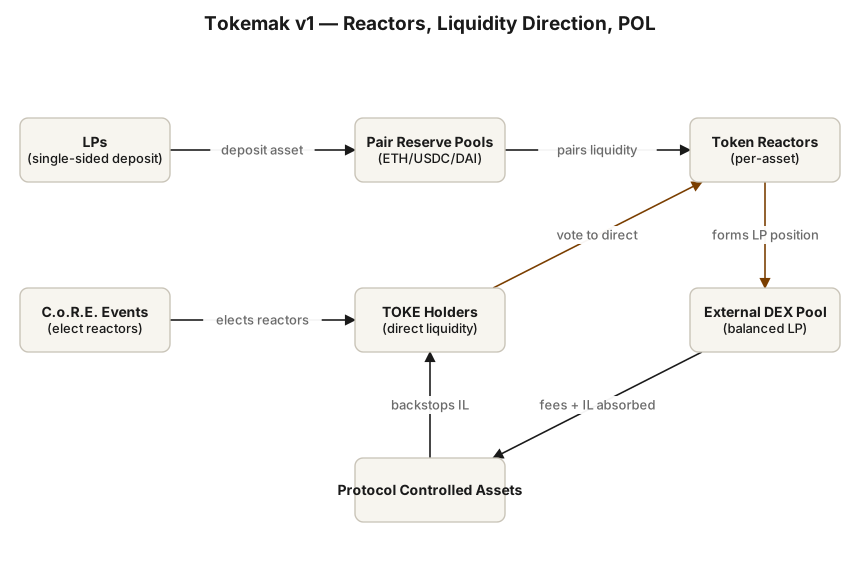
Tokemak's v1 architecture had three interlocking parts:
- Genesis Pools / Pair Reserves: Single-sided, globalized reserves where LPs deposited one asset (ETH, USDC, DAI, sUSD) and earned TOKE emissions. These reserves supplied the "pair" side (the stable/ETH leg) of trading positions.
- Token Reactors: Per-asset pools (e.g., a SUSHI reactor, an FXS reactor). A project's community deposited its token single-sided into that token's reactor, and Tokemak combined it with reserve assets to form a balanced LP position on an external DEX. Because deposits were single-sided, the protocol — not the individual LP — absorbed impermanent loss, backstopped by Protocol Controlled Assets (PCA) accumulated from trading fees and TOKE reserves (the "black hole" effect).
- Liquidity Directors (LDs): TOKE holders staked into reactors to vote on which venue and how much liquidity each token received. This made TOKE a meta-governance / liquidity-routing asset directly comparable to veCRV and vote-escrow Convex (vlCVX): projects wanted TOKE (or bribes to TOKE holders) to point deep liquidity at their own token.
Bootstrapping happened through C.o.R.E. events (Collateralization of Reactors Events) — governance "elections" in which TOKE holders voted from a slate of dozens of applicant projects to decide which five reactors would launch first. C.o.R.E.1 ran late September 2021; C.o.R.E.2 followed in November 2021 with a much larger candidate field.
The v2 redesign (Autopilot / LMPs) abandoned much of the per-token-reactor voting model. Instead it introduced Autopools (Liquidity Management Pools) that algorithmically and continuously rebalance a base asset (e.g., ETH, then stablecoins) across many pools and DEXs to optimize risk-adjusted yield, auto-compounding returns. Autopilot went to guarded launch in early 2024, with a broader launch around September 16, 2024; autoUSD (stablecoins) followed in May 2025 and baseUSD on Base in September 2025. accTOKE emerged as the staking/value-accrual sink for TOKE in v2.
Outcome
Status: partial_success. Tokemak succeeded as a technical and conceptual experiment — it shipped a genuinely novel liquidity-direction primitive, hit ~$1B+ TVL rapidly, and became a canonical reference point for DeFi 2.0 and the liquidity wars alongside OlympusDAO and Convex. But the v1 model did not achieve durable product-market fit: TVL and TOKE's price contracted severely through the 2022 bear market, and the team ultimately paused and re-architected the entire protocol into v2/Autopilot. The pivot to a rebalancing yield-optimizer (and by 2025 the Auto Finance rebrand) is effectively an admission that the original reactor/liquidity-directing thesis, at its ambitious scale, did not sustain. TOKE remains live and the protocol is ongoing under new form, so it is neither a clean success nor an outright failure or exploit.
Why it worked
- Real problem, sharp framing. "Mercenary liquidity" was a genuine, widely-felt pain point; Tokemak's "liquidity as a service" and "tokenized liquidity" framing gave founders and communities a clear mental model and made TOKE strategically desirable.
- Meta-governance flywheel. Because TOKE directed real capital, it slotted directly into the bribe/vote economy of the Curve/Convex wars, attracting protocols competing for reactors and creating reflexive demand for the token.
- Novel IL handling. Single-sided deposits with protocol-absorbed impermanent loss were a legitimately attractive UX for both LPs and projects, differentiating it from vanilla AMM LPing.
Where the design broke
- PCA vs. impermanent loss economics. Having the protocol absorb IL is only sustainable if fees/spreads plus PCA growth outrun losses. In a bear market with falling reactor-token prices, the value backstop eroded and the "black hole" accretion thesis weakened.
- Emissions-dependent demand. Much of TOKE's utility depended on high emissions and speculative demand to be a liquidity director; when emissions and token price fell, the incentive to lock capital collapsed.
- Complexity and cold-start. The reactor model required simultaneous participation from LPs, reserve depositors, token communities, and voters — a hard multi-sided cold-start that thinned out once the cycle turned.
- The whole DeFi 2.0 category deflated. Tokemak underperformed partly because its entire cohort (Olympus-style reflexive tokenomics, protocol-owned liquidity) lost narrative and capital in 2022.
Lessons
- Directing capital is not the same as retaining it. Vote-directed liquidity creates strong demand for the governance token during incentive peaks, but that demand is reflexive and evaporates when emissions and prices fall. Utility that only exists at high token prices is fragile.
- If a protocol underwrites impermanent loss, it is running an insurance/market-making book. That book must be priced and reserved conservatively; a bull-market accretion assumption is not a risk model.
- Multi-sided cold-start mechanisms are bull-market-fragile. Designs requiring several coordinated participant classes can look explosive on the way up and unravel quickly on the way down.
- A willingness to fully re-architect (v1 reactors -> v2 Autopilot -> Auto Finance) can preserve a team and token even when the original thesis fails — pivoting toward a simpler, algorithmic yield-optimizer is a survival lesson, not just a failure.
Redesign (EDITORIAL — hypothesis, not fact)
The following is speculative analysis by the researcher, not established fact.
The core flaw in v1 Tokemak was that it socialized impermanent-loss risk onto a protocol balance sheet whose backing (PCA + TOKE reserves) was itself procyclical — it inflated in bull markets and deflated exactly when IL claims spiked. A redesign should decouple token demand from token price reflexivity and price IL as an actual liability.
A stronger v1 might have: (1) explicitly reserved against IL using a segregated, largely non-TOKE-denominated backstop (stablecoins/ETH), with reactor onboarding gated by measured historical volatility and correlation, so high-vol tokens paid higher "insurance premiums" via lower emissions or fee splits; (2) made liquidity direction a paid service with real revenue — projects pay recurring fees (or verifiable bribes routed on-chain) that flow to LDs and the reserve, so TOKE demand tracks cashflow to liquidity directors rather than emission speculation; and (3) implemented dynamic, risk-aware caps on how much single-sided exposure any reactor could take relative to reserve depth, preventing the protocol from underwriting more IL than it could cover.
Interestingly, v2's Autopilot already moves in a related direction — replacing hand-directed, IL-heavy per-token reactors with algorithmic, risk-adjusted rebalancing of base assets. The editorial hypothesis is that Tokemak's most valuable insight (liquidity as directable infrastructure) was correct, but should have launched as a conservatively-underwritten, fee-generating utility rather than an emissions-fueled reflexive token — arguably the exact lesson the v2/Auto Finance pivot encodes in hindsight.
Sources
- Introducing: Tokemak — The Utility for Sustainable Liquidity (official) — primary (docs)
- Tokemak v2: Introducing LMPs, Autopilot, and the DAO Liquidity Marketplace (official) — primary (docs)
- Autopilot — Guarded Launch Announcement (official blog) — primary (docs)
- C.o.R.E. — Collateralization of Reactors Event (official) — primary (governance)
- TOKE token contract on Etherscan — primary (contract)
- Official handle migration announcement (@TokenReactor -> @TokemakXYZ) — primary (governance)
- DeFi Project Spotlight: Tokemak, the Liquidity Black Hole (Crypto Briefing) (analysis)
- Tokemak Decentralized AMM Hits $1B TVL (The Defiant) (news)
- DeFi 2.0 Explained (Finematics) (analysis)
Related experiments
Last verified: 2026-07-26 · Spot an error? Suggest a correction