OlympusDAO
A decentralized reserve-currency protocol whose OHM token is backed by a protocol-owned treasury, using bonding and high-APY staking rebases (the '(3,3)' game) to bootstrap protocol-owned liquidity.
▶ Run interactive simulation animated mechanism with editable parameters
How it works onchain
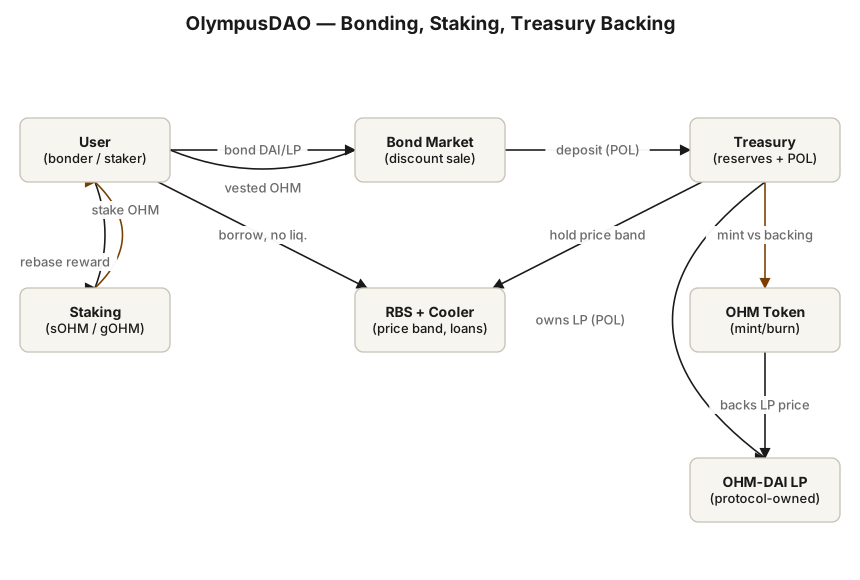 Open full-size diagram
Summary
OlympusDAO launched in March 2021 on Ethereum as a "decentralized reserve currency" protocol. Its token, OHM, is not pegged to a dollar; instead each OHM is backed by a basket of real assets held in a protocol-owned treasury, and OHM is intended to float freely above its intrinsic backing. Olympus popularized the "DeFi 2.0" concept of protocol-owned liquidity (POL): rather than renting liquidity by paying mercenary yield farmers, the protocol buys and owns its own liquidity-pool positions through a bonding mechanism. Combined with extraordinarily high staking rebase yields (APYs advertised well above 1,000% and at times ~10,000%+) and the viral "(3,3)" game-theory meme, Olympus grew a treasury into the hundreds of millions of dollars and spawned dozens of forks (Wonderland/TIME, KlimaDAO, and many others). It became the canonical example of both the promise and the fragility of reflexive, high-emission tokenomics. The founding team is pseudonymous, led by "Zeus," with a co-founder known as "Apollo."
Design (Mechanism)
Olympus combined three interlocking primitives:
- Bonding. Users sell assets (stablecoins like DAI/LUSD, or LP tokens such as OHM-DAI) to the treasury in exchange for OHM at a discount, vested linearly over roughly 5–10 days. By accepting LP tokens as bond payment, the protocol accumulated its own liquidity — protocol-owned liquidity — so it (not mercenary LPs) earns trading fees and controls the depth of the OHM market. Bonding also grew the treasury and thus the backing per OHM.
- Staking and rebasing. Stakers deposit OHM and receive sOHM (later gOHM, a non-rebasing wrapped version). New OHM minted from bond sales and treasury inflows is distributed to stakers via automatic rebases each epoch, so a staker's balance grows over time. This produced the headline APYs and was designed to remove OHM from circulation and reduce sell pressure.
- Treasury backing and the "risk-free value" floor. The protocol nominally guaranteed at least 1 DAI of backing per OHM: if OHM ever traded below backing, the protocol could buy and burn OHM (buyback), and if above, it could mint and sell via bonds. In practice OHM traded at a large premium to backing for much of 2021.
The social layer was the (3,3) meme, a payoff-matrix framing (borrowed from a prisoner's-dilemma-style table) arguing that if everyone stakes ("cooperates"), everyone wins — while bonding and selling are individually rational but collectively worse. This coordinated holders toward staking.
Later, post-collapse, Olympus pivoted toward sustainability with two notable mechanisms documented in the official docs and olympus-v3 code: Range Bound Stability (RBS), which used treasury operations to keep OHM within a managed price band, and Cooler Loans, letting holders borrow against the liquid reserves backing OHM at a fixed ~0.5% interest rate, perpetual term, and no price-based liquidations.
Outcome
Status: partial_success. Measured against its own launch narrative — becoming a stable, widely used reserve currency / unit of account — Olympus did not succeed; OHM never became money, and its price collapsed. OHM peaked around $1,300–$1,415 in 2021 and then fell more than 90% during the early-2022 unwind, with a well-publicized ~$11M whale dump triggering cascading liquidations and slippage, and roughly $150M of OHM liquidated over a month as collateral triggers tripped across Olympus and its leveraged forks. Yet Olympus was not an outright failure or exploit: the treasury and the protocol survived, the DAO continued to operate and ship (RBS, Cooler Loans), OHM retained substantial hard backing (documentation later cited roughly $11+ of liquid backing per OHM against a ~$195M treasury), and the protocol-owned-liquidity concept it pioneered was widely adopted across DeFi.
Why it worked
- POL solved a real problem. Owning liquidity instead of renting it is a genuinely durable idea; it removed the "mercenary capital" liquidity-flight failure mode and became a lasting DeFi primitive (later echoed by protocol-owned-liquidity designs and "bonds-as-a-service" like Bond Protocol).
- Reflexive incentives bootstrapped a treasury fast. High APY + bonding discounts + the (3,3) meme created a self-reinforcing inflow: rising price justified staking, staking reduced float, reduced float amplified price moves, and bond sales fed the treasury.
- Strong memetics and community. The god-themed branding and "gm (3,3)" culture gave Olympus outsized mindshare on crypto Twitter, driving both adoption and a large fork ecosystem.
Where the design broke
- The APY was inflationary, not value-creating. Rewards were newly minted OHM, not organic revenue. When inflows slowed, dilution outpaced backing growth and the premium-to-backing collapsed.
- Reflexivity is symmetric. The same loop that pumped the price ran in reverse: falling price → unstaking/selling → liquidations of leveraged (folded) positions → more selling. Forks that added leverage (and copycats) amplified the cascade.
- Premium was unjustified. OHM's market cap far exceeded treasury backing; there was no fundamental reason it should sustain such a multiple, so mean-reversion to backing was inevitable once momentum broke.
- Governance/pseudonymity and trust. Anonymous leadership limited public accountability, and the team's ability to unilaterally control treasury and emissions parameters left holders dependent on trust rather than enforceable guarantees.
Lessons
- Emission-funded yield ("APY") is a marketing metric, not a return; sustainable protocols must eventually tie rewards to real revenue or to accumulated backing, not to inflation.
- Reflexive, game-theory-coordinated token designs are powerful on the way up and equally violent on the way down — designers must model the downside coordination game, not just the cooperative equilibrium.
- Protocol-owned liquidity is the durable, exportable innovation here; separate the genuinely useful mechanism (owning your liquidity, treasury backing, buyback floors) from the speculative wrapper (hyper-inflationary staking).
- A hard, transparent asset floor (backing per token, buybacks, no-liquidation loans like Cooler) can turn a collapsing reflexive asset into a slower, survivable one — Olympus's post-2022 pivot is evidence of this.
Redesign (EDITORIAL — hypothesis, not fact)
The following is the researcher's analysis, not established fact. If rebuilding Olympus today, I would keep the treasury + protocol-owned-liquidity core and discard the hyper-APY rebase loop that made price purely reflexive. Concretely: (1) fund staking rewards from real treasury yield (POL trading fees, RBS-style market operations, lending revenue) and cap emissions so backing-per-token is non-decreasing by construction. (2) Make the backing floor a first-class, on-chain-enforced redemption right (as Cooler Loans and buyback ranges partially do) so the token's downside is credibly bounded and the "premium" is an explicit, bounded speculation layer on top of hard backing rather than the whole asset. (3) Replace the "(3,3) forever" meme with transparent, real-time dashboards of backing, runway, and dilution, so holders price the token against fundamentals instead of momentum. (4) Discourage leveraged folding of the token (which turned forks into liquidation bombs) by limiting recursive collateralization and offering the fixed-rate, no-liquidation Cooler design as the sanctioned borrowing path. The goal: preserve the genuine innovation (own your liquidity, back your token) while removing the reflexive Ponzi-adjacent dynamics that caused the -90% unwind.
Sources
- Olympus Protocol Documentation — primary (docs)
- Olympus official website — primary (docs)
- OHM Bond Paper (olympus-docs, GitHub) — primary (docs)
- OlympusDAO GitHub org (olympus-v3, olympus-frontend) — primary (contract)
- OHM V2 token contract (Etherscan) — primary (contract)
- OHM V1 token contract (Etherscan) — primary (contract)
- Olympus DAO Might Be the Future of Money (or It Might Be a Ponzi) (CoinDesk) (analysis)
- OlympusDAO Created a Breakthrough DeFi Model — Now It's Down 93% and Called a 'Ponzi' (The Defiant) (analysis)
- DAO leader causes cascade across 'rebase' tokens after $11M dump (Protos) (news)
- The Secret Weapon of DeFi 2.0 | Zeus from Olympus DAO (Bankless podcast) (retrospective)
Related experiments
Last verified: 2026-07-26 · Spot an error? Suggest a correction