DODO (PMM)
DEX that replaced the constant-product curve with a Proactive Market Maker (PMM) algorithm anchoring concentrated liquidity to an external oracle price.
▶ Run interactive simulation animated mechanism with editable parameters
How it works onchain
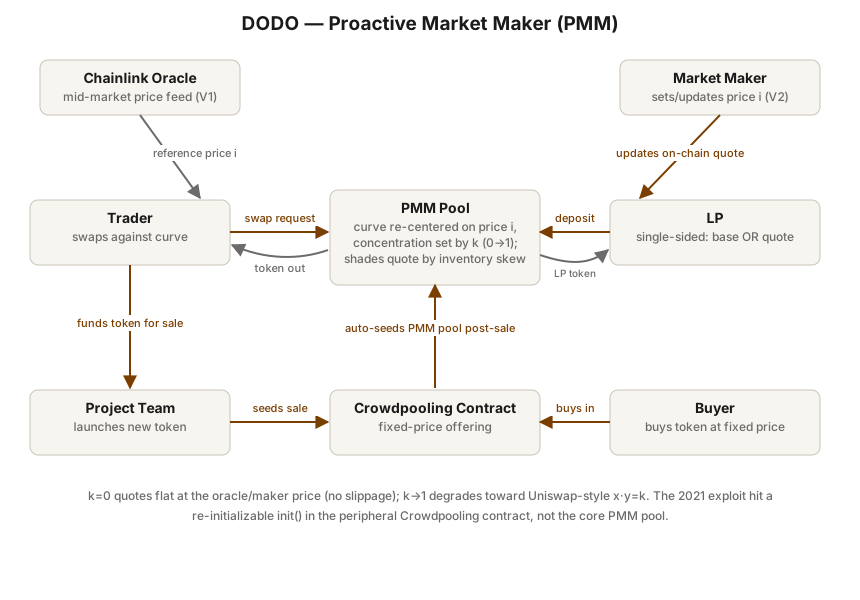 Open full-size diagram
Summary
DODO is a decentralized exchange launched on Ethereum in August 2020 by Mingda Lei ("Radar Bear"), Diane Dai, and Qi Wang. Its core experiment was the Proactive Market Maker (PMM) algorithm, conceived in April 2020 as an answer to the two biggest weaknesses of the constant-product AMM (x·y=k): capital spread thinly across all prices, and passive pricing that guarantees impermanent loss when the market moves. Instead of letting the curve alone discover price, PMM anchors liquidity around an externally supplied reference price (an oracle in V1, or a maker-set price in V2), concentrating most capital near the mid-market price the way a professional order-book market maker would. The project raised a $5M private round in September 2020 led by Pantera Capital, Binance Labs, and Three Arrows Capital, with Coinbase Ventures, Galaxy Digital, and others participating. DODO grew into a multi-chain DEX and launchpad ("Crowdpooling"), survived a $3.8M exploit of its Crowdpooling contracts in March 2021 (most funds recovered), and remains operational — though with a far smaller footprint than the concentrated-liquidity incumbents it anticipated.
Design (Mechanism)
PMM generalizes the AMM bonding curve with two key inputs:
- i — the reference price. In DODO V1 this is a mid-market price fed from an oracle (e.g., Chainlink); in V2, pool creators (market makers) can set and update it themselves. The curve is re-centered around i, so quoted prices "proactively" track the external market rather than waiting for arbitrageurs to drag the pool price into line.
- k — the slippage/liquidity-concentration factor, adjustable between 0 and 1. At k=0 the pool quotes the flat oracle price (infinite depth, no slippage); as k→1 the curve degenerates toward Uniswap-style x·y=k. Small k concentrates most inventory near the mid price, giving order-book-like depth with limited capital.
Price also responds to inventory: as the pool's holdings of a token deviate from its target balance, PMM shades the quote away from i to attract rebalancing flow — mimicking a market maker managing inventory risk. Because pricing is anchored per-asset rather than by a paired ratio, DODO supports single-sided liquidity provision: LPs can deposit only the base or only the quote token, removing the forced 50/50 pairing of classic AMMs.
On top of PMM, DODO built Crowdpooling (a token-launch mechanism combining a fixed-price offering with automatic seeding of a PMM pool), private/pegged pool types for market makers and stablecoins, a trading aggregator, and the DODO governance token (ERC-20 at 0x43Dfc4159D86F3A37A5A4B3D4580b888ad7d4DDd, 1B supply). The protocol deployed across many EVM chains, including BNB Chain, Polygon, and Arbitrum.
Outcome
- DODO gained early traction in 2020–2021 as one of the first credible alternatives to constant-product AMMs, particularly for stablecoin pairs, long-tail token launches, and professional market-making via V2's maker-set price feeds. Its aggregator and pools continued to route meaningful volume across chains for years.
- March 8–9, 2021: attackers exploited a bug in the V2 Crowdpooling contract — its
init()function could be re-called with attacker-supplied parameters — draining roughly $3.8M from four pools (WSZO, WCRES, ETHA, FUSI) using counterfeit tokens. Roughly $3.1M was recovered (one attacker returned funds via samczsun's mediation), and DODO paid about $300K in bounties. Core PMM pools were unaffected. - Uniswap V3 (May 2021) delivered concentrated liquidity without oracle dependence and captured the design space DODO had pointed at; DODO never seriously threatened the leading DEXs' share afterward.
- As of early 2026 the protocol is still live and multi-chain, but TVL sits around the low tens of millions of dollars (≈$21.8M per DefiLlama-derived reporting in February 2026), far below 2021-era DeFi leaders, and the DODO token trades a couple of cents — down dramatically from its early-2021 highs.
Why it worked
- Real capital-efficiency gains. Anchoring liquidity to a reference price concentrated depth where trades actually happen, delivering lower slippage per dollar of TVL than x·y=k — a genuine algorithmic advance validated later by the industry-wide shift to concentrated liquidity.
- Single-sided deposits lowered LP friction and reduced (though did not eliminate) impermanent-loss exposure relative to paired deposits.
- Flexibility as a product line. The same PMM core powered stable pools (small k), launchpad pools (Crowdpooling), and professional market-maker pools (V2 maker-set i), letting one primitive serve several markets.
- Strong early backing and timing — launching into DeFi Summer 2020 with Pantera/Binance Labs/Framework-era capital gave it distribution and listings quickly.
Why it failed or underperformed
- Oracle dependence cut both ways. V1's reliance on external price feeds imported oracle latency and trust assumptions, and made truly permissionless listing of price-feed-less long-tail assets awkward — exactly where AMMs shine.
- Uniswap V3 commoditized the insight. Once concentrated liquidity existed without an oracle anchor, DODO's differentiation narrowed to niches (stable pairs, launches, professional MM pools) already contested by Curve and launchpads.
- The 2021 Crowdpooling exploit damaged trust in the newer, non-core contracts during the protocol's peak growth window.
- Token value accrual stayed weak, and liquidity mining-driven TVL proved mercenary; when incentives faded, so did depth and volume relative to competitors.
Lessons
- Concentrating liquidity near the mid price is the correct direction for AMM design — DODO demonstrated this before Uniswap V3 — but the version that wins is the one with the fewest external dependencies (V3 needed no oracle).
- An oracle-anchored curve converts the AMM's arbitrage-leakage problem into an oracle-trust and oracle-latency problem; you must be explicit about which risk you prefer and who bears it.
- Auxiliary contracts (launchpads, wrappers) are attack surface: DODO's core PMM was never broken, but a re-initializable
init()in a peripheral Crowdpooling contract still cost $3.8M. Initialization guards and uniform audit rigor across the whole surface matter. - Being algorithmically first is not a moat. Distribution, liquidity network effects, and composability integrations decided the DEX race more than curve mathematics.
Redesign (EDITORIAL — hypothesis, not fact)
This section is editorial hypothesis, not fact. A modern PMM revival might drop the external oracle for majors and instead use the maker-set-price mode (V2 style) as its center of gravity: recruit professional market makers as "curve operators" who quote i on-chain, bonded by slashable collateral so that a stale or manipulated quote costs the operator rather than LPs. Passive LPs would deposit single-sided into operator vaults and share spread revenue, turning PMM into an on-chain brokerage between retail capital and professional pricing — closer to today's intent/RFQ systems (UniswapX, CoW) but with persistent on-chain depth that contracts can compose with. Crowdpooling's fixed-price-offering-plus-instant-pool idea remains sound and arguably anticipated modern fair-launch launchpads; rebuilt with immutable, non-reinitializable pool factories and an auction-set opening price, it could differentiate the DEX again. Finally, k could be made dynamic — widening automatically with realized volatility — giving LPs an on-curve analogue of a market maker widening spreads in turbulent markets.
Sources
- DODO Docs — PMM Algorithm — primary (docs)
- DODO Docs — PMM in Details — primary (docs)
- DODO Docs — Join Community (official links) — primary (docs)
- DODO token contract on Etherscan — primary (contract)
- DODOEX GitHub — primary (contract)
- Halborn — Explained: The DODO DEX Hack (March 2021) (analysis)
- CoinDesk — DODO DEX Drained of $3.8M in DeFi Exploit (news)
- BeInCrypto — DODO Details $3.8 Million DeFi Attack in Post Mortem (news)
- Securities.io — Diane Dai, Co-Founder & CMO of DODO, Interview (retrospective)
- DODO Blog — Market-making algorithm comparison: Uni V3, Curve V2, DODO — primary (analysis)
- DefiLlama — DODO TVL, Fees, Revenue & Volume (analysis)
- Komodo Academy — DODO: Everything You Need To Know (analysis)
Related experiments
Last verified: 2026-07-26 · Spot an error? Suggest a correction