Arrakis Finance
A Gelato spin-off that wrapped Uniswap V3 concentrated-liquidity positions into fungible, auto-managed ERC-20 vaults, briefly commanded ~25% of Uniswap V3 liquidity via MakerDAO's G-UNI integration, then pivoted to B2B onchain market making for token issuers after its whale-dependent TVL collapsed.
▶ Run interactive simulation animated mechanism with editable parameters
How it works onchain
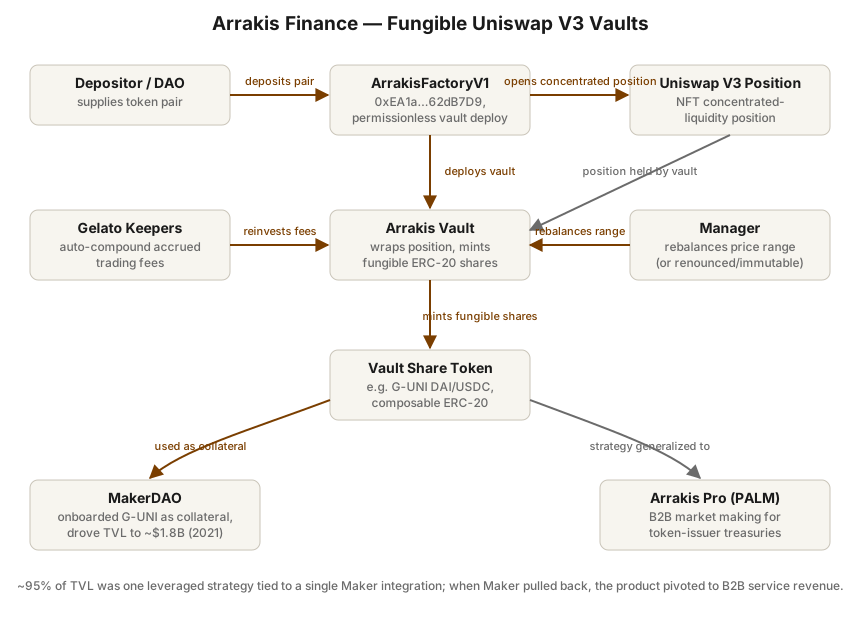 Open full-size diagram
Summary
Arrakis Finance began life in mid-2021 as G-UNI, an in-house product of Gelato Network that solved a problem Uniswap V3 created: concentrated-liquidity positions are NFTs, not fungible tokens, and they need active management. G-UNI wrapped a managed Uniswap V3 position into a plain ERC-20 share token, with Gelato keepers auto-compounding fees. The product's breakout moment came in September 2021, when MakerDAO onboarded G-UNI DAI/USDC LP tokens as collateral, letting users lever stablecoin LP positions and pushing peak TVL to roughly $1.8B — about 25% of all Uniswap V3 liquidity at the time (per The Block's reporting of the team's figures). In early 2022 the product rebranded as Arrakis and spun out of Gelato, ran a GEL "lockdrop" that promised 3% of a future SPICE token supply, and raised a $4M seed (Uniswap Labs Ventures, Accel, Polygon Ventures, Robot Ventures) closed in September 2022. As Maker restructured and wound down its stablecoin-LP exposure, Arrakis's TVL collapsed by ~95%+. The team pivoted through V2 (a generalized vault/manager framework) to today's Arrakis Pro: a non-custodial B2B market maker for token issuers, RWAs, and liquidity bootstrapping across Uniswap V4, Aerodrome, Velodrome and PancakeSwap, claiming 100+ token-issuer clients. Current TVL is roughly $60M across seven chains (DefiLlama, July 2026). The SPICE token promised in 2022 has, as far as could be verified, never had a confirmed official launch.
Design (Mechanism)
- Fungible LP wrapper. An Arrakis V1 (G-UNI) vault holds a Uniswap V3 position within a defined price range and issues ERC-20 shares against it. Fungibility restores composability lost with V3's NFT positions — shares can be used as collateral (MakerDAO), staked in liquidity-mining programs, or held passively.
- Auto-compounding via keepers. Gelato Network bots periodically reinvest accrued trading fees back into the position, compounding returns without user action.
- Manager role. Each vault has a designated manager who can rebalance the price range. Vaults can be effectively immutable (manager renounced), managed by professional market makers, or self-managed. Vault deployment is permissionless through the ArrakisFactoryV1 contract (Ethereum:
0xEA1aFf9dbFfD1580F6b81A3ad3589E66652dB7D9, labeled "Arrakis: Factory" on Etherscan). - V2 abstraction layer (2022). Generalized the design: multiple positions per vault, separation of vault custody from strategy execution, and a public/private vault split with trustless, managed, or self-managed styles.
- PALM / Arrakis Pro. "Protocol Automated Liquidity Management" targeted DAO treasuries: protocols deposit mostly their own token, and Arrakis strategies gradually bootstrap deep two-sided liquidity — replacing rented liquidity mining or opaque CEX market-maker deals with a self-custodial onchain arrangement. The current Arrakis Modular/Pro stack extends this to Uniswap V4 hooks (price convergence, dynamic fees), yield-bearing RWAs, and liquidity bootstrapping.
- Token mechanics (incomplete). The May–September 2022 GEL lockdrop allocated 30M SPICE (3% of supply) to Gelato token lockers, with the airdrop "at the full discretion of the Arrakis team." No verified token generation event followed.
Outcome
Ongoing, with a dramatic arc. As G-UNI, it was arguably the fastest-growing liquidity manager in DeFi: the MakerDAO integration (G-UNI DAI/USDC vault types, with debt ceilings that Maker governance discussed raising past $1B) drove TVL to ~$1.8B and made Arrakis the largest LP on Uniswap V3. That TVL was overwhelmingly one leveraged stablecoin strategy from one counterparty. When Maker pulled back from stablecoin-LP collateral during its 2022–2023 risk restructuring, TVL fell to the low tens of millions. Delphi Digital flagged the dependence risk explicitly ("Arrakis Finance is Growing, But Must Shed Dependence"). The team survived the drawdown, shipped V2 and then Arrakis Pro, and repositioned as onchain market-making infrastructure for token issuers (case studies: Morpho, Maple, Bitpanda). Current aggregate TVL is ~$60M (Ethereum ~$34.5M, Base ~$13M, plus Arbitrum, BSC, Plasma, Optimism, Polygon). The V1 contract repo was archived (deprecated) in June 2026, though contracts remain live. SPICE token status: no confirmed launch found; treat Etherscan tokens named "SPICE" as unverified.
Why it worked
- It solved a real, immediate problem. Uniswap V3 shipped without fungible LP tokens or fee auto-compounding; G-UNI restored both within weeks-to-months of V3's launch, inheriting all of V3's integration demand.
- A killer whale integration. MakerDAO collateral onboarding turned a wrapper into a systemically significant product — a single governance vote delivered more TVL than years of retail acquisition could.
- Credible team and distribution. Built by Gelato's founders/engineers (Hilmar Orth, Ari Rodriguez) on Gelato's keeper network, with Uniswap Labs Ventures later investing — strong legitimacy inside the exact ecosystem it served.
- Non-custodial B2B positioning. PALM/Pro's pitch — deep liquidity without handing tokens to an opaque CEX market maker — matched real post-FTX demand from token issuers.
Limitations and criticisms
- Extreme counterparty concentration. ~25% of Uniswap V3 liquidity sounded like dominance, but most of it was one strategy (DAI/USDC) levered through one integration (Maker). When Maker's risk appetite changed, ~95% of that TVL left — the growth was rented, not owned.
- Passive-LP economics are hard. Research on LVR and toxic flow shows passive concentrated-liquidity strategies often lose to arbitrageurs; auto-compounding fees alone was not enough to make retail LPing structurally profitable, capping organic vault demand.
- The SPICE token remains undelivered. The 2022 GEL lockdrop harvested holder commitment against an airdrop that, four years on, has no verified delivery — an unresolved overhang from an open-ended token promise.
- Commoditized category. Gamma, Charm, Ichi, Steer and others compete in the same ALM niche; differentiation increasingly depends on the B2B service business rather than the retail vault product.
Lessons
- TVL concentration is a liability metric, not a vanity metric. A protocol whose deposits are dominated by one governance-controlled counterparty inherits that counterparty's politics and risk cycles; the headline number masks fragility.
- Wrappers that restore composability capture integration demand fast — and lose it just as fast. Fungibility layers over new primitives (V3 NFT positions) are high-velocity but thin-moat businesses; the durable value migrated to strategy/management, not wrapping.
- Automating a strategy doesn't make it profitable. Auto-compounding and rebalancing optimize execution of passive LPing, but LVR/adverse selection is a pricing problem; mechanism designers must fix flow toxicity (dynamic fees, RFQ, hooks), not just operations — which is where Arrakis eventually went.
- Unbounded token promises compound into reputational debt. "Airdrop at the team's full discretion, no earlier than next year" converted goodwill into a multi-year grievance; if you run a lockdrop, commit to a deadline or an unwind path.
- Pivoting from B2C TVL to B2B service revenue can rescue a protocol. Arrakis's survival came from selling market-making outcomes to ~100+ token issuers, not from recovering vault deposits.
Redesign (EDITORIAL — hypothesis, not fact)
This section is editorial hypothesis, not a factual account. A redesigned Arrakis would treat the Maker integration as a portfolio position, not a business model: cap any single counterparty at, say, 20% of TVL for incentive/fee purposes, and use the Maker windfall period (2021–22) to aggressively diversify strategy types while demand was hot. Second, it would attack LP profitability head-on from day one — dynamic fees and arb-internalization (the direction Arrakis later took with V4 hooks and its HOT/RFQ-style work) matter more than compounding, so shipping a toxicity-aware AMM layer in 2022 rather than 2024 might have retained organic LPs through the bear market. Third, token design: either no token, or a fee-linked token launched on a committed schedule with the lockdrop escrow programmatically refundable (e.g., SPICE mints automatically at T+18 months or GEL lockers receive protocol fee rebates instead). Finally, the B2B pivot could have been formalized as onchain service agreements — issuer-facing vaults with transparent KPIs (depth at ±2%, uptime, realized spread) written into the vault contract — turning "trust us, we're non-custodial" into verifiable, slashing-backed market-making SLAs.
Sources
- Arrakis Finance official site — primary (docs)
- Arrakis Pro documentation — primary (docs)
- Arrakis Vault V1 core contracts (archived repo) — primary (contract)
- Arrakis: Factory contract (Etherscan) — primary (contract)
- Introducing Arrakis Finance — Web3's Liquidity Layer — primary (retrospective)
- Announcing the $GEL Lockdrop Program (Gelato) — primary (governance)
- MakerDAO Integrates Gelato Network's G-UNI Uniswap V3 Token as Collateral (news)
- G-UNI DAI/USDC collateral onboarding application (Maker forum) — primary (governance)
- Decentralized market maker Arrakis Finance raises $4 million (The Block) (news)
- Arrakis — Trustless Market Making Strategies on Uniswap v3 (Uniswap blog) (analysis)
- Arrakis Finance TVL (DefiLlama) (analysis)
- Arrakis Finance is Growing, But Must Shed Dependence (Delphi Digital) (analysis)
Related experiments
Last verified: 2026-07-26 · Spot an error? Suggest a correction