Sudoswap
A minimal, fully on-chain automated market maker for NFTs that priced ERC721/ERC1155 tokens along customizable bonding curves and popularized royalty-optional, low-fee NFT trading.
▶ Run interactive simulation animated mechanism with editable parameters
How it works onchain
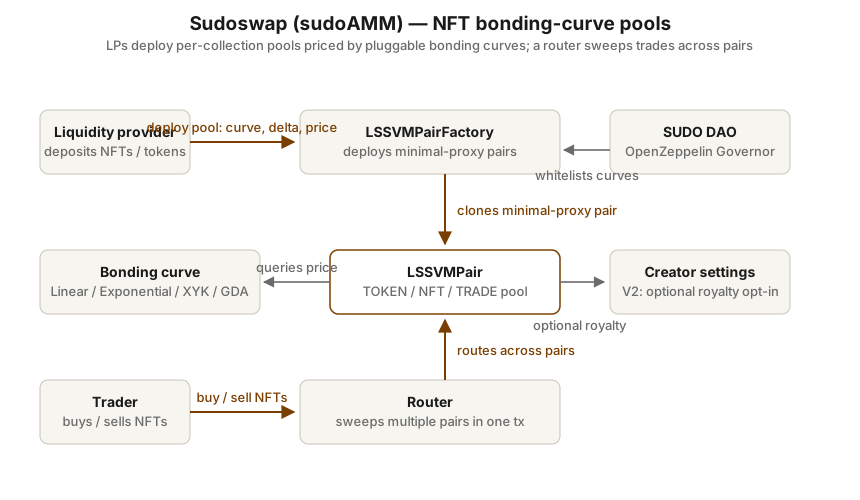 Open full-size diagram
Summary
Sudoswap (the "sudoAMM" protocol) is a minimal, gas-efficient automated market maker for NFTs that launched on Ethereum mainnet on July 8, 2022. Instead of the peer-to-peer, off-chain-orderbook model used by OpenSea and its imitators, sudoswap let anyone create on-chain liquidity pools that buy and/or sell a specific NFT collection along a deterministic bonding curve. It brought DeFi-style AMM primitives — pooled liquidity, deterministic pricing, instant fills, and permissionless pair creation — to a market that had previously depended on human buyers matching human sellers. It became the canonical reference implementation for "NFT AMMs" and a flashpoint in the 2022 debate over enforced creator royalties, because its pools charged a flat ~0.5% protocol fee and did not pay collection royalties by default. It was created pseudonymously by 0xmons (aka Owen), with Zefram Lou (zefram.eth) as a core smart-contract co-author. A SUDO governance token and DAO followed in early 2023.
Design (Mechanism)
The base unit of the protocol is LSSVMPair, a pool contract deployed via LSSVMPairFactory for one NFT collection paired with ETH or an ERC20. Each pair has one of three types:
- TOKEN pool — holds tokens and only buys NFTs from traders (single-sided bid).
- NFT pool — holds NFTs and only sells them for tokens (single-sided ask).
- TRADE pool — holds both and quotes two-sided, capturing an LP fee spread.
Pricing is governed by a whitelisted, stateless bonding-curve contract implementing the ICurve interface. V1 shipped Linear, Exponential, and XYK (constant-product) curves; V2 added a GDA (gradual Dutch auction) curve. The pair holds all state and does input/output validation, while the curve contracts are intended to be pure functions — so each successful buy moves the price up by delta and each sell moves it down, exactly like a discretized Uniswap curve but over indivisible NFTs. Liquidity providers pick a spot price, a delta, and a curve when depositing.
The design goals were extreme gas efficiency and minimalism: pairs are deployed as minimal-proxy clones, pricing math is deterministic and cheap, and routing is done on-chain via a router that can sweep multiple pairs/collections in one transaction. V2 (2023) added ERC1155 support, on-chain property checkers (so a pool can restrict which token IDs it will accept, e.g. only NFTs with a given trait), and creator settings contracts letting collections opt into royalty payments in exchange for a share of pool fees. Governance runs through an OpenZeppelin Governor with on-chain SUDO voting controlling curve whitelisting and factory configuration; a separate "Labs" entity employs contributors. Contracts are AGPL-3.0 licensed.
Outcome
Technically the protocol was a strong success and became the template an entire category copied. Within roughly its first week it processed on the order of $100M in trading, and by mid-August 2022 daily volume reportedly reached ~15% of OpenSea's daily volume — a remarkable share for a brand-new, minimalist contract. It forced the market's hand on royalties: within weeks X2Y2 made royalties optional, Magic Eden and others followed, and the "royalty wars" that reshaped NFT marketplace economics in late 2022 were catalyzed in large part by sudoswap's zero-royalty default. In January 2023 the team launched the SUDO governance token and DAO, with a large share airdropped to XMON holders who locked their tokens and to protocol liquidity providers.
Commercially, however, the outcome is muted. The NFT bull market collapsed, and AMM-style NFT liquidity proved thin and prone to adverse selection outside a handful of high-float collections. Copycats (notably Blur's later liquidity/bidding pools) captured the pro-trader flow, and sudoswap's volume and mindshare receded from its 2022 peak. The protocol and SUDO token remain live and the contracts have not been exploited or abandoned, but sudoswap did not sustain a dominant marketplace position — hence a "technically successful, commercially unsuccessful" framing.
Why it worked
- Right primitive at the right moment. It ported a well-understood DeFi pattern (AMM + bonding curve) into NFTs precisely when traders wanted instant, deterministic liquidity rather than slow, negotiated sales.
- Minimalism and gas efficiency. Pure curve contracts, minimal-proxy pairs, and an on-chain router made pool creation and multi-item sweeps cheap and composable.
- Aligned incentives for a bear market. A flat ~0.5% fee and no mandatory royalties made it the cheapest venue to trade, which mattered enormously as prices fell and margins compressed.
- Fully on-chain and permissionless. Anyone could spin up a market for any collection without listing approval, which made it a neutral liquidity layer other apps could build on.
Where the design broke
- AMM liquidity is a poor fit for heterogeneous NFTs. Most NFTs are non-fungible in value (traits, rarity), so pooled uniform pricing exposes LPs to adverse selection — informed traders cherry-pick the underpriced items, leaving pools with the junk.
- Reflexive, collapsing demand. The 2022–2023 NFT downturn shrank the entire market; deterministic curves amplified losses for LPs on the way down.
- Competitive displacement. Blur's aggressive bid-pool + token-incentive model out-competed sudoswap for professional traders, and OpenSea/marketplaces adapted their own liquidity and fee tactics.
- Royalty backlash. Being the tip of the royalty-removal spear made sudoswap a target of creator communities, limiting some collections' willingness to route liquidity there.
Lessons
- Fungibility is a prerequisite for AMMs, not an afterthought. A single bonding curve implicitly assumes items are interchangeable; wherever value dispersion within a collection is high, uniform-price pools leak money to informed flow. Property checkers (V2) were a partial fix but not a full answer.
- A protocol can win the design argument and still lose the market. sudoswap set the technical and economic template for NFT AMMs and reshaped royalty norms industry-wide, yet token incentives and trader UX (Blur) captured the volume. Being first and elegant is not the same as being sticky.
- Default settings are policy. Making royalties optional-by-default did more to change NFT marketplace economics than any governance vote — the default became the industry norm within weeks, showing how much power sits in a protocol's out-of-the-box parameters.
- Minimalism is a durable moat for infrastructure. The lean, AGPL, fully on-chain contracts remained un-exploited and composable, which is why the protocol endures as a liquidity primitive even after its volume peak passed.
Redesign (EDITORIAL — hypothesis, not fact)
The following is the researcher's editorial analysis, not established fact. Sudoswap's core weakness was treating NFTs within a collection as fungible. A redesign should make the pricing model trait-aware by default rather than bolting on filtering. Concretely: (1) integrate an on-chain or oracle-fed rarity/trait score so a single pool can price items on a curve modulated by a per-item multiplier, letting one liquidity position quote different prices for a floor item versus a grail without splitting liquidity into dozens of thin sub-pools. (2) Add explicit adverse-selection protection — e.g. dynamic spreads that widen with recent one-sided flow, or a short commit-reveal/oracle delay on buys — so LPs are not systematically picked off by information they lack. (3) Replace or augment static bonding-curve deltas with volatility-aware curves that steepen in fast markets, borrowing from perp-DEX funding/AMM hybrids, to protect LPs during reflexive crashes. (4) On the go-to-market side, the fatal gap was liquidity incentives: a redesign would front-load SUDO (or fee-share) emissions to two-sided TRADE pools on high-value collections from day one, directly contesting Blur's bid-pool flywheel rather than ceding pro-trader volume. The through-line: keep sudoswap's minimalist, permissionless, fully-on-chain ethos, but stop pretending NFTs are fungible and stop assuming neutral, unincentivized liquidity will out-compete an aggressively subsidized rival.
Sources
- sudoswap/lssvm — sudoAMM Protocol (contracts, AGPL-3.0) — primary (contract)
- sudoswap docs — protocol reference and contract addresses — primary (docs)
- sudoswap docs — Bonding Curves and Pricing — primary (docs)
- announcing sudoAMM (official blog) — primary (docs)
- 0xmons blog — sudoswap v69: An NFT AMM — primary (retrospective)
- Web3 Galaxy Brain — Sudoswap v2 with 0xmons (founder interview) — primary (retrospective)
- zefram.xyz — Projects (co-founder confirmation) — primary (retrospective)
- Sudoswap and The Impending NFT Royalty Crisis (Tally) (analysis)
- NFT Trading Platform SudoSwap Airdrops its Governance Token (CryptoPotato) (news)
Related experiments
Last verified: 2026-07-26 · Spot an error? Suggest a correction