ether.fi
Non-custodial ETH staking protocol that rode the EigenLayer restaking wave to become the largest liquid restaking token (eETH/weETH) issuer, then pivoted toward a crypto neobank with its Cash card.
▶ Run interactive simulation animated mechanism with editable parameters
How it works onchain
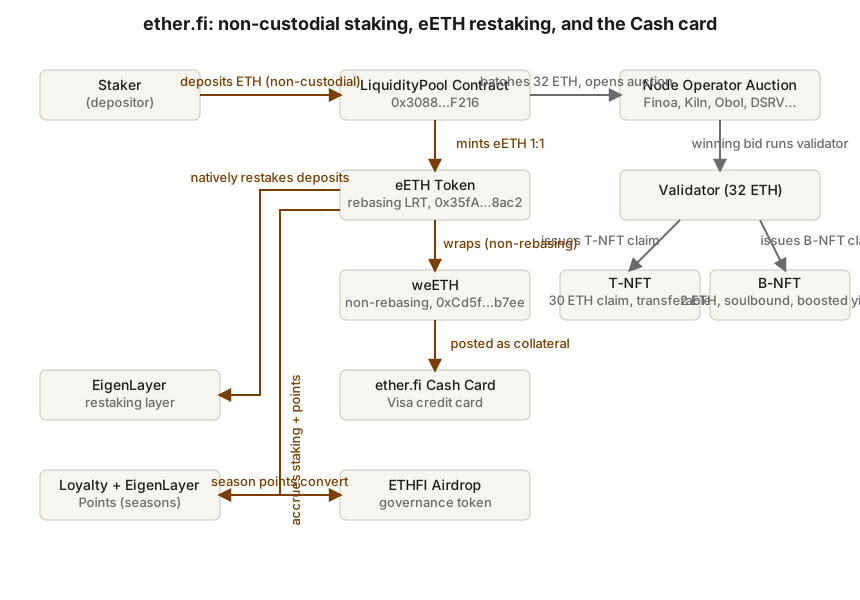 Open full-size diagram
Summary
ether.fi is a non-custodial Ethereum staking protocol founded in 2022 by Mike Silagadze (previously founder/CEO of edtech company Top Hat) and Rok Kopp, with development beginning in December 2022 in the immediate aftermath of the FTX collapse. Its founding thesis was that stakers should never surrender their withdrawal keys to an intermediary. The protocol launched delegated staking on mainnet in 2023, then in late 2023 shipped eETH, a rebasing liquid restaking token (LRT) that automatically restakes deposits into EigenLayer. A points-and-airdrop flywheel made ether.fi the largest LRT issuer during the 2024 restaking boom — TVL roughly quadrupled to about $3 billion in early 2024 and later grew to the $7–8 billion range. The ETHFI governance token launched in March 2024 via airdrop and Binance Launchpool. In April 2025 the company announced a pivot from pure restaking toward a "DeFi neobank," rolling out its crypto-collateralized Visa Cash card in the U.S.
Design (Mechanism)
ether.fi's original design decomposed staking into distinct, contract-mediated roles:
- Key separation. In the initial delegated-staking design, stakers retained withdrawal keys while node operators ran validators with validator signing keys — the core non-custodial claim that differentiated ether.fi from Lido-style pools where the protocol controls withdrawals.
- Node-operator auction. Each time 32 ETH accumulated for staking, the protocol ran an auction in which registered node operators bid for the right to run the validator, creating a permissionless-leaning market for validator operation rather than a whitelisted set alone (launch operators included Finoa, Kiln, DSRV, Chainnodes, Obol, Allnodes, and Cosmostation).
- Dual-NFT withdrawal claims. Each validator's stake was represented by two NFTs: a transferable T-NFT representing a 30 ETH claim, and a non-transferable, soulbound B-NFT representing a 2 ETH claim. The B-NFT holder earned a boosted yield (~50% higher) in exchange for bearing first-loss slashing exposure and monitoring responsibility — an explicit insurance/deductible tranche encoded as an NFT.
- eETH / weETH liquid restaking. The eETH liquidity pool (LiquidityPool contract 0x3088...F216) let any-size deposits mint rebasing eETH (0x35fA...8ac2), with weETH (0xCd5f...b7ee) as the non-rebasing wrapped version for DeFi composability. Deposits were natively restaked through EigenLayer, so holders accrued staking rewards plus EigenLayer points plus ether.fi "loyalty points."
- Points → token conversion. Seasons of loyalty points converted into the ETHFI airdrop (Season 1: 6% of supply, Season 2: 5%; ~11% total via airdrop, with 23% to core contributors, ~27% treasury, 32.5% investors). ETHFI debuted March 18, 2024 around $4.13 after Binance Launchpool distribution.
- Cash card (2025 pivot). ether.fi Cash is a Visa credit card that lets users borrow fiat spending power against ETH, LRTs, and yield-bearing collateral — turning the staked balance sheet into a consumer-facing credit product rather than requiring users to sell assets.
Outcome
Ongoing and, so far, one of the clear winners of the restaking cycle. ether.fi became the largest liquid restaking protocol during 2024, with TVL surging from under $1 billion to roughly $3 billion in early 2024 and continuing toward the $7–8+ billion range across its ecosystem by 2025. The ETHFI token launch was among the most valuable airdrops of the cycle (initial airdrop tranche valued around $210 million per Blockworks), though the token fell ~20–25% after debut. Notably, when restaking hype cooled through 2024–2025 and EigenLayer AVS yields disappointed, ether.fi retained most of its TVL while competitors bled, and management pivoted the brand toward a consumer neobank: U.S. availability of staking and the Cash card was announced in April 2025, and card-specific balances reportedly reached ~$156 million within months. The protocol has had no known loss-of-funds exploit; a September 2024 attempt to hijack its domain registrar account (Gandi) was detected and stopped within hours with no user losses.
Why it worked
- Timing and narrative fit. ether.fi shipped the first major LRT just as EigenLayer's points meta ignited; eETH let users triple-dip (staking yield + EigenLayer points + ether.fi points) with a liquid, DeFi-composable token.
- Non-custodial positioning post-FTX. "Keep your keys" was a credible differentiator in 2023, and the T-NFT/B-NFT structure gave the safety story concrete mechanics rather than marketing copy.
- Aggressive but delivered points program. Unlike many points schemes, ether.fi converted points into a real, sizable airdrop with a Binance listing, which validated the farming and kept depositors loyal for Season 2.
- Willingness to pivot. When restaking yields underwhelmed, the team redeployed its large captive TVL toward products with real cash flow (Cash card, Liquid vaults) instead of defending a fading narrative.
Limitations and criticisms
- The restaking yield thesis underdelivered. AVS payments on EigenLayer never materialized at scale, so the "restaking premium" that justified LRTs was mostly points speculation; ether.fi's pivot to neobanking is an implicit acknowledgment of that.
- Token performance lagged protocol success. ETHFI fell sharply post-debut and, like most LRT governance tokens, has struggled to capture the value of the TVL it governs; heavy insider/investor allocation (~55%+ to team and investors) drew criticism.
- Progressive decentralization is incomplete. The elegant auction/B-NFT design applies to a slice of activity; most TVL flows through the pooled eETH product where operator selection and DAO/multisig control look more like conventional LSTs.
- Off-chain attack surface. The 2024 Gandi domain-hijack attempt showed that a multi-billion-dollar onchain protocol can still be one registrar recovery flow away from a mass-phishing event, even though this one was caught with no user losses.
Lessons
- Points programs that actually pay out (a real airdrop, on schedule, exchange-listed) build durable TVL loyalty; ether.fi retained deposits after the restaking narrative faded largely because it had honored its incentives.
- Tokenizing risk tranches works: the B-NFT (first-loss, boosted-yield, soulbound) is a reusable pattern for encoding slashing insurance and operator accountability directly in asset structure.
- An LRT is a distribution wedge, not a business; when the underlying yield source (AVS fees) disappoints, the surviving move is to monetize the balance sheet through adjacent products (credit cards, vaults) before TVL leaves.
- DNS/registrar security is protocol security — front-end and domain custody deserve the same threat modeling as contracts.
Redesign (EDITORIAL — hypothesis, not fact)
This section is editorial speculation. A redesigned ether.fi might (1) make the B-NFT insurance tranche a permissionless market — letting third parties underwrite slashing risk at auction-set premiums instead of bundling it with staker responsibilities; (2) tie ETHFI value capture directly to Cash-card interchange and vault fees via onchain revenue sharing from day one, avoiding the governance-token-with-no-cash-flow trap; (3) precommit airdrop supply to a transparent points-to-token formula published before farming begins, reducing the meta-gaming and mercenary churn of opaque seasons; and (4) decentralize the operator set with permissionless bonding plus DVT (Obol-style) as the default rather than an aspiration, so the non-custodial claim holds for pooled eETH deposits, not just 32-ETH direct stakers.
Sources
- ether.fi Deployed Contracts (GitBook docs) — primary (docs)
- eETH token contract on Etherscan — primary (contract)
- Introducing ether.fi — a new kind of liquid staking protocol (official Medium) — primary (docs)
- Announcing ETHFI: The ether.fi Governance Token (official Medium) — primary (governance)
- ether.fi Node Operators guide (GitBook docs) — primary (docs)
- ether.fi Community Resources (official help center, social handles) — primary (docs)
- Ether.Fi's Token Falls 20% After Debut (CoinDesk, March 2024) (news)
- Ether.fi Pivots to Become Neobank, Rolls Out Cash Cards in U.S. (CoinDesk, April 2025) (news)
- How Ether.fi's Mike Silagadze Retained TVL as Restaking Lost Its Luster (CoinDesk, March 2025) (news)
- Ether.fi foils domain hijack attempt (CryptoSlate, Sept 2024) (news)
- ether.fi launches eETH: non-custodial staking and native restaking (Token Terminal interview) (analysis)
- Hats Finance audit competition report for ether.fi — primary (audit)
Related experiments
Last verified: 2026-07-27 · Spot an error? Suggest a correction