VitaDAO
A decentralized collective that funds early-stage longevity research and holds the resulting intellectual property onchain as IP-NFTs governed by VITA token holders.
▶ Run interactive simulation animated mechanism with editable parameters
How it works onchain
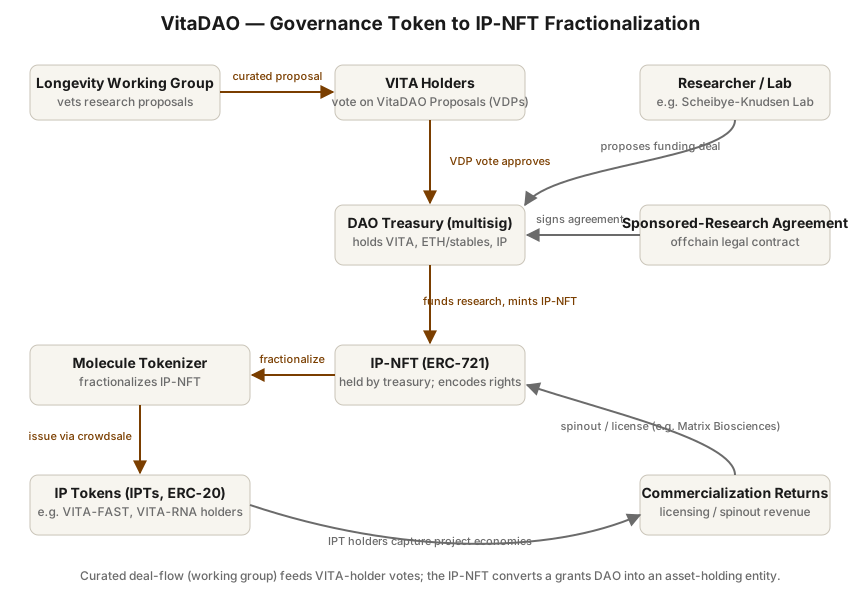 Open full-size diagram
Summary
VitaDAO is a decentralized autonomous organization founded in 2021 to fund early-stage longevity and aging research and to hold the resulting intellectual property (IP) onchain. It launched publicly on 18 June 2021 with a Gnosis Auction genesis sale of its VITA governance token (ERC-20 at 0x81f8f0bb...6FA321 on Ethereum). VitaDAO was initiated by the team behind Molecule — notably Tyler Golato and Paul Kohlhaas — as the flagship "BioDAO" demonstrating that a community of token holders could collectively finance drug discovery normally gated by venture capital and big pharma. Rather than only writing grant checks, VitaDAO's distinguishing feature is that funded research IP is minted as an "IP-NFT" owned by the DAO treasury, converting patents, datasets, and sponsored-research agreements into transferable, governable onchain assets. As of 2026 the project remains active, has funded 30+ projects, deployed roughly $4.7M into research, produced its first biotech spinout (Matrix Biosciences), and attracted institutional backing including Pfizer Ventures.
Design (Mechanism)
VitaDAO combines a standard governance-token DAO with a novel IP-tokenization layer:
- VITA governance token. VITA is an ERC-20 used to vote on funding proposals, treasury allocation, and strategic decisions. Genesis distribution allocated a large share to the community: roughly 30% for the initial genesis distribution (with ~10% auctioned via Gnosis Auction and immediately claimable), and the majority reserved unminted in the treasury for future contributor rewards and research funding. Tokens were also distributed to service providers and contributors who supported the DAO.
- Proposal + working-group governance. Deal-flow is sourced and vetted by a Longevity Working Group of scientists, then put to VITA holders as VitaDAO Proposals (VDPs) on a governance forum and voting system. This creates a curated-then-democratic funnel rather than pure open voting on unvetted science.
- IP-NFT. When VitaDAO funds a research project, the associated IP and sponsored-research agreement is wrapped into an ERC-721 "IP-NFT" (developed with Molecule) that encodes sub-licensing rights and encrypted access to research data. The IP-NFT is held by the DAO treasury, giving the collective legal and economic exposure to the research outputs.
- IP Tokens (IPTs) / fractionalization. An IP-NFT can be fractionalized via Molecule's Tokenizer contract into project-specific ERC-20 IP Tokens. IPTs decentralize governance and economic rights over a single research asset to a targeted community of holders (e.g., ApoptoSENS, VITA-FAST, VITA-RNA), letting each project bootstrap its own micro-community and funding without each lab building and auditing its own smart contracts.
- Treasury. The DAO treasury (multisig at
0xf5307a...53e5ac2) holds VITA, stablecoins/ETH, and the IP assets, and recycles returns from commercialization back into new research.
Outcome
VitaDAO has been one of the most durable and legitimizing experiments in "decentralized science" (DeSci). By 2026 it reported funding 30+ longevity projects with roughly $4.7M deployed and a treasury valued in the tens of millions (project materials cite ~$55.8M including IP assets and a large VITA position). Concrete milestones include:
- Pfizer Ventures round (Jan 2023): VitaDAO closed a $4.1M raise that included Pfizer Ventures and Shine Capital, a notable instance of traditional pharma capital entering a DAO.
- First spinout (2023): Matrix Biosciences, built on naked-mole-rat HMW-HA longevity research from Vera Gorbunova's lab, became the first company spun out of VitaDAO-funded work.
- BIO Protocol integration (2024–2026): VitaDAO became the anchor "BioDAO" of the broader BIO Protocol ecosystem launched by the same founders, positioning it within a network of research DAOs.
Because outcomes in drug discovery take a decade-plus, the ultimate scientific/commercial payoff is still unproven, so the honest status is ongoing (and arguably too_early_to_judge on returns), with clear success on the meta-goal of proving the model can attract capital, talent, and institutional partners.
Why it worked
- A real, legible primitive (the IP-NFT). Turning sponsored-research agreements into an onchain asset gave the DAO something tangible to own and govern, differentiating it from grant DAOs that fund but capture nothing.
- Curated deal-flow. Domain-expert working groups filtered proposals before token votes, avoiding the "uninformed crowd funds bad science" failure mode.
- Founder credibility and ecosystem. The Molecule team provided legal/technical infrastructure and continuity, and later BIO Protocol gave VitaDAO distribution and liquidity support.
- Narrative fit. Longevity is an emotionally compelling, mission-driven cause that recruited scientists and patient-capital contributors who cared beyond speculation.
Limitations and criticisms
VitaDAO carries structural weaknesses typical of early DeSci experiments:
- Token/mission mismatch. VITA's market value is loosely coupled to actual research success; long biotech timelines mean the token trades on sentiment and DeSci hype cycles rather than de-risked assets, and it has seen significant drawdowns.
- Centralization in practice. Despite token voting, deal origination, scientific vetting, and operations concentrate in a core team and the Molecule/BIO orbit, limiting how "decentralized" the science funding truly is.
- No commercial exits yet. As of 2026 there is no landmark therapeutic approval or major licensing exit returning capital to VITA holders, so the economic loop is still theoretical.
Lessons
- Owning IP beats only funding it. The IP-NFT converts a grants DAO into an asset-holding entity, which is the key design move that makes a research DAO potentially self-sustaining rather than a one-way donation pool.
- Expert curation + token voting is a workable hybrid. Pure token democracy is a poor fit for evaluating science; a vetted funnel feeding holder votes balances legitimacy with competence.
- Match token economics to the underlying timeline. Funding decade-long R&D with a liquid, speculatively priced governance token creates a persistent expectation-vs-reality gap; project-specific IPTs partly address this by isolating risk to individual assets.
- Institutional legitimacy is a gettable milestone. Attracting Pfizer Ventures and producing a real spinout shows a DAO can interface with traditional pharma — a reusable credibility path for other DeSci projects.
Redesign (EDITORIAL — hypothesis, not fact)
The following is the researcher's editorial analysis, not established fact. If rebuilt today, VitaDAO's biggest opportunity is to tighten the loop between token value and scientific de-risking. One approach: shift most economic exposure to project-level IPTs with milestone-gated vesting, so holders capture value only as assets clear scientific checkpoints (IND filing, licensing deal), while VITA functions purely as a curation/reputation and treasury-governance token rather than a speculative proxy for the whole portfolio. Governance could adopt conviction voting or futarchy-style prediction markets over research proposals, using domain-expert reviewer stakes to weight signal and slashing bad reviewers — turning scientific vetting into an accountable, incentivized market instead of an opaque working group. On the legal side, pairing each IP-NFT with a jurisdiction-tested SPV or foundation wrapper (rather than relying on token-encoded rights alone) would make licensing enforceable and reassure pharma counterparties. Finally, a transparent, standardized returns waterfall (how commercialization revenue flows to IPT holders, the treasury, and researchers) published per project would replace today's ambiguity with a credible economic promise, which is ultimately what will determine whether the DeSci model outlives its first hype cycle.
Sources
- VitaDAO official website (homepage, metrics, social links) — primary (docs)
- VITA Token — Etherscan (ERC-20 contract) — primary (contract)
- Participating in the VitaDAO Genesis (Gnosis Auction, tokenomics) — primary (docs)
- How VitaDAO Works — primary (docs)
- Unlocking Research Innovation with IP-NFTs (mechanism) — primary (docs)
- IP Tokenization Guide — Molecule Docs — primary (docs)
- VitaDAO Closes $4.1M Funding Round With Pfizer Ventures — CoinDesk (news)
- Pfizer-backed VitaDAO spins out biotech company (Matrix Biosciences) — Blockworks (news)
- Announcing the first spinout company funded by VitaDAO — primary (retrospective)
- VDP-73 Fractionalization of ApoptoSENS IP-NFT — Governance Forum — primary (governance)
Related experiments
Last verified: 2026-07-26 · Spot an error? Suggest a correction