Balancer
A generalized AMM using a weighted geometric-mean invariant that turned index funds inside out — LPs get paid to be rebalanced — and helped ignite DeFi Summer with one of the first liquidity-mining programs, before a 2025 rounding-error exploit drained $128M from its V2 stable pools.
▶ Run interactive simulation animated mechanism with editable parameters
How it works onchain
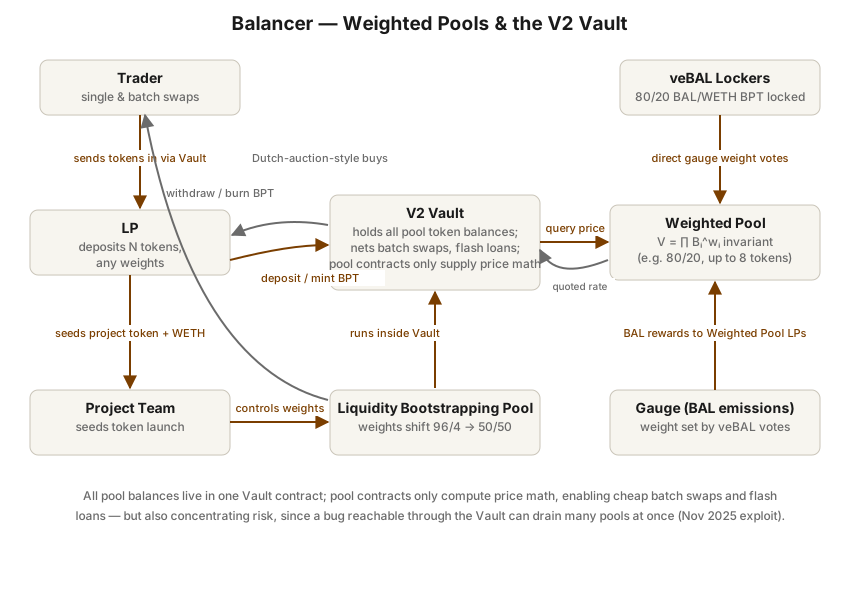 Open full-size diagram
Summary
Balancer generalized Uniswap's constant-product AMM into an n-dimensional weighted portfolio machine. The 2019 whitepaper by Fernando Martinelli and Nikolai Mushegian defined pools by a weighted geometric-mean invariant (the product of each token balance raised to its normalized weight stays constant), allowing up to eight tokens with arbitrary weights such as 80/20 instead of the mandatory 50/50 pair. The pitch inverted the index fund: instead of paying a manager fees to rebalance your portfolio, arbitrageurs pay you fees while rebalancing it for you. The project began around 2018 as research inside BlockScience, spun out as Balancer Labs with a $3M seed round, and shipped its "Bronze" V1 to Ethereum mainnet in March 2020. Its June 2020 BAL liquidity-mining program — begun June 1, with distribution live June 23, days after Compound's COMP — made it one of the archetypes of DeFi Summer yield farming. Balancer V2 (2021) moved all pool tokens into a single Vault contract, and V3 (late 2024) added a hooks framework. In November 2025, a rounding-error exploit in V2 composable stable pools drained roughly $128M across multiple chains, one of the largest DeFi hacks of that year; V3 was unaffected and the protocol continues.
Design (Mechanism)
- Weighted invariant. Each pool maintains V = ∏ Bᵢ^wᵢ, where Bᵢ is the balance and wᵢ the normalized weight of token i. Spot price between any two tokens is the ratio of their balance/weight quotients. A 50/50 two-token pool reduces exactly to Uniswap's x·y=k; anything else — 80/20 pools, 8-token index pools — is a generalization. Unequal weights let LPs shape inventory exposure (e.g., 80% project token / 20% WETH reduces impermanent loss relative to 50/50 at the cost of higher slippage).
- Pools as products. Public (shared) pools were immutable and permissionless to join; private/smart pools had controllable parameters. Anyone could launch a pool with custom tokens, weights, and swap fees — Balancer as an "AMM factory" rather than a single exchange.
- Liquidity Bootstrapping Pools (LBPs). Pools whose weights shift over time (e.g., 96/4 project-token/stable declining toward 50/50), producing a falling-price Dutch-auction-like token launch that punishes sniping bots and front-loaded speculation. LBPs became DeFi's standard fair-launch primitive (used by Perpetual Protocol, Gitcoin, and many others).
- BAL and liquidity mining. 145,000 BAL per week streamed to LPs proportional to liquidity provided, starting June 1, 2020 — among the first programs to distribute a governance token as a liquidity subsidy. veBAL vote-escrow tokenomics (2022, modeled on Curve's veCRV) later tied emissions direction to locked 80/20 BAL/WETH LP tokens.
- V2 Vault architecture. All tokens for all pools held in one Vault contract (0xBA1222...BF2C8), separating token accounting from pool math. This enabled gas-efficient batch swaps that only settle net token movements, cheap multi-hop routing, protocol-level flash loans, and third-party pool types (stable pools, boosted pools wrapping yield-bearing tokens) plugged into shared liquidity infrastructure.
- V3. A rebuilt vault with a hooks system (custom logic on pool operations) and native support for 100% boosted, yield-bearing liquidity — positioning Balancer as programmable AMM infrastructure rather than a retail DEX.
Outcome
Partial success, with a severe late-stage exploit. Balancer was a top-tier DeFi protocol for five years: TVL grew from $16M in May 2020 to billions at peak, BAL liquidity mining helped define the yield-farming era, and LBPs, 80/20 pools, and the V2 Vault design were widely imitated (notably, the Vault-style architecture prefigured Uniswap V4's singleton). But security incidents recurred: the June 28, 2020 STA deflationary-token exploit ($500K, from pool accounting that trusted internal balance records against fee-on-transfer tokens); an August 2023 boosted-pool vulnerability ($900K lost despite advance warning); a September 2023 DNS hijack ($240K); and finally, on November 3, 2025, an attacker exploited rounding-direction errors in the batch-swap "upscale" math of V2 composable stable pools, compounding tiny precision losses into invariant manipulation and draining ~$128M across six chains in under 30 minutes. Balancer's TVL fell ~58% in two days. V3, weighted pools, and other V2 pool types were unaffected, and the protocol remains live, but V2's stable-pool franchise was effectively destroyed. As a trading venue Balancer also never seriously threatened Uniswap or Curve in their core markets.
Why it worked
- The weighted invariant was a genuine mathematical generalization, not a marketing fork — one formula subsumed pairs, index pools, and bootstrapping auctions, giving Balancer several defensible niches (LBPs, 80/20 governance-token pools, multi-token treasuries).
- The "index fund that pays you" framing gave passive LPs a legible reason to hold multi-asset pools.
- Being weeks behind Compound with liquidity mining put BAL at the center of DeFi Summer; the subsidy bootstrapped real liquidity fast (TVL nearly tripled in June 2020).
- The V2 Vault delivered concrete gas and capital-efficiency wins and made Balancer attractive as neutral infrastructure for external pool designers.
Why it failed or underperformed
- Generality is an attack surface. Every pool type, wrapper, and math path multiplied audit burden; five significant incidents in five years, culminating in the $128M rounding exploit, show the complexity tax compounding. The 2025 bug lived in heavily audited, years-old code — subtle fixed-point rounding direction, not a novel mechanism.
- The single-Vault design concentrated risk: one bug class reachable through batch swaps exposed assets across many pools and chains simultaneously.
- In head-to-head swap routing, generalized math lost to specialized competitors — Uniswap V3's concentrated liquidity for volatile pairs, Curve for stables — leaving Balancer squeezed into niches.
- Liquidity-mining emissions bought TVL but much of it was mercenary; veBAL governance then imported Curve-style bribe politics without Curve's stablecoin moat.
Lessons
- Generalizing an invariant is powerful research but every added degree of freedom (weights, pool types, wrapped assets, batch settlement) is a standing liability that must be paid for in audits forever; the marginal pool type should justify its marginal attack surface.
- Shared-vault singletons trade gas efficiency for correlated blast radius — protocol architects should pair them with per-pool-type isolation or circuit breakers, because "one bug, all pools, all chains" is the realistic failure mode.
- Rounding direction in fixed-point AMM math is consensus-critical: always round against the user, and fuzz invariant monotonicity under batched/composed operations, not just single swaps (the 2025 exploit composed individually-negligible errors).
- Being second-to-market with a token incentive (BAL after COMP) can still capture a cycle's narrative — timing of distribution mechanics can matter as much as protocol mechanics.
- Novel token-handling assumptions (fee-on-transfer, yield-bearing wrappers) break AMM accounting invariants; reconcile against actual balances, not internal bookkeeping.
Redesign (EDITORIAL — hypothesis, not fact)
This section is editorial hypothesis, not established fact. A redesigned Balancer would keep the weighted invariant and LBPs — its two clearly differentiated inventions — and shed generality elsewhere. Concretely: (1) segment the Vault into per-pool-class sub-vaults with independent pausability and per-block outflow rate limits, so a math bug in one pool family cannot drain the network in 30 minutes; (2) enforce a machine-checked rounding policy — formal verification or differential fuzzing that every mutation path (including batch swaps) weakly favors the pool — as a deployment gate for any new pool math; (3) replace open-ended BAL emissions with time-boxed, KPI-tied LBP-style distributions, since Balancer's own bootstrapping mechanism was better designed than its perpetual farming subsidy; and (4) lean fully into the "AMM operating system" position V3 gestures at — licensing hooks and pool math to specialized front ends — rather than competing for retail order flow against concentrated-liquidity venues it structurally cannot beat on price.
Sources
- Balancer V2 Vault (verified contract) — primary (contract)
- Balancer v3 Documentation — primary (docs)
- BAL is live! (Fernando Martinelli, Balancer Protocol blog) — primary (retrospective)
- Balancer Liquidity Mining Begins (Fernando Martinelli) — primary (governance)
- Balancer Nov 3 2025 Exploit Post-Mortem (official X thread) — primary (retrospective)
- How an Attacker Drained $128M from Balancer Through Rounding Error Exploitation (Check Point Research) (analysis)
- Understanding the Balancer v2 Exploit (OpenZeppelin) (analysis)
- Balancer Pool with STA Deflationary Token Incident (1inch analysis, June 2020) (analysis)
- Following COMP's Surge, DeFi Platform Balancer Begins Distribution of BAL Tokens (CoinDesk, June 2020) (news)
Related experiments
Last verified: 2026-07-26 · Spot an error? Suggest a correction