Dynamic Set Dollar
A faster, more aggressive fork of Empty Set Dollar whose uncollateralized rebase-and-coupon stablecoin ballooned to ~$300M in weeks, lost its $1 peg within a month, and never recovered despite a v2 redesign.
▶ Run interactive simulation animated mechanism with editable parameters
How it works onchain
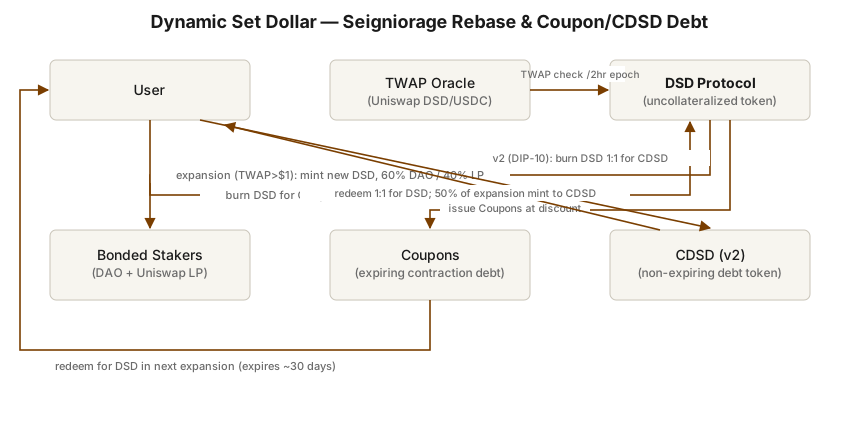 Open full-size diagram
Summary
Dynamic Set Dollar (DSD) was an uncollateralized, "purely algorithmic" USD stablecoin on Ethereum, launched by an anonymous team in late November 2020 as an explicit fork of Empty Set Dollar (ESD). Its pitch was speed: where ESD adjusted supply every 8 hours, DSD rebased every 2 hours (12 epochs/day), removed ESD's 3% per-epoch supply-change cap, and re-tuned coupon expiry and reward splits so the system could "respond even quicker to market demand." Riding the winter 2020–21 algorithmic-stablecoin mania, DSD issued roughly $300M of stablecoins at its late-December peak and traded as high as ~$3 — then collapsed as low as $0.27 within a month of launch. A February 2021 v2 (DIP-10) replaced expiring coupons with a tradable debt token (CDSD), but the peg was never durably restored; development ceased around April 2021 and the project was abandoned.
Design (Mechanism)
DSD inherited ESD's seigniorage architecture and cranked up the reactivity:
- Peg target and oracle. DSD targeted $1, measured via a Uniswap TWAP against USDC, checked each epoch.
- Fast epochs, uncapped rebase. Epochs lasted 2 hours (12 potential supply adjustments per day vs. ESD's 3). ESD's maximum 3% supply change per epoch was removed, though the supply-elasticity formula was dampened to partially compensate.
- Expansion. When TWAP > $1, new DSD was minted: 60% to DSD bonded in the DAO, 40% to bonded Uniswap DSD/USDC liquidity providers (vs. ESD's 80/20), deliberately weighting rewards toward liquidity depth.
- Contraction via coupons. When TWAP < $1, users could burn DSD to buy coupons at a discount — a claim on future DSD redeemable only if/when the protocol re-entered expansion. DSD coupons expired 360 epochs (~30 days) after purchase, versus ESD's 90-epoch window, to make debt-buying less of a knife-edge bet.
- DIP-10 / v2 (Feb 2021). After coupons demonstrably failed — coupon pricing ignored holding duration, so rational actors bought them near the peg rather than deep in contraction, exactly when buy pressure was least needed — v2 replaced them with CDSD: burn free-floating DSD 1:1 for a non-expiring, freely tradable ERC-20 debt token. Contraction rewards were capped at 100% of burned principal; during expansion, 50% of newly minted supply went to bonded CDSD stakers, redeemable pro-rata 1:1 for DSD; bonded DSD earned up to 20% APY during contractions. The team framed this as importing the symmetry of perpetual-futures funding rates.
Governance ran through DAO-bonded DSD (DIP proposals). The token contract is 0xBD2F0Cd039E0BFcf88901C98c0bFAc5ab27566e3; code was published at github.com/dynamicsetdollar.
Outcome
Failed. DSD's first weeks looked like triumph: launched around November 28–29, 2020, it grew to roughly $300M in circulating stablecoin supply by late December, with the token spiking to ~$3 amid farming demand. But an uncollateralized token trading at $3 is a stablecoin in name only, and the overshoot reversed violently: by December 28, 2020 — one month after launch — DSD hit $0.27 with ~789,000 DSD already burned into coupon debt. Cointelegraph called it the design's "massive test"; skeptics like Emin Gün Sirer (whales as the real stabilizers) and Ari Paul ("these just look like pump and dumps to me") were quoted on the model's fragility in real time. The protocol spent essentially the rest of its life below peg. DIP-10/CDSD (February 2021) briefly restructured the debt overhang but did not restore $1; official communications stopped around April 2021, the website went dark, and DSD now trades as an untended remnant at a small fraction of a dollar.
Why it worked
- Fork-and-tune go-to-market. Launching as "ESD but faster" during peak algo-stable mania captured enormous reflexive demand instantly — ~$300M supply within a month, with no VC raise and no collateral.
- Real mechanism iteration. The 2-hour epochs, dampened elasticity, longer coupon expiry, and LP-weighted rewards were genuine parameter experiments on ESD's design, and DIP-10's duration-aware, non-expiring CDSD correctly diagnosed why static-priced expiring coupons fail. The v2 analysis remains one of the clearer public postmortems of coupon mechanics.
- Yield-driven liquidity bootstrapping. The 40% LP reward share built deep Uniswap liquidity quickly, which is exactly what a rebase-oracle system needs early on.
Where the design broke
- No floor without collateral. Once confidence broke, the only bid below peg was speculative coupon/CDSD buying — a claim on future expansion that never came. Death spiral dynamics were structural, not incidental.
- Coupons front-run their own purpose. As the team itself admitted in DIP-10, coupons priced without holding-duration risk get bought near the peg, not in the depths of contraction — contraction pressure arrived precisely when the mechanism supplied none.
- Speed amplified reflexivity. Faster epochs and no supply cap meant DSD inflated harder above peg (attracting mercenary farmers) and accumulated debt faster below it. Reactivity is symmetric; so is panic.
- Farm-and-dump demand. Almost all demand was seigniorage yield-seeking, not use of DSD as money. When expansion APY vanished, so did holders — Ari Paul's "pump and dump" read proved accurate in effect if not intent.
- Debt overhang. Hundreds of thousands of DSD in coupon claims meant any recovery toward $1 would be met by a wall of redemption selling — a self-blocking peg.
Lessons
- A stablecoin whose demand is its own emission schedule is a Ponzi-shaped instrument regardless of intent. Organic transactional demand must exist before, not after, the peg mechanism is stress-tested.
- Debt-based contraction fails when debt pricing ignores duration and risk. Expiring, discount-priced coupons invite peg-proximity sniping; even the improved CDSD only restructures the overhang — it cannot conjure a buyer of last resort.
- Increasing mechanism speed increases fragility, not stability. DSD's core bet — that ESD failed for being too slow — was falsified; both directions of reflexivity accelerated.
- Seigniorage overhang is anti-recovery. Every promise of future supply to debt holders raises the sell wall at the peg, making re-pegging progressively harder the longer contraction lasts.
- Anonymous teams can ship and iterate honestly (DSD's DIP-10 self-critique was candid), but anonymity plus a failing peg leaves no one accountable for wind-down; abandonment, not orderly redemption, was the endgame.
Redesign (EDITORIAL — hypothesis, not fact)
This section is editorial hypothesis, not historical fact. A modern redesign would abandon the zero-collateral premise: start as an overcollateralized or partially collateralized system (à la later FRAX v1 or a DAI-style vault core) and let the "algorithmic" share expand only as measured transactional demand — not staking demand — grows, using metrics like non-farming transfer volume and integrations as the expansion governor. Contraction should be funded, not promised: a protocol-owned reserve (accumulated from expansion-phase seigniorage rather than distributing 100% of it to insiders) acts as buyer of last resort below a hard floor (e.g., $0.90), converting death-spiral reflexivity into a bounded band. If debt instruments are used at all, price them as duration-sensitive bonds via continuous auction (discount increasing with time-below-peg), with redemption seniority ordered by purchase depth so buying in the trough is strictly more profitable than sniping near the peg — directly fixing the incentive inversion DIP-10 identified but could not solve without collateral. Finally, cap expansion-phase APY and vest it, so mercenary capital cannot mint the overshoot that manufactures the subsequent collapse. The honest conclusion from DSD, ESD, and Basis Cash is that the fully uncollateralized rebase-coupon design class is unsalvageable; the redesign is a different species, not a patched DSD.
Sources
- Introducing Dynamic Set Dollar (official announcement) — primary (docs)
- DSD V2: DIP-10 High-Level Spec (official) — primary (governance)
- Dynamic Set Dollar (DSD) token contract — Etherscan — primary (contract)
- dynamicsetdollar/dsd-protocol — GitHub — primary (contract)
- Dynamic Set Dollar faces 'massive test' as stablecoin falls as low as $0.27 — Cointelegraph (Dec 28, 2020) (news)
- Dynamic Set Dollar Review — DeFi Picks (Dec 22, 2020) (analysis)
Related experiments
Last verified: 2026-07-26 · Spot an error? Suggest a correction