Uniswap V3
An automated market maker that introduced concentrated liquidity, letting LPs allocate capital to custom price ranges for dramatically higher capital efficiency.
▶ Run interactive simulation animated mechanism with editable parameters
How it works onchain
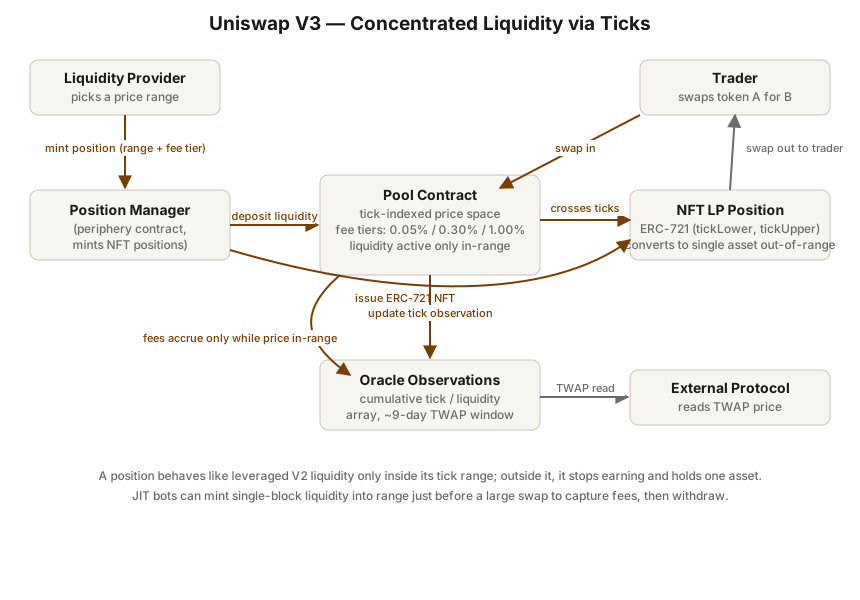 Open full-size diagram
Summary
Uniswap V3 is the third major version of the Uniswap protocol, a non-custodial automated market maker (AMM) for token swaps on Ethereum and EVM chains. Announced in March 2021 and deployed to Ethereum mainnet on May 5, 2021, it replaced the uniform x*y=k liquidity curve of V1/V2 with concentrated liquidity: liquidity providers (LPs) specify a finite price range in which their capital is active, rather than spreading it uniformly from zero to infinity. Within its active range an LP's position behaves like a much deeper V2 pool, delivering — per the official announcement — up to ~4,000x greater capital efficiency for LPs who target tight ranges around a peg. V3 also introduced multiple per-pair fee tiers, LP positions represented as NFTs, improved and cheaper time-weighted average price (TWAP) oracles, and shipped under the Business Source License 1.1 (a time-delayed GPL) to restrict verbatim forking. It became the dominant DEX design of its era and one of the most-copied smart-contract systems in DeFi.
Design (Mechanism)
The core innovation is concentrated liquidity via ticks. The price space is discretized into "ticks" (each tick = a 0.01% / 1-basis-point price step). An LP mints a position bounded by a lower and upper tick; their capital is only deployed — and only earns fees — while the pool's spot price sits inside that band. If the price exits the range, the position converts entirely to the outer asset and stops earning until price returns. This makes a V3 position mathematically equivalent to a leveraged V2 position, plus effectively a "range order" (a one-sided limit-order-like fill as price crosses the band).
Supporting mechanisms:
- Multiple fee tiers. Each pair can have separate pools at 0.05%, 0.30%, and 1.00% (a 0.01% tier was later added via governance), so LPs price risk by expected volatility — stablecoin pairs use low tiers, volatile/long-tail pairs use higher tiers.
- NFT LP positions. Because every position has unique tick bounds and fee tier, LP shares are non-fungible ERC-721 tokens (via the NonfungiblePositionManager periphery) rather than fungible ERC-20 LP tokens. Fungible "common" positions can be rebuilt in peripheral contracts.
- Oracle upgrade. V3 stores an array of cumulative tick and liquidity observations, letting any consumer compute a TWAP over any window in roughly the last ~9 days in a single call, at about half the gas of V2 oracle reads.
- Architecture. Split into
v3-core(immutable pool + factory math, the deployedUniswapV3Factoryat0x1F98431c8aD98523631AE4a59f267346ea31F984) andv3-periphery(routers, position manager, quoter). Deployment is deterministic across many EVM chains at the same factory address.
Outcome
Status: major_success. Uniswap V3 became the reference implementation for concentrated-liquidity AMMs and, for years, the highest-volume DEX contract set in DeFi, deployed across Ethereum, Optimism, Arbitrum, Polygon, Base, BNB Chain, Celo, and Avalanche, with cumulative trading volume in the trillions of dollars and multi-billion-dollar TVL. Its design shaped a generation of forks and successors (PancakeSwap V3, Sushi's Trident/V3 concentrated pools, Algebra, and Uniswap's own V4 hooks architecture). The BSL license and brand meaningfully slowed verbatim clones during the two-year exclusivity window. Commercially and technically the launch is unambiguously a landmark. The contracts have not suffered a core protocol exploit.
Why it worked
- Capital efficiency solved a real cost. V2 liquidity was mostly idle far from the current price; concentrating it near the spot price gave traders deeper effective liquidity (tighter slippage) with far less locked capital, which is compelling for both LPs seeking yield and for aggregators routing size.
- Right primitive at the right time. Stablecoin and pegged-asset trading (USDC/USDT, ETH/stETH) benefited enormously from ultra-tight ranges, and DeFi's 2021 growth gave immediate demand.
- Composability and tooling. NFT positions plus a clean core/periphery split enabled a whole ecosystem of automated liquidity managers (Gamma, Arrakis, Charm) to build on top, expanding effective supply of managed liquidity.
- Defensive licensing and brand. BSL 1.1 protected the first-mover window; Uniswap's brand, front-end, and governance token (UNI) reinforced network effects.
Limitations and criticisms
Concentrated liquidity redistributes risk as much as it creates efficiency, and V3 exposes real, unresolved problems for its participants:
- LP profitability and amplified impermanent loss. Concentrated liquidity is leveraged liquidity, so it also leverages impermanent (divergence) loss. Multiple peer-reviewed studies (e.g., Loesch et al., arXiv 2111.09192; Bancor/IntoTheBlock analysis) found that a large share of V3 LPs — on the order of half in several samples — would have been better off simply holding, once IL is netted against fees.
- Active management burden. Tight ranges must be re-centered as price moves, or the position goes out of range and stops earning. This pushed sophistication and gas costs onto LPs and toward third-party managers and MEV bots.
- Toxic flow and JIT liquidity. Concentration made LPs more exposed to informed/arbitrage flow, and enabled just-in-time (JIT) liquidity attacks where a bot mints huge single-block liquidity to capture a large swap's fees then withdraws, diluting passive LPs' returns.
- Complexity. The tick math, NFT positions, and range mechanics raised the barrier to entry versus V2's set-and-forget simplicity.
Lessons
- Capital efficiency and risk are coupled. Letting LPs lever their liquidity boosts headline efficiency and fee density but proportionally amplifies divergence loss — an AMM upgrade can improve trader experience while worsening the median LP's real return.
- Passive-friendly design has value. V2's uniform curve was capital-inefficient but nearly effortless; V3 shifted labor and MEV exposure onto LPs, creating demand for an entire layer of active-management and vault products to abstract that complexity back away.
- Mechanism design must anticipate adversarial actors. JIT liquidity and toxic-flow capture show that any fee-earning primitive will be gamed at the block level; incentive edges (e.g., who earns the fee on a large fill) should be reasoned about under MEV.
- Licensing can be a moat. BSL 1.1 demonstrated that source-available-but-restricted licensing plus brand can preserve first-mover advantage in open-source DeFi far better than pure MIT/GPL.
Redesign (EDITORIAL — hypothesis, not fact)
The following is the researcher's editorial hypothesis, not established fact.
If redesigning from scratch, the central tension to attack is that V3 optimizes for aggregate liquidity depth while quietly making the median passive LP unprofitable. A redesign might: (1) make protocol-native, gas-cheap auto-rebalancing / auto-compounding ranges a first-class feature so LPs are not forced into third-party vaults or manual management, reducing out-of-range dead time; (2) add loss-versus-rebalancing (LVR)-aware fees — dynamic fee tiers that rise with realized volatility or with detected arbitrage/toxic flow, so LPs are compensated precisely when they bear the most adverse selection, and add explicit anti-JIT mechanics (e.g., time-locked or block-delayed fee accrual) so single-block liquidity cannot skim large swaps; and (3) expose an auction or MEV-recapture layer at the pool level so value currently extracted by searchers is returned to LPs. Notably, Uniswap's own V4 (hooks) moves toward some of this by making customizable per-pool logic possible — the hypothesis here is that concentrated liquidity's next leap is less about raw efficiency and more about redistributing the MEV and adverse-selection costs back toward the LPs who currently subsidize them.
Sources
- Introducing Uniswap v3 (official announcement) — primary (docs)
- Uniswap v3 Core Whitepaper — primary (docs)
- Uniswap/v3-core smart contracts (GitHub) — primary (contract)
- UniswapV3Factory on Etherscan — primary (contract)
- Uniswap developer docs (official social links) — primary (docs)
- Impermanent Loss in Uniswap v3 (Loesch et al.) (analysis)
- Concentrated Liquidity Increases Risk of Impermanent Loss (Bancor/IntoTheBlock) (analysis)
- Demystifying Just-in-Time (JIT) Liquidity Attacks on Uniswap V3 (analysis)
Related experiments
Last verified: 2026-07-26 · Spot an error? Suggest a correction