Bancor
The first on-chain automated market maker: a bonding-curve 'smart token' protocol that pioneered continuous, contract-native liquidity before Uniswap, later famous for its (ultimately paused) single-sided impermanent-loss protection.
▶ Run interactive simulation animated mechanism with editable parameters
How it works onchain
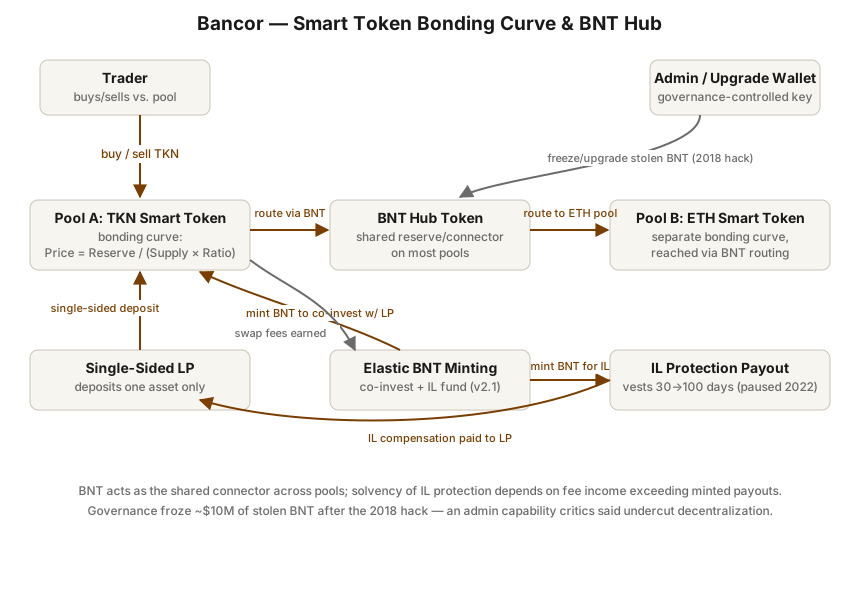 Open full-size diagram
Summary
Bancor is the original on-chain automated market maker (AMM). Launched in June 2017 after a then-record $153 million token generation event, it introduced "smart tokens" — ERC-20 tokens whose own smart contract holds reserve balances and continuously prices itself against those reserves via a bonding curve. This let any token be bought or sold directly against its contract at an algorithmically calculated price, without an order book or counterparty. The design predates Uniswap (2018) and established the conceptual template — a reserve-backed pricing formula recalculated on every trade — that the entire AMM sector later built on. The protocol is named after John Maynard Keynes's proposed 1944 supranational reserve currency, reflecting its central design idea: the Bancor Network Token (BNT) as a common reserve connecting all pools. Bancor was technically pioneering and found real usage, but a compromised-wallet hack, high gas costs, competitive displacement by simpler AMMs, and ultimately a failed impermanent-loss-protection promise left it commercially diminished.
Design (Mechanism)
The core primitive is the smart token: a token that holds one or more "connector" (reserve) balances and prices itself with the constant-reserve-ratio formula:
Price = Reserve Balance / (Token Supply × Reserve Ratio)
Buying mints new smart tokens and adds the paid reserve; selling burns smart tokens and returns reserve. The reserve ratio (0–100%) sets curve steepness and how much price moves per trade. BNT was designed as a universal reserve "hub": most pools held BNT as one connector, so any token could route to any other token through BNT, giving network-wide liquidity from pairwise pools. This hub-and-spoke topology contrasted with Uniswap's later ETH-paired then arbitrary-pair model.
Later iterations reshaped the economics:
- v2 / v2.1 (2020): Introduced single-sided liquidity and impermanent-loss (IL) protection. A user could deposit just one asset (e.g., only ETH, or only BNT). To fund the other side, the protocol used an elastic BNT supply: it minted BNT to co-invest alongside LPs, earning fees on that co-invested BNT. IL suffered by LPs was compensated by minting BNT, while excess protocol-earned BNT was burned to offset costs. Coverage vested linearly — a 30-day cliff, then up to 100% protection after 100 days.
- v3 (2022): Extended single-sided staking, an "omnipool," instant IL protection, and auto-compounding rewards.
The economic bet was that swap fees on protocol-owned BNT liquidity would, over time, cover the minted BNT used to pay IL claims — sustainable only if fee revenue exceeded IL payouts across market conditions.
Outcome
Bancor's outcome is best read as technically successful but commercially unsuccessful.
- Technical/first-mover success: It shipped the first working on-chain AMM and validated bonding-curve liquidity, directly seeding an entire DeFi category.
- 2018 hack: In July 2018 a wallet used to upgrade smart contracts was compromised; roughly $23.5M was taken (about $12.5M ETH, ~$10M BNT, ~$1M NPXS). Bancor froze the stolen BNT — an admin capability that recovered ~$10M but drew heavy criticism (notably from Charlie Lee) that a protocol able to freeze tokens is not truly decentralized.
- IL-protection collapse (June 2022): During market stress (the Terra/3AC/Celsius era), Bancor paused its flagship IL protection, citing "hostile market conditions," the insolvency of large centralized entities that had been key liquidity-mining beneficiaries rapidly dumping BNT, and a large external short on BNT. LPs who had been promised full IL coverage were left exposed. Protection was framed as temporary but the episode broke the core value proposition.
- Long tail: TVL migrated away; by 2025–2026 protocol TVL sat in the low tens of millions. The community pivoted toward newer products (Carbon DeFi, Arb Fast Lane) with 100% of fees directed to BNT buyback-and-burn. BNT supply peaked ~289M (May 2022) and later contracted to roughly ~115M.
Why it worked
- Genuine primitive innovation: The smart-token bonding curve solved cold-start liquidity for long-tail tokens without market makers or order books — a real problem, elegantly.
- Record capitalization and mindshare: The $153M raise funded years of R&D and made Bancor a canonical reference point; the whitepaper's pricing formula became foundational teaching material for AMMs.
- Iterative product ambition: Single-sided liquidity and IL protection were legitimately novel attempts to fix AMMs' worst UX problems (needing paired capital; suffering IL), attracting significant TVL at peak.
Where the design broke
- Complexity vs. Uniswap's simplicity: Bancor's BNT-hub routing and multi-connector design were gas-heavy and harder to reason about than Uniswap's minimal constant-product pairs, which won developer and liquidity network effects.
- The IL-protection promise was under-hedged: Compensating IL by minting BNT works only while fees exceed payouts. Under correlated stress with reflexive BNT price declines and short pressure, the mechanism became self-undermining, forcing the June 2022 pause — the exact moment protection was most needed.
- Centralized control points: The 2018 admin wallet held the ability to upgrade contracts and freeze tokens, and the 2022 IL-protection pause was a discretionary team decision — both sat outside the bonding-curve mechanism itself and could override its outputs.
- BNT reflexivity: Tying network-wide liquidity and IL solvency to a single, mintable, price-sensitive hub token concentrated systemic risk in BNT itself.
Lessons
- Being first is not the same as winning the category. Bancor invented the AMM but a simpler, more composable competitor (Uniswap) captured the durable network effects. Primitive elegance and gas/UX minimalism beat feature richness.
- Do not promise unconditional insurance you fund with your own reflexive token. IL protection via elastic minting is only solvent when fee income beats payouts; correlated market crashes break exactly that assumption. Guarantees that must be paused are worse than never promising them.
- Admin powers are a latent liability. Upgrade wallets and freeze functions provided a recovery path in 2018, but the same functions mean a single compromised or discretionary key can move or lock user funds — emergency levers double as attack surface.
- Concentrating systemic risk in one hub token is dangerous. Routing all liquidity and solvency through BNT made the whole system as fragile as its most reflexive asset.
Redesign (EDITORIAL — hypothesis, not fact)
The following is analysis and opinion, not established fact.
If rebuilt today, Bancor's most defensible contribution — the bonding-curve smart token — should be decoupled from the two features that ultimately hurt it: the mandatory BNT hub and mint-funded IL insurance.
- Drop the single-hub reserve. Allow arbitrary pairs and stablecoin/blue-chip reserves; use BNT (if retained) purely as an optional routing/incentive layer, not as the solvency backbone. This removes the reflexivity that turned a BNT drawdown into a protocol-wide crisis.
- Fund IL protection from a pre-capitalized, transparent insurance fund with hard, on-chain solvency caps — never from open-ended minting. Coverage should degrade gracefully and provably (e.g., pro-rata payouts capped at the fund balance) rather than via a discretionary "pause." Publish a real-time solvency ratio; auto-throttle new coverage when it falls below threshold. A promise that can silently fail is worse than an explicit, visibly-bounded one.
- Minimize admin surface with immutable core contracts and timelocked, DAO-gated upgrades, replacing the 2018-style upgrade wallet. Any freeze capability, if kept at all, should be a slow, multi-sig-plus-governance action, not a hot key.
- Lean into the surviving strength. Bancor's later Carbon DeFi (range/limit-order AMM) suggests the team's real edge is novel curve mechanics; a redesign might position the protocol as an order-type and curve-shape innovator layered atop neutral, well-capitalized pools, rather than trying to be a monolithic liquidity hub.
The through-line: keep the mathematical inventiveness, but eliminate the single points of reflexive and administrative failure that repeatedly converted market stress into existential events.
Sources
- Bancor Protocol Whitepaper — Continuous Liquidity and Asynchronous Price Discovery — primary (docs)
- Bancor Protocol Whitepaper (original PDF) — primary (docs)
- Press Release: Bancor Announces $153 Million Raise, Largest Token Generation Event in History — primary (retrospective)
- BNT Token Contract — Etherscan — primary (contract)
- Proposing Bancor v2.1: Single-Sided AMM Exposure with Elastic BNT Supply (Governance Forum) — primary (governance)
- Bancor v3 Technical Docs — Contracts — primary (docs)
- $13.5 Million Hack Ignites Fresh Debate Over Crypto Project Bancor (CoinDesk) (news)
- Bancor pauses impermanent loss protection citing 'hostile' market conditions (Cointelegraph) (news)
- Bancor Raised $153 Million and Found Actual Users. Why Did Its Price Tank? (CoinDesk) (analysis)
Related experiments
Last verified: 2026-07-26 · Spot an error? Suggest a correction