Synthetix
SNX-collateralized synthetic-asset protocol whose pooled-debt model pioneered liquidity mining and DeFi derivatives, then spent years unwinding that same debt machinery until sUSD was retired in 2026 and the protocol pivoted to a mainnet perps exchange.
▶ Run interactive simulation animated mechanism with editable parameters
How it works onchain
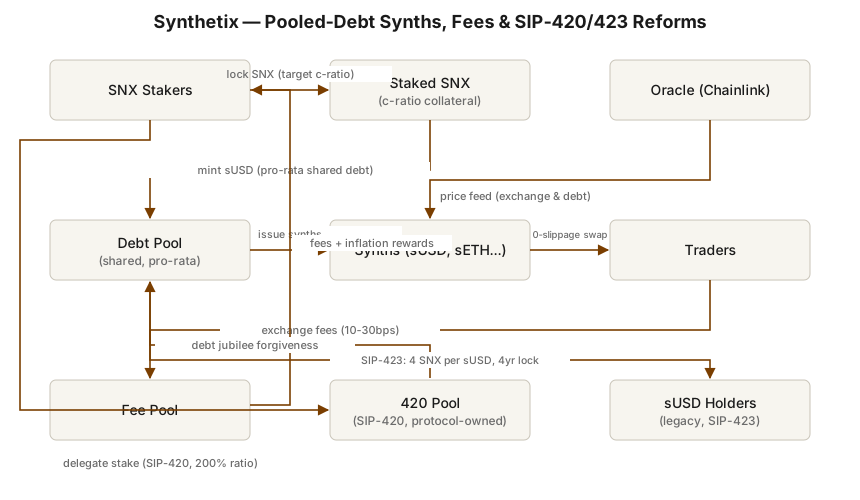 Open full-size diagram
Summary
Synthetix began life in 2017 as Havven, a decentralized stablecoin project founded by Australian entrepreneur Kain Warwick (whitepaper co-authored with Anton Jurisevic, Samuel Brooks, and Michael Spain) as an alternative to Tether. It raised roughly $30M in its early-2018 ICO, launched on Ethereum mainnet in 2018, and rebranded to Synthetix later that year, generalizing the stablecoin design into a full synthetic-asset ("Synth") platform: SNX stakers collectively collateralized a family of tokens (sUSD, sETH, sBTC, synthetic gold, indices) tracking oracle prices. Synthetix is one of DeFi's most influential experiments — it effectively invented liquidity mining (the 2019 sETH/ETH Uniswap incentives), popularized staking-inflation rewards, and seeded the perps DEX wave (Kwenta on Optimism). But its core mechanism — a shared debt pool backed by the protocol's own volatile token — proved chronically hard to manage. After the SIP-420 restructuring triggered a deep sUSD depeg in April 2025 (bottoming near $0.68), governance retired legacy sUSD via SIP-423 in mid-2026, compensating holders in vested SNX, and the protocol relaunched as a perpetual-futures exchange on Ethereum mainnet.
Design (Mechanism)
- Pooled collateral, shared debt. Stakers locked SNX at a very high collateralization ratio (long ~750%, later lowered) to mint sUSD. Minting created debt denominated in sUSD, but critically each staker owed a pro-rata share of the global debt pool, not the specific synths they minted. If traders in aggregate got richer (e.g., sBTC holders during a rally), every staker's debt grew — stakers were the collective counterparty to all synth holders.
- Infinite-liquidity exchange. Synths swapped against the debt pool at oracle prices with no order book and no slippage (fees ~10–30 bps), an early "oracle-priced AMM-less exchange."
- Incentives. Stakers earned exchange fees plus SNX inflation rewards (introduced 2019 to bootstrap staking), claimable only while maintaining the target c-ratio — a continuous incentive to manage debt. The 2019 sETH Uniswap pool rewards are widely credited as the first liquidity-mining program.
- Iterations. V2x added perps and moved most activity to Optimism (Synthetix served as backend liquidity for Kwenta and others). V3 (2023–24) rebuilt the system around generalized pooled collateral (SNX, ETH, USDC, etc.). SIP-420 (2025) created a protocol-owned "420 Pool": stakers delegated positions to a shared pool at a 200% issuance ratio (down from 750%), with a "debt jubilee" forgiving historical debt over time. SIP-423 (June 2026) froze legacy sUSD and converted holders to SNX claims at 4 SNX per sUSD, locked 4 years with a 1-year linear vest, decoupling SNX staking from stablecoin obligations.
Outcome
Partial success, and still operating. Peak-era Synthetix was a top-5 DeFi protocol by TVL and the intellectual source of mechanisms (liquidity mining, staking rewards, synths, oracle-priced swaps) copied across the industry. It survived a serious June 2019 oracle incident (a stale/incorrect sKRW feed let a bot mint tens of millions of sETH; resolved via negotiated bounty rather than exploit) and multiple redesigns. But the endogenous-collateral stablecoin never durably scaled: sUSD repeatedly traded off-peg, and the April 2025 depeg (to ~$0.68 after SIP-420 removed peg-maintenance incentives) was the deepest in its history. The "Repeggening" campaign (requiring jubilee participants to hold sUSD in the 420 Pool) recovered the peg to ~$0.96, but governance ultimately chose euthanasia over repair: SIP-423 retired legacy sUSD. In 2024–25 Synthetix also unwound its Optimism L2 deployment and returned to Ethereum mainnet as a perps DEX ("onchain custody, offchain performance"). The SNX token and community endure; the original mechanism largely does not.
Why it worked
- Incentive invention. Liquidity mining and inflationary staking rewards solved cold-start liquidity years before "DeFi Summer"; the whole industry adopted its playbook.
- Zero-slippage synths were a real product. Oracle-priced exchange offered trades AMMs of the era couldn't, attracting genuine trading volume and later powering perps frontends.
- Relentless, legitimate governance. The SIP process, elected councils, and willingness to pivot (Havven→Synthetix→V3→perps) kept a 2017-vintage project alive through four market cycles.
- Aligned counterparty design. Making stakers the traders' counterparty, paid in fees and inflation, created a self-contained economy that briefly worked at scale.
Why it failed or underperformed
- Endogenous collateral. Backing sUSD with SNX — whose value derived from the system's own fees — created reflexivity: SNX drawdowns squeezed the c-ratio exactly when stability was needed most.
- Shared-debt UX was brutal. Stakers bore market risk they didn't choose (debt-pool skew, frontrunning losses, "one-off events"), requiring hedging sophistication most holders lacked.
- Incentive surgery broke the peg. SIP-420's lower issuance ratio and debt jubilee removed the individual incentive to buy cheap sUSD and burn debt — the peg's main restoring force — and supply flooded out; the depeg followed within weeks.
- Complexity debt. Years of migrations (V2x, V3, L2 in-then-out) fragmented liquidity and exhausted integrators; competitors with simpler perps designs (GMX, Hyperliquid) captured the market Synthetix had opened.
Lessons
- A stablecoin backed by the protocol's own token inherits the token's beta. Exogenous or diversified collateral is the price of durable pegs; Synthetix's V3 multi-collateral move conceded this too late.
- Pegs are held by micro-incentives, not intentions. The moment SIP-420 made debt repayment optional/forgiven, arbitrageurs had no reason to buy sub-peg sUSD. Any redesign must model who profits from restoring the peg on day one.
- Socialized debt needs socialized tooling. If users share a debt pool, the protocol must ship hedging/delegation natively (as the 420 Pool finally did) rather than expect retail stakers to run delta-neutral books.
- Being first is not a moat. Synthetix invented mechanisms that competitors implemented with less baggage; migration-heavy roadmaps hand your market to fast followers.
- Orderly retirement is a valid governance outcome. SIP-423's convert-and-vest wind-down of sUSD (par compensation in locked SNX, revenue-share fallback) is a rare example of a protocol sunsetting a failed mechanism while compensating holders rather than leaving the token to fall to zero.
Redesign (EDITORIAL — hypothesis, not fact)
This section is editorial analysis — a hypothesis, not fact. A redesigned Synthetix-2018 would keep the pooled-counterparty exchange but split the two jobs it conflated: (1) the stablecoin should have been collateralized by exogenous assets (ETH, later LSTs/USDC) from day one, with SNX serving only as a junior/insurance tranche that absorbs first losses in exchange for fees — turning reflexivity into an explicit, priced risk position rather than the system's foundation. (2) Debt-pool exposure should have been an opt-in, tokenized hedgeable instrument (a "counterparty vault" with published skew, caps per synth, and automatic funding-rate rebalancing — roughly what perps funding later did) instead of an obligation silently attached to all stakers. Finally, incentive changes of SIP-420's magnitude should have been shipped with a peg-defense module active before the change (e.g., debt forgiveness streamed only in proportion to sUSD bought-and-burned below peg), which the later "Repeggening" improvised reactively. Plausibly, that design retains Synthetix's liquidity-mining flywheel while avoiding both the 2025 depeg and the eventual retirement of its stablecoin.
Sources
- Synthetix official site — primary (docs)
- SNX Proxy Token on Etherscan — primary (contract)
- SIP-420: Protocol Owned SNX (delegated staking / 420 Pool) — primary (governance)
- SIP-423: sUSD Retirement & Staking Reform — primary (governance)
- Synthetix blog: Transitioning to Synthetix V3 — Scaling sUSD & Migrating SNX — primary (docs)
- Synthetix blog: The Repeggening — primary (retrospective)
- Synthetix blog: 420, Stake It — primary (docs)
- Cointelegraph: What happened to sUSD? How a crypto-collateralized stablecoin depegged (analysis)
- PANews: Abandoning L2 and returning to the mainnet, Synthetix V3 kicks off the Perp DEX war (news)
- Blockworks: Synthetix looks to fix staking, revive stablecoin (news)
- Interview: The Past, Present & Future of Synthetix with Kain (official blog) — primary (retrospective)
Related experiments
Last verified: 2026-07-26 · Spot an error? Suggest a correction