BitShares
Dan Larimer's 2014 Graphene-era 'decentralized autonomous company' that pioneered DPoS consensus, an on-chain order-book DEX, and bitUSD — the first crypto-collateralized stablecoin — years before DeFi, but whose stablecoins broke in the 2018 bear market.
▶ Run interactive simulation animated mechanism with editable parameters
How it works onchain
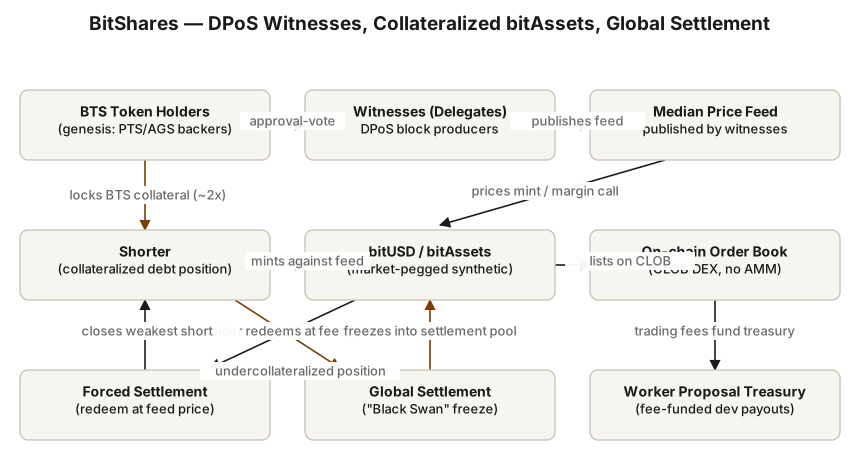 Open full-size diagram
Summary
BitShares is arguably the single most influential "prehistoric DeFi" experiment. Conceived by Dan "Bytemaster" Larimer on June 2, 2013 (initially as a design for "a fiat/Bitcoin exchange without fiat deposits") and incubated through Invictus Innovations — co-founded with Charles Hoskinson before he left for Ethereum and later Cardano — BitShares X launched on July 19, 2014 as a self-described Decentralized Autonomous Company (DAC). It shipped, in one system and years ahead of Ethereum-era DeFi: the first delegated proof-of-stake (DPoS) chain, the first on-chain order-book DEX, the first crypto-collateralized stablecoin (bitUSD, ~July 21, 2014), an on-chain treasury with worker proposals, and stakeholder governance by approval voting. Its October 13, 2015 rewrite on the Graphene engine (built by Cryptonomex) made it, for a time, the fastest production blockchain. Yet BitShares never captured durable users or liquidity: Larimer left in 2016 to build Steem and then EOS, bitUSD suffered a "global settlement" bad-debt event in December 2018, and the chain persists today as a marginal system with BTS down more than 99% from its peak.
Design (Mechanism)
Fundraise via protocoin + donations. Before launch, ProtoShares (PTS, November 5, 2013) was a mineable placeholder coin redeemable for future BitShares, and AngelShares (AGS, December 14, 2013) took BTC/PTS donations for a share of genesis allocation — an ICO prototype pre-dating the ICO era.
DPoS consensus. Introduced by Larimer on December 8, 2013: BTS holders continuously approval-vote for a small set of block producers ("delegates," later "witnesses") who take turns producing blocks in seconds. This traded validator-set decentralization for throughput and explicit accountability — misbehaving witnesses are voted out. The Graphene rewrite (BitShares 2.0, October 2015) claimed ~100,000 TPS in benchmarks (without signature verification) and 1–3 second blocks; the same engine later powered Steem and EOS.
Market-pegged assets (bitAssets/SmartCoins). bitUSD, bitCNY, bitGold etc. were synthetic assets created by shorters who locked BTS collateral (initially ~2x the debt value) against a median price feed published by elected witnesses. Peg enforcement came from: margin calls when collateral ratio fell below maintenance; forced settlement, letting any bitUSD holder redeem against the least-collateralized short at feed price (making 1 bitUSD a claim on ~$1 of BTS); and a global settlement ("black swan") procedure that froze all positions of an asset into a settlement pool if the worst position became undercollateralized. This is recognizably the MakerDAO template — CDP-style debt, price oracles, liquidation — built on a bespoke chain in 2014.
DEX. A fully on-chain central limit order book with maker/taker orders matched in consensus, no AMM, plus user-issued assets (UIAs) — permissioned tokens issuable by anyone, used by gateways to issue IOUs like OPEN.BTC.
Self-funding governance. Transaction fees and a reserve pool funded "worker proposals" approved by BTS voter approval; an elected committee tuned chain parameters (fees, collateral ratios). The chain paid its own developers — a DAO treasury before the word existed.
Outcome
Technically, BitShares delivered nearly everything it promised: it ran for over a decade without a fatal consensus failure, processed real DEX volume (notably large bitCNY usage in China around 2017–18), and its Graphene/DPoS lineage powered Steem, Hive, EOS, and inspired dozens of chains. Commercially and monetarily it underperformed badly. The project's lead architect departed in early 2016, leaving it without continuity of design leadership; liquidity migrated to centralized exchanges and later to Ethereum DeFi. In December 2018, the BTS price crash pushed bitUSD's aggregate collateral below its debt, triggering global settlement: the peg broke, holders faced roughly 20–30% haircuts on redemption, and debt positions were frozen — prompting years of patchwork governance responses (BSIP-58 "global settlement protection," alternative black-swan handling in core PR #2499) that critics argued simply suspended honest accounting of bad debt. As of 2025 BTS trades around a tenth of a cent with modest daily volume; the chain is alive but peripheral, and even its official web presence has fragmented across bitshares.org, bitshares.github.io, and community sites.
Why it worked
- Right primitives, astonishingly early. Collateralized stablecoins, an on-chain order book, oracle price feeds, liquidations, and a self-funding treasury all shipped in 2014–15 and demonstrably functioned — the conceptual blueprint MakerDAO, dYdX-style perps, and DAO treasuries later refined.
- Performance engineering. Graphene's in-memory state and DPoS gave sub-3-second blocks and real throughput when Bitcoin and Ethereum could not, making an on-chain order book plausible at all.
- Aligned bootstrap. PTS/AGS distribution and worker proposals created a stakeholder base that funded development from the chain itself for a decade.
Where the design broke
- Reflexive collateral. bitAssets were backed solely by BTS — the system's own volatile equity. A deep BTS bear market simultaneously crushed collateral value and demand for leverage, guaranteeing the 2018 global settlement. MakerDAO survived similar stress partly by diversifying collateral; BitShares never could.
- Single-architect dependency. Design continuity was concentrated in one person across BitShares, Steem, and EOS; each move to a new chain left the prior one without its lead designer, compounding an earlier dilution event (the 2014 "Great Consolidation") that had already eroded trust in early PTS/AGS allocations.
- Governance as bottleneck. Voter apathy, Chinese-community/Western-community splits, and committee micromanagement of feeds and parameters (culminating in feed adjustments that delayed recognizing bitCNY/bitUSD bad debt) undermined the credibility of the very peg mechanisms the chain existed to provide.
- Isolated liquidity. A bespoke chain with gateway-IOU bridges could not compete once composable liquidity aggregated on Ethereum.
Lessons
- An endogenously collateralized stablecoin (backed only by its own chain's token) is structurally short its own ecosystem; it survives bull markets and dies in the first deep drawdown — a lesson re-learned expensively by Terra/UST seven years later.
- Being first with a mechanism matters far less than being where liquidity and developers compose; BitShares invented the primitives and Ethereum monetized them.
- On-chain treasuries and stakeholder voting can sustain a project for years, but they cannot substitute for committed founding leadership, and they invite parameter-level manipulation when insolvency looms — honest accounting rules (automatic settlement) must be credibly hard to override.
- "Global settlement" as a black-swan mechanism protects the system's ledger but destroys user trust if it socializes losses opaquely; loss-allocation design deserves as much attention as the happy-path peg.
Redesign (EDITORIAL — hypothesis, not fact)
This section is editorial speculation. A modern BitShares would keep DPoS-speed execution and the CLOB but fix the collateral reflexivity: bitAssets should have accepted exogenous collateral (BTC via trust-minimized bridges, later ETH/RWAs) with BTS only as a junior recapitalization asset, MKR-style, and an automatic debt-auction backstop instead of committee-managed price feeds. Feed publication should have been separated from block production (witnesses held both roles, concentrating power), and global settlement replaced with a Maker-like emergency shutdown plus transparent pro-rata haircut schedule fixed in code. Finally, the treasury's worker proposals could have funded an EVM-compatibility layer circa 2017, letting BitShares' liquidity and stablecoins compose with the ecosystem that ultimately ate it. Whether any of this would have overcome the founder exodus is unknowable.
Sources
- The History of BitShares — official documentation — primary (docs)
- BitShares core implementation (bitshares-core) — primary (contract)
- BSIP-58: Global Settlement Protection Through Price Feeding — primary (governance)
- bitshares-core PR #2499: Implement alternative black swan response methods — primary (governance)
- Graphene technology — BitShares documentation — primary (docs)
- awesome-bitshares (official resource list, social links) — primary (docs)
- BitShares Black Swan and the troubles of stablecoins (community postmortem) (analysis)
- Guide to BitShares Blockchain Protocol (analysis)
Related experiments
Last verified: 2026-07-27 · Spot an error? Suggest a correction