Steemit
The first large-scale 'blogging pays' social network, where a purpose-built DPoS chain minted inflationary tokens into a reward pool distributed by stake-weighted upvotes.
▶ Run interactive simulation animated mechanism with editable parameters
How it works onchain
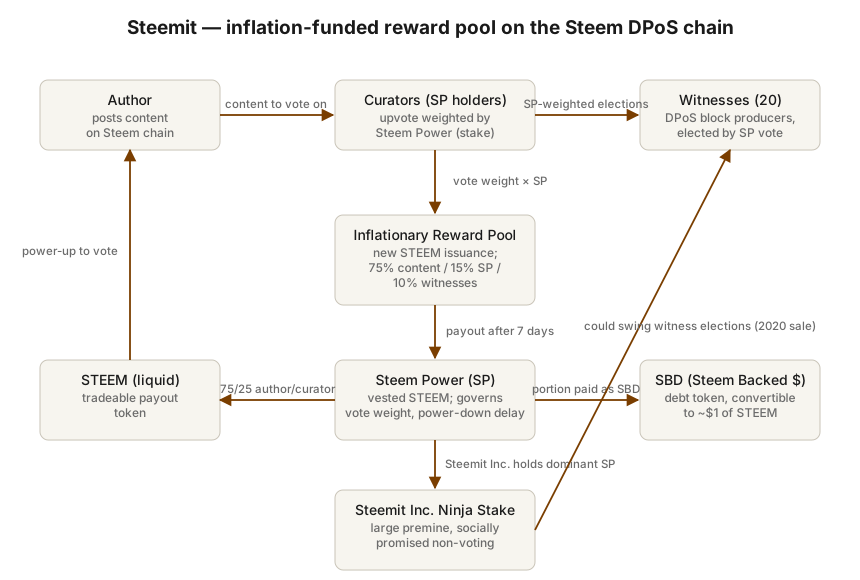 Open full-size diagram
Summary
Steemit was the flagship application of Steem, a purpose-built delegated-proof-of-stake (DPoS) blockchain co-founded by Ned Scott and Daniel Larimer (BitShares, later EOS) in January 2016. The chain went live on 2016-03-24 and the Steemit.com social platform formally launched on 2016-07-04, distributing roughly $1.3M in first rewards to early users. The pitch: a Reddit-like site where upvotes mint real money. Instead of advertisers paying creators, token inflation funded a "reward pool" split among authors and curators by stake-weighted voting. STEEM briefly reached a top-3 market cap ranking in July 2016 and Steemit accumulated over a million accounts, making it the canonical proto-SocialFi experiment that Hive, and later Friend.tech-era social tokens, are measured against. It survived a 2016 hack (~$85k across compromised accounts) and the 2018 bear market (70% staff layoffs, Nov 2018), but in February 2020 Ned Scott sold Steemit Inc. — including its huge early-mined "ninja stake" — to Justin Sun's Tron, triggering the most famous governance war in blockchain history and the community's exodus to the Hive fork in March 2020. Steemit still operates under Tron today as a shadow of its peak.
Design (Mechanism)
- Three-token system. STEEM (liquid); Steem Power (SP) — STEEM vested for governance/voting influence, withdrawable only via a multi-week "power down" (originally ~2 years, later 13 weeks); and Steem Backed Dollars (SBD) — a debt instrument redeemable for ~$1 of STEEM via conversion, an early algorithmic-stable design.
- Inflation-funded reward pool. New issuance (after hard fork 16 in late 2016: ~9.5%/yr, decaying toward 0.95%) fills a pool, with 75% to content rewards, 15% to SP holders, 10% to witnesses.
- Stake-weighted voting with vote power regeneration. Each account's upvote weight = its SP × a regenerating "voting mana," metering influence over time. Payouts finalized after 7 days.
- Author/curator split. ~75/25 between author and curators (moved to 50/50 in 2019's HF21 "Economic Improvement Proposal"); a reverse-auction window penalized instant votes to reward genuine discovery.
- Reward curve experiments. Originally superlinear (n²) — rewards concentrated on whale-backed posts; HF19 (2017) made it linear — which made self-voting and vote-selling directly profitable; HF21 (2019) introduced a convergent-linear curve plus a free downvote pool to police abuse.
- Consensus/governance. DPoS with 20 elected witnesses + 1 rotating slot, 3-second blocks, feeless transactions rate-limited by stake ("bandwidth"). Witness elections by SP vote — the attack surface later exploited in 2020.
- The ninja mine. Steemit Inc. quietly mined a dominant share of early supply at launch, held as a "development stake" under an informal promise not to use it in governance. This promise was social, not coded.
Outcome
Partial success. As a proof of concept it worked spectacularly for a time: real users earned life-changing money (especially in the developing world), the chain sustained high transaction volumes with feeless UX years before "gasless" was a buzzword, and it seeded an entire genre (Hive, and conceptually every subsequent SocialFi attempt). But the economy degenerated: bid bots and vote-selling markets turned the reward pool into a stake-yield instrument rather than a content-quality signal; STEEM fell from top-3 to irrelevance; Steemit Inc. cut 70% of staff in November 2018. The February 2020 sale to Tron converted the ninja stake into a governance weapon: after community witnesses ran soft fork 0.22.2 freezing that stake, Sun — with custodial deposits from Binance, Huobi and Poloniex — voted in puppet witnesses. The community hard-forked to Hive on 2020-03-20, excluding the Steemit stake; the remaining Steem chain later confiscated millions of STEEM from dissident accounts in HF23. Steemit persists under Tron with modest activity; the experiment's intellectual legacy migrated to Hive.
Why it worked
- Real, immediate payouts were an unprecedented growth hook; "blogging pays" onboarded non-crypto users at scale in 2016–2017.
- Feeless, 3-second UX made a blockchain feel like a website — a genuine technical achievement of Graphene/DPoS.
- Curation rewards gave lurkers a job and an income, aligning attention (briefly) with distribution.
- A rising token made the inflation-funded pool feel free; bull-market reflexivity subsidized the whole loop.
Where the design broke
- Rewarding stake, not quality. Stake-weighted voting has no oracle for content value; rational whales converged on self-voting, circular voting rings, and bid bots that sold votes openly. Every reward-curve patch (n² → linear → convergent linear + downvotes) moved the exploit rather than removing it.
- Inflation-funded rewards are a bear-market death spiral. When the token fell, rewards, morale, and Steemit Inc.'s treasury (which auto-sold STEEM) collapsed together.
- Ungoverned founder stake. The ninja mine was a loaded gun secured only by a promise; its sale to a buyer with no such promise made the 2020 takeover trivial.
- DPoS + custodial exchange stake. Witness elections could be swung by exchanges voting customers' coins — a failure mode nobody had priced in.
- Account security friction (the 2016 hack, master-password UX) and a stagnant frontend limited mainstream retention.
Lessons
- A promise not to vote is not a mechanism. Any large pre-mine/founder stake must be constrained in code (time-locks, non-voting classes, DAO custody), because ownership — and intentions — can be sold.
- Stake-weighted content rewards get repriced as yield. If a vote mints money, the equilibrium is vote-selling, not curation; subjective-value oracles cannot be built from token weight alone.
- Custodial stake breaks stake-based governance. Exchanges are latent super-voters; chain governance must handicap or exclude custodial keys, or accept them as political actors.
- Inflation subsidies need a countercyclical design — a fixed emission pool denominated in a volatile token amplifies boom-bust rather than damping it.
- Forking is the real constitutional court. Hive showed the community's exit option is the ultimate check on capture — but only communities with independent devs and infrastructure can exercise it.
Redesign (EDITORIAL — hypothesis, not fact)
The following is editorial analysis — a hypothesis, not established fact. A modern Steemit would (1) place the founder/development stake in a code-enforced non-voting vesting vault governed by a separate grants process; (2) exclude or quadratic-discount custodial exchange stake in validator/witness elections, and require a time-lock between acquiring stake and voting with it (Hive adopted a 30-day version of this); (3) fund rewards not from raw inflation but from endogenous revenue (promoted-content fees, ad-revenue splits, subscriptions) so payouts scale with real demand; (4) replace one-token-one-vote curation with a reputation-weighted, prediction-market-like scheme where curators stake on future engagement and are slashed for collusive patterns detectable via graph analysis; and (5) keep the app-chain feeless UX but anchor checkpoints to a neutral settlement layer so a hostile witness set cannot rewrite history. The core bet — that content monetization can bootstrap a token economy — remains plausible; Steemit's failure was less the idea than an unsecured treasury and a reward oracle that paid stake to admire itself.
Sources
- Steem official protocol site (describes chain, links @steemit) — primary (docs)
- steemit/steem — blockchain source code (GitHub) — primary (contract)
- The History of Steem/Steemit Launch in the Words of @dan (early launch days) — primary (retrospective)
- Steemit Hacked for '$85,000' As Users Complain of Weak Security (July 2016) (news)
- Steemit Lays Off 70% of Its Staff, Citing Crypto Bear Market (CoinDesk, Nov 2018) (news)
- Steem Community Plans Hostile Hard Fork to Flee Justin Sun's Steemit (CoinDesk, Mar 2020) (news)
- Steem Community Resists Takeover, Hard Fork Launches Hive Network (Cointelegraph) (news)
- Steem Versus Hive: Testing Blockchain Governance (Harvard Business School case) (analysis)
- What the hell happened to Steem? (community retrospective on Hive) (retrospective)
Related experiments
Last verified: 2026-07-26 · Spot an error? Suggest a correction