Hive
A community-led hostile-takeover-escape fork of the Steem blockchain that excluded the attacker's stake from the airdrop and rebuilt DPoS social-chain governance without a controlling corporate premine.
▶ Run interactive simulation animated mechanism with editable parameters
How it works onchain
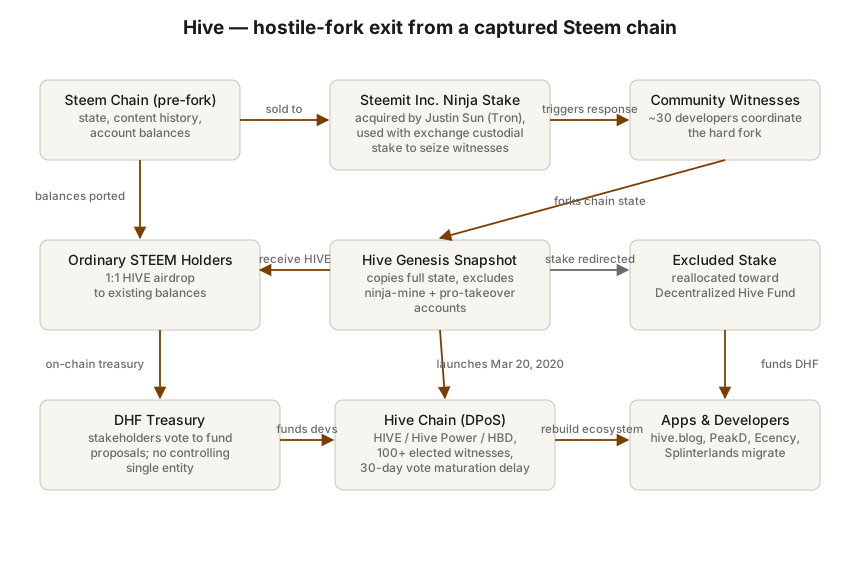 Open full-size diagram
Summary
Hive is the canonical example of "exit by fork" as a governance defense. In February 2020, Justin Sun (Tron) acquired Steemit Inc., and with it the company's "ninja-mined" stake — a premine amounting to a large share of STEEM supply that, by informal social contract, was never supposed to vote in governance. Fearing Sun would use it to control the chain, Steem's elected witnesses executed Soft Fork 0.22.2 (Feb 22–24, 2020) to freeze that stake. Sun responded by coordinating with exchanges (Binance, Huobi, Poloniex), which used customer deposits to power up STEEM and vote in his replacement witnesses, reversing the freeze — a genuine hostile takeover of a delegated-proof-of-stake chain using custodial funds.
Rather than fight a stake war they could not win, roughly 30 community developers hard-forked the entire chain — code, content history, and account state — into a new network, Hive, launched March 20, 2020. Every STEEM holder received a 1:1 HIVE airdrop, except the Steemit Inc. ninja-mine accounts and accounts that had publicly supported the takeover; the excluded stake's role was effectively replaced by a community-controlled treasury, the Decentralized Hive Fund (DHF). Hive has run continuously since, hosting social apps (hive.blog, PeakD, Ecency) and games (notably Splinterlands), while Steem — which retaliated in May 2020 with Hardfork 23, confiscating ~23.6M STEEM from 64 pro-Hive accounts — faded into irrelevance.
Design (Mechanism)
- Base layer: Graphene-based DPoS chain inherited from Steem: 3-second blocks, top-20 elected consensus witnesses (plus a rotating backup slot), fee-less transactions rate-limited by staked "Resource Credits," content rewards paid from inflation via stake-weighted curation, and a dual-token system (liquid HIVE, staked Hive Power, and the HBD algorithmic stablecoin convertible against $1 of HIVE).
- Fork-as-exit: Rather than contesting governance on the captured chain, the community copied the full state and social graph to a new chain where the attacker simply does not exist. This weaponizes the fact that in DPoS the "product" (community, content, developers) is portable, while the attacker's capital is not.
- Punitive airdrop exclusion: The 1:1 airdrop excluded the ninja-mined Steemit stake and accounts that actively, publicly supported the takeover — an explicit social-consensus judgment encoded in the genesis state.
- Governance hardening: A 30-day maturation delay was added before newly powered-up stake counts toward witness or proposal voting. This directly patches the attack vector Sun used (exchanges powering up custodial coins and voting instantly).
- DHF treasury: The role of Steemit Inc.'s development stake was replaced by an on-chain proposal/funding system (inherited from Steem's SPS, funded in part with the excluded stake), where stakeholders vote to fund development — no single entity controls the war chest.
Outcome
The fork succeeded operationally and socially. Hive launched on schedule, major exchanges honored the airdrop, and within a week HIVE traded above STEEM. Nearly all active applications, developers, and prominent community members migrated. Steem's counter-move — HF23's confiscation of ~$5–6M from 64 dissident accounts in May 2020 (partially "rescued" mid-fork by an anonymous actor via Bittrex) — cemented the reputational verdict. As of 2026, hive.io reports 100+ elected witnesses, 150+ ecosystem apps, and continuous uptime; the chain remains community-governed with no controlling stake. Commercially, however, Hive remains a niche asset: it never regained Steem's 2017-era prominence, and its social platforms are small relative to mainstream or newer crypto-social competitors (e.g., Farcaster, Lens). Hence: partial_success — a decisive governance victory and durable chain, with modest market adoption.
Why it worked
- The community, not the token, was the moat. Content, apps, and developers migrated wholesale; Sun bought a chain and was left holding an empty one.
- Speed and coordination: the fork shipped ~18 days after the takeover, while outrage was hot and before the community fragmented.
- Credible fairness: a 1:1 airdrop with narrowly targeted exclusions kept ordinary holders whole, so exchanges and users had little reason to object.
- The exclusion targeted stake already carved out by a prior norm — the ninja-mined stake was, by pre-existing social contract, meant to be non-voting, so its removal enforced an existing rule rather than writing a new one.
- The 30-day vote delay closed the specific exploit that enabled the takeover, showing the fork was a mechanism upgrade, not just a grudge.
Where the design broke
- The underlying attention economy was already declining; forking preserved the community but could not restore Steem's 2017 relevance, and HIVE's market value stayed modest.
- DPoS stake-weighted curation kept its old pathologies: whale voting rings, self-voting, and reward disputes carried over from Steem.
- Airdrop exclusion by social judgment set an uncomfortable precedent (a genesis blacklist decided off-chain by insiders), which critics cite even while sympathizing with the cause.
- The episode exposed, but did not solve, custodial-stake governance risk industry-wide: exchanges voting customer coins remains possible on many DPoS/PoS chains.
Lessons
- Exit is a real governance weapon. When voice fails on-chain, a coordinated fork that ports state and community can strand an attacker's capital on a dead chain — the strongest known deterrent to buying a DPoS network.
- Custodial stake is a standing governance attack. Any stake-voting system that lets freshly acquired or exchange-held tokens vote immediately is takeover-prone; maturation delays (like Hive's 30 days) are cheap and effective.
- Premines carry latent governance risk even under a social contract. Steemit's "non-voting" ninja stake was safe only until ownership changed; hard-code such promises or expect them to be broken.
- Legitimacy comes from restraint. Hive's exclusions were narrow and justified by prior norms; Steem's HF23 confiscation of ordinary users' funds, by contrast, destroyed its remaining legitimacy. Symmetric-looking actions read very differently depending on whose rules were broken first.
Redesign (EDITORIAL — hypothesis, not fact)
This section is editorial hypothesis, not fact. A modern redesign would (1) hard-code the founders'/treasury stake as constitutionally non-voting at the protocol level rather than by promise; (2) generalize the vote-maturation delay into time-weighted governance power (voting weight accrues with stake age), making custodial flash-voting structurally worthless; (3) require witness-set changes above a threshold (e.g., replacing >1/3 of consensus witnesses within one week) to trigger an automatic timelock, giving communities days rather than hours to respond to a capture attempt; (4) replace the genesis blacklist with a transparent, on-chain-ratified exclusion vote published before the snapshot, to procedurally launder what was, in 2020, an ad-hoc insider decision; and (5) let exchanges vote only via explicitly delegated, revocable customer mandates. The deeper hypothesis: forkability itself should be treated as a designed feature — chains that keep state, content, and identity easily portable make hostile acquisition of the token layer close to worthless, which may deter such attacks entirely.
Sources
- Announcing the Launch of Hive Blockchain (official @hiveio post) — primary (docs)
- Hive official website — primary (docs)
- Press Release: The New Hive Blockchain is Launching (official Medium) — primary (docs)
- Justin Sun Bought Steemit. Steem Moved to Limit His Power (CoinDesk) (news)
- Steem Community Plans Hostile Hard Fork to Flee Justin Sun's Steemit (CoinDesk) (news)
- Steem Community Resists Takeover, Hard Fork Launches Hive Network (Cointelegraph) (news)
- Steem Hard Fork Confiscates $6.3M, Community Immediately Takes It Back (CoinDesk, on Steem HF23) (news)
- Splinter Cryptocurrency Hive Outperforms Justin Sun's Steem After One Week Trading (CoinDesk) (news)
- What Are Steem and Hive? A Comparison (Crypto Briefing) (analysis)
Related experiments
Last verified: 2026-07-26 · Spot an error? Suggest a correction