Beanstalk
A credit-based (collateral-free) algorithmic stablecoin on Ethereum that suffered a $182M flash-loan governance takeover in April 2022, recapitalized via a debt sale, and relaunched with governance moved off-chain.
▶ Run interactive simulation animated mechanism with editable parameters
How it works onchain
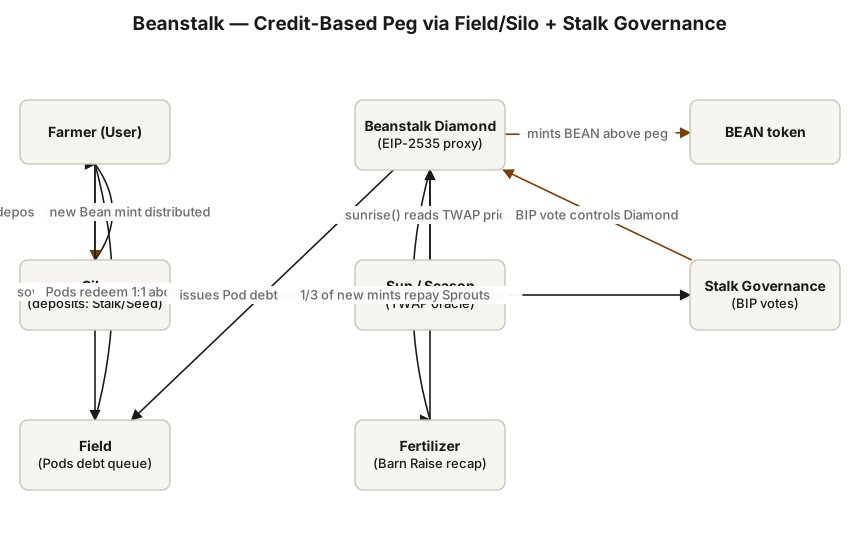 Open full-size diagram
Summary
Beanstalk is a "permissionless fiat stablecoin protocol" launched on Ethereum on August 6, 2021 by a pseudonymous team writing as Publius (later identified as University of Chicago alumni Benjamin Weintraub, Brendan Sanderson, and Michael Montoya). Its core wager was that a stablecoin does not need collateral: BEAN targets $1 using credit — the protocol borrows from its own users to contract supply when below peg and mints to stakeholders when above peg. Beanstalk grew rapidly through early 2022, then on April 17, 2022 an attacker used a $1B flash loan to seize supermajority voting power and pass a malicious governance proposal in a single transaction, extracting roughly $182M in protocol value ($77–80M attacker profit). The protocol paused, sold a recapitalization debt instrument ("Fertilizer") in a community "Barn Raise," and relaunched ("Replant," BIP-21) on August 6, 2022 with on-chain governance replaced by a community multisig. It later migrated to Arbitrum, where the current Diamond and BEAN token live. The exploit remains one of the canonical case studies of flash-loan governance capture.
Design (Mechanism)
- Credit, not collateral. BEAN is minted with no backing assets. Peg maintenance is a supply-elasticity game: when the time-weighted price is above $1, the protocol mints new Beans (seigniorage); when below $1, it issues debt to remove Beans from circulation.
- The Field (debt market). Below peg, users can "sow" Beans — burn them in exchange for Pods, fixed-interest IOUs whose yield is set by a protocol-adjusted interest rate ("Temperature"/Weather). Pods sit in a strict FIFO queue (the Pod Line) and only become redeemable 1:1 for newly minted Beans when the protocol is above peg. Lenders are thus betting on the protocol's future creditworthiness.
- The Silo (deposits and governance weight). Depositors of BEAN and whitelisted LP tokens earn Stalk (yield share + governance weight, which grows with time deposited via Seeds) and receive a share of new Bean mints. Time-weighted rewards were meant to favor long-term alignment.
- Sun/Seasons. The protocol advances in hourly "Seasons" via a publicly callable
sunrise()function that reads a time-weighted oracle price and adjusts mints, debt issuance, and interest rates. - Governance (pre-exploit). Beanstalk Improvement Proposals (BIPs) were voted with Stalk on-chain; a normal BIP had a voting delay, but an
emergencyCommitpath allowed immediate execution once a two-thirds supermajority was reached — with no timelock and no check that voting power was flash-borrowed. - Post-exploit additions. Fertilizer, a semi-fungible debt token sold for USDC in the Barn Raise, entitles holders ("Sprouts") to one-third of new Bean mints until the $77M hole plus interest ("Humidity," starting at 500% and stepping down to 20%) is repaid. On-chain governance was removed in favor of Snapshot voting executed by the Beanstalk Community Multisig (BCM).
- Architecture. An EIP-2535 Diamond proxy (facets for Field, Silo, Season, Marketplace, etc.), originally at 0xC1E088fC1323b20BCBee9bd1B9fC9546db5624C5 on Ethereum, now at 0xD1A0060ba708BC4BCD3DA6C37EFa8deDF015FB70 on Arbitrum.
Outcome
For its first ~8 months Beanstalk was one of the more credible uncollateralized-stablecoin experiments: BEAN repeatedly re-converged to $1 through several debt cycles, and TVL/market value grew into the hundreds of millions. On April 17, 2022, the attacker flash-borrowed ~$1B (Aave DAI/USDC/USDT), acquired BEAN3CRV and BEANLUSD LP positions, deposited them for >67% of Stalk voting power, and called emergencyCommit on a pre-seeded malicious BIP-18 (proposed a day earlier to satisfy the 24-hour minimum) that transferred protocol assets to the attacker — netting ~$182M in damage and ~$76–80M profit, part of which was donated to a Ukraine relief address and laundered via Tornado Cash. BEAN collapsed ~86%+. The team paused the protocol, ran the Barn Raise (raising ~$17M+ of the $77M target as Fertilizer credit by August 2022), and Replanted on August 6, 2022. Attempted whitehat negotiation failed; no funds were recovered on-chain (in 2024, U.S. authorities charged an individual in connection with the exploit). Post-relaunch, Beanstalk continued operating and shipped adjacent infrastructure (the Basin DEX) and an Arbitrum migration, but BEAN has spent extended stretches below peg (visible on DefiLlama's peg chart) and the protocol never regained its pre-exploit scale. Status as of mid-2026: operating at modest scale; the headline outcome of the experiment is the exploit.
Why it worked
- A genuinely novel credit mechanism. The Field's FIFO debt queue with an endogenous interest rate created a real market price for the protocol's creditworthiness, and it demonstrably pulled BEAN back to peg through multiple sub-peg cycles before the hack — something most "algo stables" never achieved even once.
- Time-weighted alignment. Stalk/Seed accrual rewarded long-duration depositors over mercenary capital, an early and influential design for loyalty-weighted yield and governance.
- Capital efficiency narrative. Zero collateral meant no reliance on centralized reserves (unlike USDC-backed designs) and no reflexive collateral spiral (unlike Terra's burn/mint arbitrage against a volatile sister asset) — the debt was explicit and priced.
- Credible crisis response. Pausing, openly accounting for the loss, selling recourse-like debt (Fertilizer) instead of quietly printing, and relaunching in under four months preserved a real community when most exploited protocols simply die.
Where the design broke
- Flash-loan governance capture. Governance power was purchasable atomically: voting weight came from depositable LP tokens,
emergencyCommitallowed same-transaction execution at a two-thirds supermajority, and there was no timelock, no flash-loan guard, and no delay between acquiring stake and voting with it. The 24-hour proposal window was satisfied by pre-planting the malicious BIP a day early. - Audit scope excluded the governance path. The audits covering the DeFi logic did not cover (or did not catch) the emergency-governance path; the attack required no code bug at all — it executed the governance system exactly as designed.
- Reflexive credit under broken confidence. After the exploit (and the Terra collapse weeks later), the credit mechanism's core input — belief that the protocol will be able to mint future Beans to pay Pods — was impaired; below-peg periods lengthened because lending to Beanstalk demanded ever-higher rates, which itself signals distress.
- Debt overhang. Fertilizer's claim on one-third of all future mints (plus the pre-existing Pod line) taxed the upside that peg-restoring demand depended on, making recovery to former scale structurally harder.
Lessons
- Any votable stake that can be flash-acquired will be flash-acquired. On-chain governance over a treasury needs at least one of: a timelock on execution, vote-weight snapshots taken before proposal creation, or stake lock-ups that break atomicity. "Emergency" fast paths are the attack surface, not the safety valve.
- Governance is part of the security perimeter. Audits scoped to "the DeFi logic" miss the fact that a governance module with treasury-move powers is equivalent to an admin key priced at the cost of a supermajority.
- Uncollateralized stability is a confidence instrument. Credit-based pegs can work while the protocol's implied credit rating is good, but a single solvency shock permanently raises its cost of borrowing; unlike collateralized designs, there is no balance sheet to rebuild trust against.
- Honest recapitalization beats silent dilution. Explicitly priced recovery debt (Fertilizer) let losses be socialized transparently and voluntarily — a reusable template — but also shows that post-exploit debt overhang can cap the relaunched protocol's growth.
Redesign (EDITORIAL — hypothesis, not fact)
This section is editorial analysis — a hypothesis, not a statement of fact. A redesigned Beanstalk would keep the Field/Pod credit market — its most original contribution — but treat governance as a hardened, slow subsystem: vote weight snapshotted at proposal creation minus N seasons, mandatory execution timelock (even for emergencies, with a veto-only guardian multisig for pauses rather than arbitrary calls), and a cap on the fraction of vote weight any single-transaction deposit can carry. On the monetary side, the pure zero-collateral stance could be softened without abandoning the thesis: route a fraction of above-peg seigniorage into a protocol-owned reserve (as its Arbitrum-era descendants and forks have explored) so the implied credit rating is backed by an observable, growing cushion — turning "trust our future mints" into "trust our future mints plus this on-chain buffer." Finally, cap the Pod line's duration or make Temperature respond to queue length, so the debt overhang that throttled the post-Replant recovery cannot grow unboundedly. The hypothesis: Beanstalk's peg mechanism was closer to viable than its reputation suggests, and it was the governance module — not the monetary design — that killed the experiment's first life.
Sources
- Beanstalk: A Permissionless Fiat Stablecoin Protocol (whitepaper) — primary (docs)
- Farmers' Almanac — Contracts — primary (docs)
- Introducing Beanstalk (launch post) — primary (docs)
- BIP-21: Replant Beanstalk (GitHub PR) — primary (governance)
- Beanstalk: The Path Forward — primary (retrospective)
- Immunefi — Hack Analysis: Beanstalk Governance Attack, April 2022 (analysis)
- Halborn — Explained: The Beanstalk Hack (April 2022) (analysis)
- CoinDesk — Attacker Drains $182M From Beanstalk Stablecoin Protocol (news)
- CoinDesk — Beanstalk 'Barn Raise' Aims to Restore $77M in Lost Funds (news)
- Cointelegraph — Once hacked for $77M, Beanstalk's algo stablecoin protocol relaunches (news)
- DefiLlama — Bean (BEAN) peg chart (analysis)
Related experiments
Last verified: 2026-07-26 · Spot an error? Suggest a correction