Uniswap
The first widely adopted constant-product automated market maker, replacing order books with permissionless x*y=k liquidity pools on Ethereum.
▶ Run interactive simulation animated mechanism with editable parameters
How it works onchain
 Open full-size diagram
Summary
Uniswap is a decentralized exchange (DEX) protocol on Ethereum that replaced the traditional order book with a constant-product automated market maker (AMM). Instead of matching buyers and sellers, it lets anyone deposit a pair of tokens into a pool and lets anyone else swap against that pool at a price determined algorithmically by the formula x * y = k. It was created by Hayden Adams, a mechanical engineer laid off from Siemens in 2017, who taught himself Solidity to implement an AMM design that Vitalik Buterin had sketched in a Reddit post and blog post. The V1 smart contracts were deployed to Ethereum mainnet on November 2, 2018 — the final day of Devcon 4 — funded in part by a ~$50,000 Ethereum Foundation grant plus a Runtime Verification audit. Uniswap became the canonical AMM, the template that essentially all later DEXs forked or adapted, and one of the highest-volume applications in all of crypto.
Design (Mechanism)
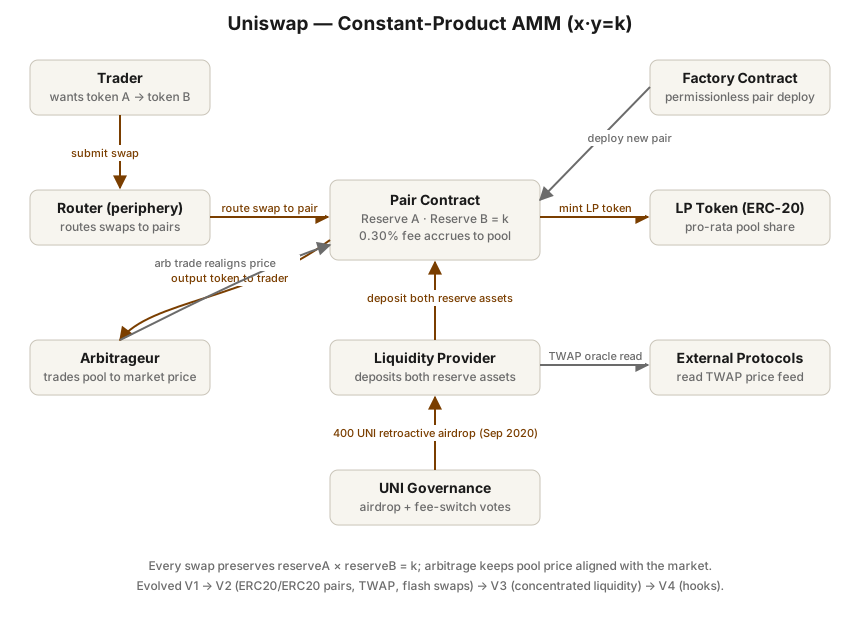
The core mechanism is the constant-product invariant. Each pool holds reserves of two assets (in V1, always ETH paired with one ERC-20). The product of the two reserves, k, must not decrease on a swap; the price a trader receives is simply the ratio of reserves adjusted so that k is preserved, minus a fee (0.30% in V1/V2). This means:
- Permissionless listing: anyone can create a market for any ERC-20 by deploying an exchange via the factory contract — no gatekeeper, no listing fee.
- Passive liquidity: liquidity providers (LPs) deposit both sides of a pair and receive LP tokens representing their pro-rata share; fees accrue to the pool. No active order management is required.
- Deterministic pricing and arbitrage: the curve always quotes a price, and external arbitrageurs keep pool prices aligned with the broader market, which is also what makes Uniswap usable as an on-chain price oracle.
The architecture evolved substantially:
- V1 (Nov 2018): ETH-to-ERC20 pools only; factory at 0xc0a47dfe034b400b47bdad5fecda2621de6c4d95.
- V2 (May 2020): direct ERC20-to-ERC20 pairs, time-weighted average price (TWAP) oracles, and flash swaps; factory at 0x5C69bEe701ef814a2B6a3EDD4B1652CB9cc5aA6f.
- V3 (May 2021): concentrated liquidity, letting LPs allocate capital to specific price ranges for far greater capital efficiency, plus multiple fee tiers; factory at 0x1F98431c8aD98523631AE4a59f267346ea31F984.
- V4 (Jan 31, 2025): a singleton contract holding all pools, "hooks" (modular contracts that attach custom logic to pool lifecycle events), and flash accounting for cheaper multi-hop swaps.
Governance runs through the UNI token, launched September 16, 2020, whose most famous feature was a retroactive airdrop of 400 UNI to every address that had used the protocol before September 1, 2020 (~150M UNI, 15% of supply, to 250,000+ addresses).
Outcome
Status: major_success. Uniswap became the defining primitive of DeFi. It demonstrated that a fully on-chain, non-custodial market maker could sustain deep, liquid markets without a centralized order book or matching engine, and it did so with a tiny contract footprint. It has repeatedly ranked among the highest-volume DEXs in crypto, its code is the most-forked in DeFi (SushiSwap, PancakeSwap, and countless others descend from V2), and UNI became one of the largest governance tokens. The September 2020 airdrop set the template for "retroactive public goods" token distributions that shaped the entire industry. V4 launched across ten-plus chains on day one, extending the model with programmable hooks.
Why it worked
- Radical simplicity: the x*y=k invariant is easy to reason about, cheap to run on-chain, and impossible to "trick" into losing value — the invariant enforces solvency by construction.
- Permissionlessness solved the cold-start problem: any long-tail token could get a market instantly, so Uniswap captured the enormous demand for trading new ERC-20s that centralized exchanges wouldn't list.
- Aligned passive incentives: LPs earned fees without operational overhead, drawing liquidity from ordinary users, while arbitrageurs did the price-keeping for free.
- Composability: as an on-chain contract with a price oracle, Uniswap became a Lego brick other protocols built on, compounding its network effects.
- Credible neutrality and open source: the code and later the UNI airdrop signaled a genuinely community-owned protocol, earning trust and forks alike.
Limitations and criticisms
Uniswap has real limitations and unresolved tensions:
- Impermanent loss: passive LPs frequently underperform simply holding the assets, especially in volatile or trending markets — a structural cost of the constant-product curve.
- MEV and toxic order flow: deterministic on-chain pricing exposes traders to sandwich attacks and LPs to being adversely selected by arbitrageurs, transferring value out of the system.
- Capital inefficiency (pre-V3): V1/V2 spread liquidity across all prices, most of which never trade; V3's concentrated liquidity fixed efficiency but shifted complexity and IL risk onto LPs.
- Governance and value-accrual questions: the long-debated "fee switch" (directing protocol fees to UNI holders) remained unresolved for years, leaving open how much economic value UNI actually captures. The SEC issued a Wells notice to Uniswap Labs in April 2024 over the app and UNI token, and closed the investigation without enforcement action in February 2025.
Lessons
- Constraint can be a feature: replacing a flexible order book with one rigid invariant made the system simpler, cheaper, safer, and more composable — showing that on-chain mechanism design often wins by doing less, not more.
- Permissionless listing is a killer feature: removing the gatekeeper unlocked a market (long-tail tokens) that incumbents structurally could not serve.
- Retroactive airdrops can bootstrap ownership and loyalty: the 400-UNI drop rewarded actual usage rather than speculation and became an industry-defining distribution pattern.
- Externalities need explicit design: impermanent loss and MEV were left for LPs and arbitrageurs to absorb; later versions and an entire research field (V3 ranges, hooks, MEV mitigation) exist largely to address what the original elegant curve ignored.
Redesign (EDITORIAL — hypothesis, not fact)
This section is the researcher's editorial hypothesis, not established fact.
If designing an Uniswap-like protocol today, the central problem to attack is the value leakage from passive LPs to arbitrageurs and MEV searchers — the "loss-versus-rebalancing" (LVR) problem. A redesign might make the fee dynamic rather than fixed: raise the swap fee precisely when the pool is being arbitraged (high short-term volatility / stale price) so LPs recapture some of the value that today flows to arbitrageurs, and lower it during quiet two-sided flow to stay competitive for retail. V4 hooks make this expressible without forking the core, so the honest redesign is arguably "a canonical LVR-mitigating hook plus an auction for the right to arbitrage each block, with proceeds returned to LPs."
Second, oracle-anchored or auctioned rebalancing could let the pool trade closer to the true external price at the moment of the block, cutting the arbitrage tax at the source; batch auctions (as CoW/UniswapX-style intent flows explore) point in this direction. Third, on governance, the value-accrual ambiguity suggests coupling any fee switch to a concrete public-good — e.g., routing protocol fees to a transparent LP-insurance or IL-rebate fund rather than a passive holder dividend, keeping the "credibly neutral utility" framing that made the protocol legally and reputationally durable. The risk in all of this is complexity: Uniswap's original genius was legibility, and each of these mechanisms trades some of that away. The best redesign is probably not a new core but a small, auditable, optional layer that lets sophisticated LPs opt into protection while the base x*y=k pool stays exactly as boringly reliable as it has been since 2018.
Sources
- A Short History of Uniswap (Hayden Adams, official blog) — primary (retrospective)
- Uniswap V1 Factory Contract (Etherscan, verified) — primary (contract)
- Uniswap V2 Factory Contract (Etherscan, verified) — primary (contract)
- Uniswap V3 Factory Contract (Etherscan, verified) — primary (contract)
- Official Uniswap Labs links — primary (docs)
- Uniswap v2, v3, and v4 (Uniswap Labs support) — primary (docs)
- Learn: Requirements & How to claim your 400 UNI (Uniswap Governance) — primary (governance)
- Uniswap Recaptures DeFi Buzz With UNI Token's Airdropped Debut (CoinDesk) (news)
- Uniswap (Wikipedia) (analysis)
Related experiments
Last verified: 2026-07-26 · Spot an error? Suggest a correction