Drip Network
BNB Chain 'faucet' contract promising 1% daily returns (365% max payout) funded by a 10% tax on every token movement — a self-described 'deflationary daily ROI platform' that rose to $173 per token before collapsing more than 99.99%.
▶ Run interactive simulation animated mechanism with editable parameters
How it works onchain
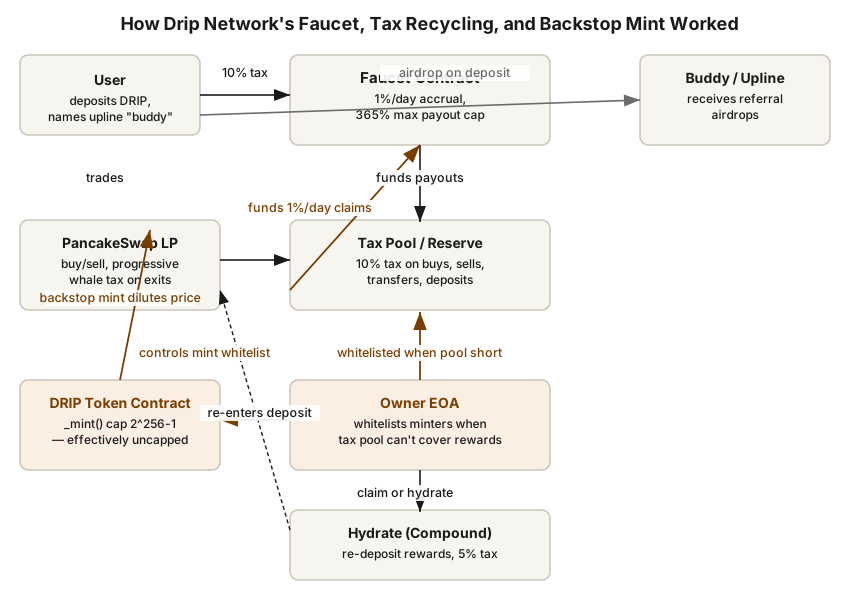 Open full-size diagram
Summary
Drip Network was a BNB Chain (BSC) "daily ROI" protocol built around a fixed-supply-ish BEP-20 token (DRIP) and a Faucet contract that paid depositors 1% of their deposit per day, capped at 365% of principal. It marketed itself as the "first ever deflationary daily ROI platform" — the pitch being that, unlike earlier ponzi faucets (Forsage, BNB miners), rewards were funded by a 10% tax charged on nearly every DRIP transaction (buys via the native "Fountain" swap, sells, transfers, deposits) rather than purely by new deposits. It launched around April 2021, was created by the pseudonymous developers "Forex_Shark" and "BB," and became one of the most heavily shilled retail yield schemes of the 2021–22 cycle, with a large referral-driven "Drip community" ecosystem (and sister projects Manor Farm / Animal Farm from the same developer). DRIP hit an all-time high of about $173.86 on January 27, 2022; by 2026 it traded around $0.001 — a >99.99% collapse — with the faucet still technically emitting rewards in a near-worthless unit.
Design (Mechanism)
- Faucet deposits: Users deposited DRIP into the Faucet (a proxy contract at 0xFFE8...9D8C). A 10% deposit tax was taken; the remaining 90% became the user's "deposit," which accrued 1% per day, claimable or compoundable, until total payouts reached 365% of the deposited amount (max payout). Principal was never withdrawable — only the reward stream.
- Hydrate (compound): Re-depositing rewards ("hydrating") incurred a reduced 5% tax and increased the deposit base, restarting the exponential-growth treadmill. Community culture heavily promoted hydration schedules.
- Tax recycling: A 10% tax on buys, sells, transfers, and deposits routed DRIP into the tax pool/faucet reserve. Roughly 80% of the 1M nominal supply sat locked in the faucet contract, and payouts drew from this pool — the "deflationary" framing.
- Backstop minting: Critically, if the tax pool could not cover owed rewards, new DRIP could be minted to pay them. Vidma Security's June 2022 analysis showed the token's
_mint()was callable by owner-whitelisted addresses, with the mint cap set to 2^256−1 (i.e., effectively uncapped), and the owner EOA (0xe8e9...3570) actively whitelisting new minters (e.g., for the updated faucet on May 31, 2022). So "max supply 1M" held only while inflows exceeded outflows. - Referrals ("buddy system"): Depositors named an upline "buddy"; referral rewards were airdropped through a team structure, fueling MLM-style recruitment content across YouTube and Twitter.
- Whale tax: Sells were charged a progressive surtax on top of the base 10% — from 0% below 1% of supply up to 50% at ≥10% of supply — explicitly to slow large holders from draining the pool.
- No independent audit existed; the "audit" circulated by the community was Slither static-analyzer output.
Outcome
Classic reflexive rise and collapse. Through late 2021 the recruitment flywheel (1%/day marketing, referral airdrops, celebrity-adjacent YouTube promotion) drove net inflows and pushed DRIP from under $1 to the $174 ATH in January 2022. Once new-buyer flow stalled, the arithmetic inverted: daily reward claims plus the backstop minting became persistent sell pressure, the price fell continuously through 2022 ($0.51 within a year of ATH), and the associated Animal Farm ecosystem also collapsed. The developer's pseudonymity and the unaudited owner mint privilege over a pool backed by ~$4M of PancakeSwap BUSD liquidity (per Vidma) eroded remaining trust as community confidence in the anonymous operators collapsed. By April 2026 DRIP printed an all-time low near $0.0008. The contracts still run; the returns are denominated in a token that no longer holds value. No exploit was needed — the tokenomics were the failure mode. Outcome: failed.
Why it worked
- A legible, fixed promise. "1% a day, 365% max" is the single most viral yield pitch in retail crypto; the cap made it feel bounded and "sustainable" versus Forsage-style unlimited claims.
- Tax recycling was genuinely cleverer than pure deposit-funded ponzis. Every trade and transfer fed the reward pool, so activity itself (not only new deposits) extended runway, and the locked faucet balance suppressed circulating supply on the way up.
- The buddy/referral system conscripted a salesforce. Thousands of "Drip team" sites, faucets, and YouTube channels did customer acquisition for free because uplines earned airdrops.
- Hydration gamified retention. Compounding was taxed less than claiming, so the dominant community strategy kept tokens in the system, delaying the reflexive unwind.
Where the design broke
- The invariant was still ponzi arithmetic. Aggregate promised outflows (365% of all deposits) could never be covered by 10% taxes on flows; solvency depended on perpetual net inflows.
- The backstop mint converted insolvency into hyperinflation. Rather than defaulting on rewards, the system printed DRIP, guaranteeing price collapse once inflows stopped — holders were diluted instead of queued.
- Centralized owner keys over an unaudited system. One EOA could whitelist arbitrary minters against a live liquidity pool; whether or not it was abused, it made the "trustless faucet" claim false.
- Pseudonymous operator risk and credibility collapse. Community trust in "Forex_Shark" was the actual collateral; once allegations and the Animal Farm losses hit, recruitment (the only fuel) ended.
- Whale tax punished exit, not entry — it slowed the drain but also trapped later participants in a falling market.
Lessons
- A fixed daily ROI denominated in the project's own mintable token is a claim on future buyers, not yield; taxes on churn only change the slope of the ponzi curve, not its sign.
- "Max payout" caps and progressive exit taxes are retention mechanics dressed as risk controls — they extend runway for early cohorts at the direct expense of late ones.
- Any "capped supply" claim is void if an owner-controlled whitelist can mint; reading the verified contract (or one analyst doing so, as Vidma did) beats every whitepaper claim.
- Referral airdrops create a distributed marketing army whose incentives are to conceal, not disclose, sustainability risk — MLM structure is itself a red flag independent of the tokenomics.
- Slither output is not an audit; communities will launder any artifact into "audited" if the yield is attractive enough.
Redesign (EDITORIAL — hypothesis, not fact)
This is editorial speculation. The honest core of Drip — "recycle activity taxes to long-term stakers" — is buildable without the fraud-shaped parts: (1) denominate rewards as a pro-rata share of actual tax revenue (a rebasing claim on a real fee pool, like veTokenomics or GMX-style fee sharing) instead of a fixed 1%/day, so the promised rate floats to what inflows support and the system is solvent by construction; (2) burn the mint key — if the pool is empty, rewards pause rather than print; (3) make principal withdrawable with a time-decayed exit fee rather than confiscated, removing the sunk-cost trap; (4) replace referral airdrops with non-transferable reputation, decoupling growth incentives from recruitment revenue; (5) require a real third-party audit and a doxxed or legally accountable operator before any owner privilege exists. The result would be a boring, low-yield fee-sharing vault — which is the point: Drip's growth came precisely from the properties that made it insolvent, so a "fixed" Drip likely never attracts the same capital.
Sources
- DRIP Token contract (BscScan, verified) — primary (contract)
- Drip Network official site — Faucet — primary (docs)
- Vidma Security — 'Drip Network: what is hiding deeply behind the project' (mint-rights analysis) (analysis)
- BehindMLM — Drip Network Review: 1% a day DRIP token Ponzi scheme (analysis)
- CoinGecko — Drip Network (DRIP) price history (analysis)
- Forex Shark AMA recap (Crypto Rob, Medium) (analysis)
- HackLaddy — 'DRIP: A Web of Lies' (analysis)
- Driptoken.network community docs — tax system and faucet mechanics (archive)
Related experiments
Last verified: 2026-07-27 · Spot an error? Suggest a correction