Wonderland (TIME)
The largest Olympus DAO fork — an Avalanche 'decentralized reserve currency' with ~80,000%+ APY rebase staking that amassed a $1B+ treasury, then imploded when its pseudonymous treasury manager was doxxed as Michael Patryn, a QuadrigaCX co-founder previously convicted of identity theft and credit card fraud.
▶ Run interactive simulation animated mechanism with editable parameters
How it works onchain
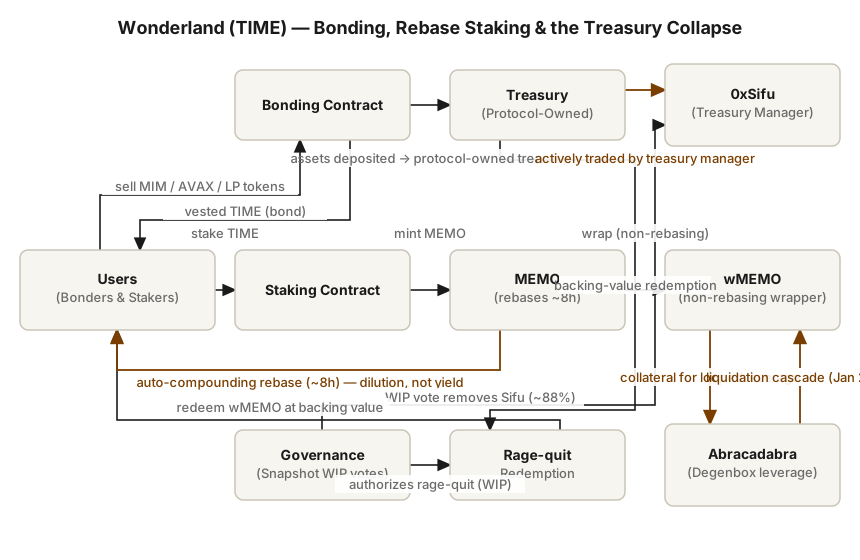 Open full-size diagram
Summary
Wonderland was the largest fork of Olympus DAO, launched on Avalanche in September 2021 by Daniele Sestagalli ("Dani Sesta"), the founder of Abracadabra Money (MIM/SPELL) and Popsicle Finance, alongside pseudonymous co-founders 0xSifu and Georgiyxo. Marketed as a "decentralized reserve currency protocol" and the flagship of Sestagalli's "Frog Nation" community, it copied Olympus's (3,3) playbook — bond sales to build a protocol-owned treasury, plus rebase staking advertising five- and six-figure APYs. TIME rocketed to an all-time high around $10,000 in November 2021 (CoinGecko records $10,064 on November 7, 2021; some sources cite intraday prices near $13,000-$14,000) and the treasury swelled past $1 billion, briefly making Wonderland one of the largest DAO treasuries in crypto. It collapsed in January 2022 in two stages: first a leverage-driven price cascade tied to Abracadabra's leveraged wMEMO "Degenbox" strategies, then the revelation by on-chain investigator ZachXBT that treasury manager "0xSifu" was Michael Patryn — co-founder of QuadrigaCX, an exchange regulators later found to be fraudulent, and a previously convicted felon (identity theft, credit card fraud) formerly named Omar Dhanani. Sestagalli admitted he had known for roughly a month and stayed silent. The token lost the vast majority of its value, a wind-down vote split the community, and although the DAO technically voted to continue and lingered for years as a treasury-investment DAO around the wMEMO token, Wonderland as a reserve-currency experiment was dead.
Design (Mechanism)
Wonderland was a close mechanical clone of Olympus DAO, transplanted to Avalanche:
- Bonding: Users sold assets (MIM, AVAX, LP tokens) to the protocol at a discount in exchange for vested TIME, building a protocol-owned treasury and protocol-owned liquidity. Each TIME was notionally "backed" (not pegged) by at least 1 MIM of treasury assets.
- Rebase staking (3,3): Staked TIME became MEMO ("Memories"), which rebased every ~8 hours. Newly minted TIME flowed mostly to stakers, auto-compounding into headline APYs that at times exceeded 80,000%. The APY was fundamentally a dilution-redistribution mechanism: it did not create value, it transferred relative ownership toward stakers and punished sellers.
- Wrapping: MEMO could be wrapped into non-rebasing wMEMO (an index token whose MEMO-per-wMEMO ratio grows), which became the composable unit used on Abracadabra as collateral — enabling looped leverage on an already reflexive asset. After January 2022, TIME and MEMO were deprecated and wMEMO became the sole governance/treasury token.
- Active treasury management: Unlike Olympus's more conservative posture, Wonderland's treasury was actively traded by "0xSifu" — farming, holding volatile assets (AVAX, CVX, SPELL, etc.), and positioning as a proto-VC fund for gaming and NFT investments. This discretionary, single-manager treasury was the protocol's distinguishing feature — and its fatal centralization.
- Governance: Snapshot votes by token holders (WIPs), which later decided Sifu's removal, whether to wind down, rage-quit redemptions at treasury backing, and the halt of rebases (WIP #17, August 13, 2022).
Outcome
Failed. TIME fell from ~$10,000 to double digits — a >99% drawdown — and the treasury dropped from over $1 billion to roughly $146 million at the trough (Forbes) before partial recovery. The January 26-27, 2022 Patryn doxxing destroyed the project's credibility; an ~88% governance vote removed Sifu as treasury manager, and Sestagalli declared "the Wonderland experiment is coming to an end." A subsequent wind-down vote narrowly favored continuing, so the DAO offered rage-quit redemptions at backing value and limped on: rebases were halted in August 2022, and the residual treasury was managed for wMEMO holders (with reporting via the affiliated Volta Club), even posting positive quarters in 2023. But as a monetary experiment — a reserve currency with sustainable staking yield — Wonderland failed comprehensively, and it became the canonical cautionary tale that ended the 2021 OHM-fork era. As of 2026 the main site's activity has withered (its TLS certificate has lapsed), while the TIME contract remains on Avalanche.
Why it worked
- Reflexive flywheel, perfectly timed: In the 2021 bull market, bonding plus 80,000% APY rebases created explosive number-go-up dynamics; Wonderland scaled a $1B+ treasury in about two months.
- Founder distribution: Sestagalli's Frog Nation following and the Abracadabra/Popsicle ecosystem gave Wonderland instant liquidity, integrations (wMEMO collateral on Abracadabra), and a devoted community.
- Cheap-chain accessibility: Avalanche's low fees let retail participate in 8-hourly rebase mechanics that would have been gas-prohibitive on Ethereum mainnet.
Where the design broke
- Ponzi-adjacent tokenomics: The APY was minted dilution, valuable only while inflows continued. Once price fell below the reflexive threshold, (3,3) inverted into a coordinated rush for the exit.
- Leverage on top of reflexivity: wMEMO Degenbox loops on Abracadabra turned a price dip into cascading liquidations in January 2022.
- Centralized, unvetted treasury control: A nine-figure treasury was managed by one pseudonymous individual who turned out to be Michael Patryn, a QuadrigaCX co-founder previously convicted of identity theft and credit card fraud. No background checks, no multisig discipline that mattered, no disclosure.
- No disclosure mechanism for known risk: the protocol had no structure requiring insiders to disclose material information about a treasury custodian's identity once it became known internally; by his own account Sestagalli knew Sifu's identity for about a month before the public doxxing, and the gap between internal knowledge and public disclosure spread the resulting loss of trust across all Frog Nation projects.
- No terminal use case: "Reserve currency" was a narrative; nothing needed TIME. Backing was never a floor, and holders discovered market price can trade toward (and below) backing in a panic.
Lessons
- Rebase APY is not yield; it is dilution redistributed. Any design whose headline number only holds under net inflows should be treated as a momentum instrument, not a currency.
- Pseudonymity for treasury custodians is categorically different from pseudonymity for developers: discretionary control of user-derived funds demands verified identity, accountability structures, or trustless constraints (mandates, vaults, timelocks).
- "Backed by treasury" is meaningless without an enforceable redemption mechanism; Wonderland's post-crisis rage-quit at backing value is the mechanism it should have shipped at launch.
- Composability multiplies fragility: allowing a reflexive token (wMEMO) as looped-leverage collateral in a sister protocol coupled the failure modes of both.
- Community votes cannot resolve a legitimacy crisis after trust is gone — Wonderland "won" its continuation vote and still effectively died.
Redesign (EDITORIAL — hypothesis, not fact)
This section is editorial hypothesis, not historical fact. A salvageable Wonderland would have inverted its trust assumptions: launch with a hard redemption right (rage-quit at pro-rata backing, always on), which converts "backing" from marketing into an enforceable price floor and disciplines treasury risk-taking. Replace the discretionary human treasury manager with a mandate-constrained structure — on-chain vault strategies with position limits, an elected and doxxed investment committee, timelocked transactions, and third-party reporting from day one (roughly what Volta Club reporting became, but pre-crisis). Cap staking emissions at a rate tied to actual treasury earnings rather than arbitrary APY targets, so the rebase is a dividend, not dilution theater. Finally, prohibit the protocol's own ecosystem from offering looped leverage on the staked token, or at least firewall it with isolated markets and conservative LTVs. Such a design would have grown far slower — and that is the point: the speed was the pathology.
Sources
- Wonderland Documentation (Introduction & FAQ) — primary (docs)
- Snowtrace — Wonderland: Time Token contract — primary (contract)
- CoinDesk — Wonderland Founder: 'I'm Here to Fix This and Make It All Back' (news)
- Forbes — Wonderland Lost (news)
- Pontem — Wonderland ($TIME) and $MIM scandal: what you need to know (analysis)
- BeInCrypto — Wonderland (TIME) Scandal: Daniele Sestagalli Ignores Community Vote, Announces Project's Closure (news)
- Volta Club DAO — Wonderland Treasury Report Q2 2023 (governance)
- CoinGecko — Wonderland TIME price and all-time high (analysis)
Related experiments
Last verified: 2026-07-27 · Spot an error? Suggest a correction