Fomo3D
A self-described 'exit scam simulator' lottery on Ethereum where the last key buyer before a countdown expires wins the pot — famously won via a block-stuffing attack for 10,469 ETH.
▶ Run interactive simulation animated mechanism with editable parameters
How it works onchain
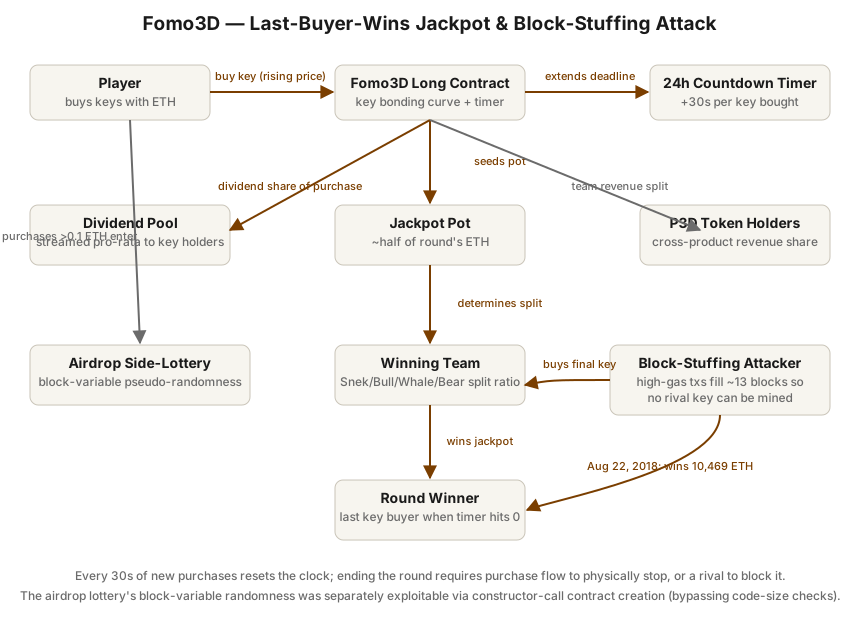 Open full-size diagram
Summary
Fomo3D was a lottery-style gambling game deployed to Ethereum in early July 2018 (the "Fomo3D Long" contract, 0xA621...9Da1, was published on July 6, 2018) by the pseudonymous Team JUST, the group behind the PoWH3D "Proof of Weak Hands" pyramid token. Marketed with deliberate, satirical honesty at exitscam.me as a game whose goal is to "exit scam every other player," it became one of the most-used dApps on Ethereum in mid-2018. At its July 21, 2018 peak, roughly 69,600 ETH moved through the game in a day with nearly 10,000 active addresses, and the round-1 jackpot exceeded $10M in value. The first round ended on August 22, 2018 when a sophisticated player used a block-stuffing attack to prevent anyone else from buying a key before the timer expired, winning 10,469 ETH (~$3M at the time). Fomo3D is now a canonical case study in incentive design, miner/blockspace-level adversaries, and on-chain randomness failures.
Design (Mechanism)
- Keys and timer. Players buy "keys" with ETH. Each round starts with a 24-hour countdown; every key purchase adds 30 seconds to the clock (capped at 24 hours). When the timer hits zero, the last buyer wins the jackpot (roughly half the pot; the exact split depends on team choice).
- Rising key price. Key price increases smoothly with total keys sold (a bonding-curve-like schedule), so early buyers pay less per key and earn proportionally more dividends.
- Dividends. A large share of every purchase is streamed pro-rata to existing key holders in the round, giving the game a Ponzi-style cash-flow layer that rewarded early participation even if you never won the pot.
- Teams. Buyers picked one of four teams (Snek, Bull, Whale, Bear); the team of the winning key determined how the pot and incoming ETH were split between the jackpot, dividends, the next round's seed, and holders of Team JUST's P3D token (cross-product revenue share).
- Airdrop side-lottery. Purchases above 0.1 ETH had a small chance to win a side "airdrop" pot, with the winner chosen by pseudo-randomness derived from block variables (timestamp, difficulty, coinbase, sender, etc.).
- Game theory. In principle the game never needs to end: it is always individually rational to spend a small key price for a chance at a huge pot. Ending the round requires the flow of new purchases to physically stop.
Outcome
Fomo3D worked exactly as coded, and its contracts were never drained — but both of its chance mechanisms were beaten by adversaries operating at the blockchain layer rather than the game layer:
- Airdrop exploit (July 2018). Ethereum core developer Péter Szilágyi publicly flagged the predictable-randomness flaw (Reddit PoC, ~July 23, 2018), and PeckShield later documented attackers using iterative, pre-calculated contract creation to win airdrop prizes with near-certainty, bypassing the game's is-this-a-contract check by calling from constructors.
- Block-stuffing win (August 22, 2018). The round-1 winner (address 0xa169...f85, nicknamed "Brother Five") bought the last key in block 6,191,896, then flooded the network with high-gas-price (
501 Gwei) transactions from a gas-burning contract, filling ~13 consecutive blocks (175 seconds) so no competing key purchase could be mined before the timer expired. Estimated attack cost was tens of ETH in gas against a 10,469 ETH payout. Team JUST publicly framed the attack as legitimate play. - Decline. After the round-1 spectacle, attention collapsed. Later rounds and the "quick" variant carried far smaller pots, a wave of clones (notably in China, e.g. Last Winner) fragmented and degraded the network, and the game faded into irrelevance by 2019. exitscam.me is offline as of 2026.
Why it worked
- Brutally honest framing ("your personal exit scam") was itself viral marketing and inoculated the team against scam accusations — the scam was the stated product.
- The mechanism stacked multiple compulsion loops: lottery jackpot, early-buyer dividends, tribal team choice, and a slot-machine-style airdrop.
- The theoretically never-ending timer created a genuinely novel Schelling-point game about who blinks last, which fascinated researchers and traders alike.
- Contracts held large sums without being drained; the core accounting was solid.
Why it failed or underperformed
- The "game that never ends" assumed the transaction-inclusion layer was neutral. Block stuffing showed the real game was fought over blockspace, and a capitalized adversary could simply buy the ending.
- On-chain pseudo-randomness (block variables) made the airdrop lottery predictable, and the contract-detection check (extcodesize-style) was bypassable via constructor calls.
- The dividend structure was zero-sum-minus-fees: late buyers systematically subsidized early buyers, so once inflows slowed the expected value turned sharply negative and attention moved on.
- No durable value or product beyond the spectacle; clones diluted the novelty within weeks.
Lessons
- Any mechanism whose outcome depends on transaction ordering or inclusion near a deadline must price in miner/validator-level and blockspace-DoS adversaries; "last actor before T wins" is an auction for blockspace, not a lottery.
- Never derive lottery randomness from block variables; use commit-reveal, VRFs, or external randomness beacons, and don't rely on code-size checks to exclude contracts.
- Radical honesty about the payout structure is a viable (if cynical) go-to-market: disclosing exactly how the dividend/jackpot mechanism worked did not deter participation.
- Incentive games whose dividends are funded by later buyers rather than by external revenue burn out as soon as inflow growth stalls, because the payout math for new entrants turns negative at that point; the mechanism's "equilibrium" life is bounded by attention, not math.
- "Code is law" cuts both ways: the block-stuffing winner was arguably the game's most faithful player, and the designers endorsed the exploit as gameplay.
Redesign (EDITORIAL — hypothesis, not fact)
The following is editorial hypothesis, not fact. A modern redesign would attack the two broken layers. First, replace "last transaction before timeout" with a sealed-deadline mechanism: end the round at an unpredictable block chosen by a VRF within a known window, so stuffing the final blocks confers no certainty, and settle the "last buyer" from purchases committed before the hidden deadline. Second, source all randomness (airdrops and round end) from a VRF or a commit-reveal beacon with slashing. Third, dampen the early-buyer subsidy — e.g., flatten dividends and route more of late-round inflows to the next round's seed — to lengthen the attention curve rather than front-load extraction. On an L2 with a centralized sequencer, the block-stuffing vector morphs into a sequencer-trust problem, so a redesign should also commit to ordering policy (or use an encrypted mempool) as part of the game's rules. Honestly disclosed, capped-stake versions could function as a legitimate mechanism-design testbed for last-buyer/dividend games, though the flattened-dividend changes above would need to actually ship to change the concentration of payouts among early participants that the original design produced.
Sources
- Fomo3D Long contract (Etherscan) — primary (contract)
- How the winner got Fomo3D prize — A Detailed Explanation (SECBIT) (analysis)
- The Anatomy of a Block Stuffing Attack (Onur Solmaz) (analysis)
- What We Learned from Fomo3D — Part 1 (Quantstamp) (analysis)
- Pwning Fomo3D Revealed: Iterative, Pre-Calculated Contract Creation For Airdrop Prizes! (PeckShield) (audit)
- Blockchain Vulnerabilities: Fomo3D Exploit Explained (Apriorit) (analysis)
- Ethereum Developer Exposes Vulnerability on a Smart Contract That Holds $12 Million Worth of ETH (Trustnodes) (news)
- A Wildly Popular Ethereum Gambling Game Just Paid Out 3 Million Dollars (Vice) (news)
- PoWH3D & FOMO3D: Flawed Behavioral Economics Wrapped in Highly Secure Smart Contracts (Bitrates) (analysis)
- The Fading Glory of Fomo3D (Longhash) (news)
Related experiments
Last verified: 2026-07-26 · Spot an error? Suggest a correction