Olympus Forks
The wave of hundreds of copy-paste clones of OlympusDAO's (3,3) protocol-owned-liquidity + high-APY rebase model that spread across chains in late 2021 and then collapsed near-universally in 2022.
▶ Run interactive simulation animated mechanism with editable parameters
How it works onchain
 Open full-size diagram
Summary
"Olympus Forks" is not a single project but a whole ecosystem phenomenon: the late-2021 explosion of clones that copied OlympusDAO's open-source contracts and its (3,3) game-theoretic marketing. OlympusDAO (launched March 2021 on Ethereum by a pseudonymous team led by "Zeus," with god-themed contributors like "Apollo" and "Hades") introduced three ideas that proved intensely forkable: Protocol-Owned Liquidity (POL) acquired via bonding, staking with auto-compounding rebases, and headline APYs in the thousands-to-millions of percent. Because the code was open and Ethereum gas was expensive, developers copied it wholesale onto cheaper chains. By one widely cited count, OlympusDAO had 677 forks as of January 18, 2022. Notable examples: Wonderland (TIME) on Avalanche (Daniele Sesta), Klima DAO (KLIMA) on Polygon, Rome DAO (ROME) on Moonriver, Snowbank (SB) on Avalanche, Hector DAO (HEC) and Spartacus (SPA) on Fantom, Invictus on Solana, and TaiChi DAO on BNB Chain. As a class, the forks failed: by early 2022 nearly all significant high-APY "rebase DAOs" were down 90%+ from their all-time highs, and most were abandoned.
Design (Mechanism)
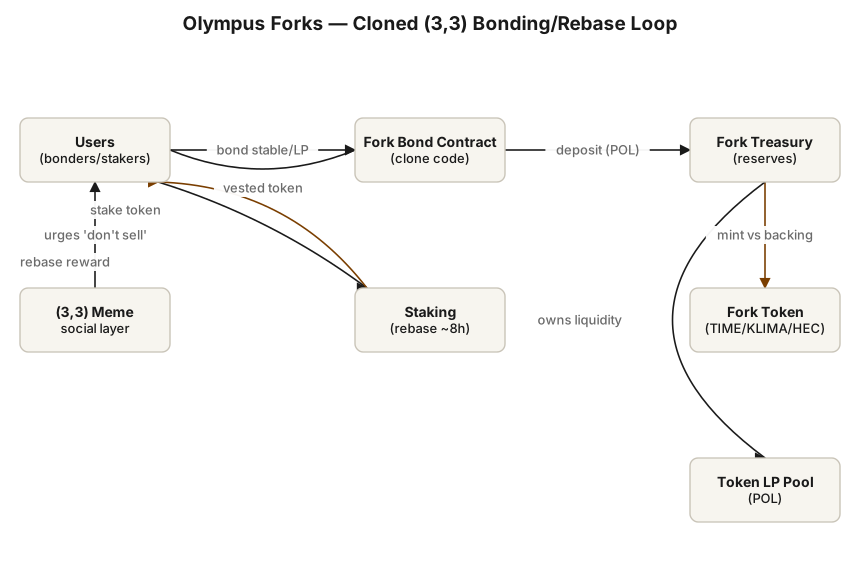
Every canonical Olympus fork reused the same loop:
- Bonding. Users sell the protocol an asset (a stablecoin, a base-chain token, or an LP position) in exchange for newly minted protocol tokens at a discount, vesting over ~5 days. This let the protocol accumulate a treasury and, crucially, own its own liquidity (POL) rather than renting it via mercenary yield-farming.
- Staking + rebase. Stakers receive new tokens each epoch (Olympus rebased every ~8 hours). Advertised APYs were astronomical — Wonderland cited ~79,000%, Snowbank flaunted numbers "over 1 quadrillion" before cutting to ~621,000%, TaiChi ~201,000%. These APYs were a function of the emission (reward) rate, not real yield.
- (3,3) game theory. Marketing framed a coordination game: if everyone stakes (rather than bonds or sells), the collective payoff is (3,3) — supply stays locked, price supposedly rises. It was a memetic nudge to hold, functionally a request not to sell.
- Treasury backing / "risk-free value." Each token was nominally backed by treasury reserves, giving a notional floor (often $1 of backing per token). Forks differentiated cosmetically: Klima backed tokens with tokenized carbon credits (BCT); Rome themed itself on ancient Rome as a Kusama/Polkadot reserve currency; Hector used "(4,4)" auto-staked bonds.
The reflexive core: high APY → buyers stake → price rises → higher backing/market cap → more bonds sold → more emissions. It worked upward only while new capital arrived.
Outcome
Outcome status: failed (as a category). The forks were a spectacular near-term commercial success and a near-total long-term failure.
- Peak. OlympusDAO itself hit an all-time high around $1,415 and a ~$4.4B market cap in November 2021. Wonderland's treasury reportedly exceeded $1B at its peak; TIME reached a top-~131 market-cap rank. Several forks reached top-200 rankings within days of launch.
- Collapse. In early 2022 the whole cohort unwound. OlympusDAO fell ~93% from its high, and financial press coverage at the time characterized the model as resembling a Ponzi scheme (see The Defiant's contemporaneous reporting). Forks fared worse: Snowbank was down ~90% from peak even before the broad crash; almost all significant high-APY DAOs ended up 90%+ down.
- Sifu identity revealed. Treasury manager "Sifu" was revealed to be Michael Patryn, co-founder of the collapsed exchange QuadrigaCX. TIME crashed further and 88% of governance voters chose to remove Sifu; Wonderland effectively wound down.
- Abandonment. Most of the 677 forks are dead or dormant. A handful (e.g., Klima) survived in altered form, but the "reserve currency" thesis did not materialize.
Why it worked (briefly)
- Free, battle-marketed code. Open-source contracts plus a viral meme ((3,3), "wen moon," ohmies) meant a team could launch a credible-looking protocol in days.
- Real innovation underneath. POL was a genuine improvement over rented liquidity — it aligned the protocol with owning its market depth instead of bleeding emissions to mercenary LPs.
- Reflexivity + FOMO. In a bull market, sky-high APYs and rising prices created a self-reinforcing inflow. Cheaper L1s (Avalanche, Fantom, Polygon, Solana, BNB) opened the game to users priced out by Ethereum gas.
- Tribal community. God/empire branding and social coordination games gave holders identity and a reason to keep staking.
Where the design broke
- Emissions ≠ yield. The advertised APY was pure inflation. Rewards were paid in newly minted tokens whose value depended entirely on new buyers — a reflexive loop that paid existing holders from new inflows and unwound once those inflows stopped.
- Death spiral. When APY-chasers exited, LPs pulled liquidity, price fell, backing-per-token compressed, staking rewards became worthless, and selling accelerated. The (3,3) coordination inverted into a (-3,-3) rush for the exits.
- Backing was thin and often risky. "Risk-free value" floors were smaller than market caps by orders of magnitude, and fork treasuries frequently held their own or affiliated tokens, not hard reserves.
- Zero moat, adverse selection. Because forking was trivial, capital fragmented across hundreds of near-identical clones. Trivial forking imposed no vetting or reputational barrier on who could control a fork's treasury — as the Sifu/Patryn revelation showed — and none carried over Olympus's contributor depth or governance structure.
Lessons
- Forkability is a liability, not a feature. Open code with no differentiation, community, or treasury moat invites hundreds of clones competing over the same pool of capital; when nearly all of them fail, trust in the category as a whole falls with them. Copying contracts is easy; copying legitimacy is not.
- APY is a marketing number until proven otherwise. Yields sourced from token emission rather than real revenue are inflation in disguise; reflexive designs only survive perpetual net inflows, which never last.
- Separate the good primitive from the bad economics. Protocol-Owned Liquidity was a durable, genuinely useful idea (later echoed across DeFi); it was strapped to an unsustainable emissions model. Judge mechanisms component-by-component.
- Anonymous treasury control is a systemic risk. The Wonderland/Sifu episode shows that opaque, pseudonymous custody of a billion-dollar treasury is a single point of failure regardless of tokenomics.
Redesign (EDITORIAL — hypothesis, not fact)
This section is the researcher's opinion, not established fact.
A redesigned "Olympus fork" worth building would keep POL and discard the unsustainable emissions model:
- Pay real yield, not emissions. Cap the reward rate to a fraction of actual treasury cash flow (bond premiums, POL trading fees, yield on reserves). If the treasury earns 8% on its assets, staking APY should track that — not 79,000%. This kills the death-spiral fuel at the root.
- Enforce a hard, verifiable floor with redemption. Let holders redeem tokens for a pro-rata share of a treasury composed of liquid, non-affiliated reserves (e.g., blue-chip stablecoins/ETH). A real, contract-enforced buyback floor turns "backing" from a slogan into a binding price support.
- Transparent, multi-sig, doxxed-or-audited treasury. On-chain, real-time treasury dashboards plus timelocked, multi-party control — never a single pseudonymous manager. Reserve composition and any deployment should require governance with delay.
- Anti-fork moat via utility, not memes. Tie the token to a service that produces external demand (Klima's carbon thesis was the right instinct even if execution failed) — liquidity-as-a-service, treasury management for other DAOs — so value derives from usage, not from convincing the next buyer to stake.
- Retire (3,3) framing. Replace the coordination-to-hold meme with honest disclosure that price depends on treasury yield and demand, removing the implicit "don't sell" social contract that always inverts under stress.
The core bet: strip out infinite inflation and pseudonymous custody, and Protocol-Owned Liquidity can be a boring, solvent, useful DeFi primitive rather than a viral collapse machine.
Sources
- OlympusDAO's Success Inspires Dozens of Forks (The Defiant) (news)
- A Deep Dive Into the Eight Most Popular OHM Forks (CoinMarketCap Academy) (analysis)
- The demise of high APY DAOs show they aren't the future of money (CryptoSlate) (analysis)
- OlympusDAO Created a Breakthrough DeFi Model – Now It's Down 93% and Called a 'Ponzi' (The Defiant) (news)
- The Wonderland Debacle (Lucas Outumuro / Sentora / IntoTheBlock) (analysis)
- Wonderland Money Sifu Scandal case study (Quadriga Initiative) (archive)
- Olympus protocol overview (olympusdao.finance) — primary (docs)
Related experiments
Last verified: 2026-07-26 · Spot an error? Suggest a correction