Titano Finance
BNB Chain 'auto-staking' rebase token that promised a fixed 102,483% APY paid every 30 minutes, spawned 100+ forks, then collapsed under its own dilution and a $1.9M insider-style exploit of its lottery product.
▶ Run interactive simulation animated mechanism with editable parameters
How it works onchain
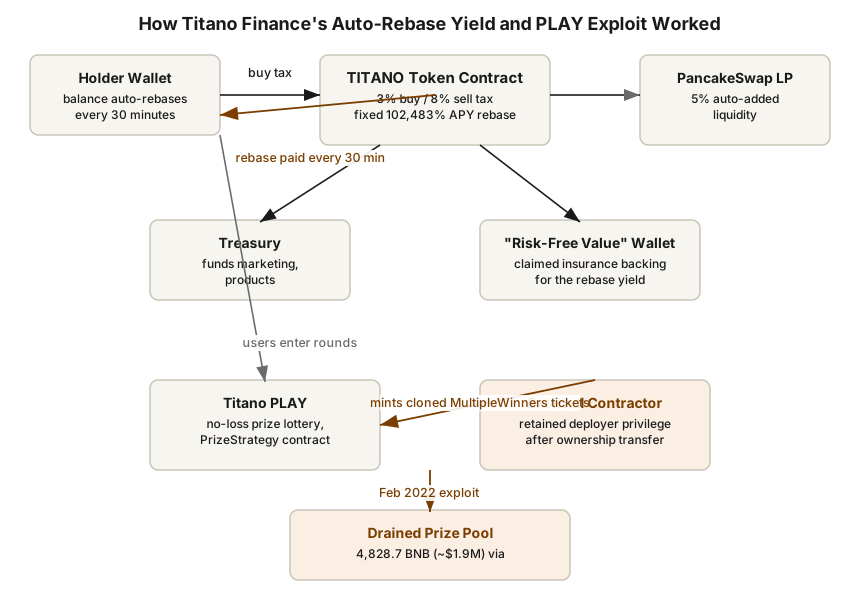 Open full-size diagram
Summary
Titano Finance was the archetypal "auto-staking, auto-compounding" (rebase) token of the late-2021 BNB Chain yield mania. Fair-launched on PancakeSwap on November 17, 2021 by an anonymous team, it marketed the "Titano Autostaking Protocol" (TAP): hold TITANO in your wallet and your balance grows via a positive rebase every 30 minutes, compounding to an advertised fixed 102,483.58% APY. Buy/sell taxes fed a treasury, an insurance-style "Risk-Free Value" (RFV) wallet, and an auto-liquidity mechanism that were claimed to "back" the yield. By April 2022 it reportedly reached roughly a $250M market cap, 80,000 holders, and had inspired over 130 copycat forks (Safuu, Libero and the wider "X% fixed APY" wave). The number printed in wallets went up; the price collapsed by well over 99% during 2022. Along the way, its side product Titano PLAY was drained of 4,828.7 BNB ($1.9M) in February 2022, allegedly by the contractor who deployed it. In February 2023 the team ended rebasing entirely and converted TITANO into a new "SWYCH" DEX token, conceding that rebasing "created a constant downward price pressure." The original titano.finance domain has since lapsed and is now occupied by an unrelated casino-spam site.
Design (Mechanism)
- Positive rebase every 30 minutes. TITANO was an elastic-supply BEP-20: 48 times a day the contract increased every holder's balance by a fixed per-epoch rate, compounding to the advertised 102,483.58% APY. No staking action, lockup, or claim transaction was needed — "buy, hold, earn."
- Buy/sell taxes as the revenue engine. Per the launch press release: 3% of every buy and 8% of every sell went to the treasury; 5% of every buy and sell was auto-added to the TITANO/BNB PancakeSwap liquidity pool. (An additional slice funded the RFV wallet; sells were taxed more heavily than buys to dampen exit.)
- Treasury + "Risk-Free Value" (RFV). The treasury funded marketing/products; the RFV wallet was framed as an insurance fund "backing" the token and supporting the floor — language borrowed from OHM-style protocol-owned-value, but without bonding: the only inflows were trading taxes.
- Fixed APY as a marketing primitive. Unlike OlympusDAO's variable, policy-driven rebase, Titano promised a fixed rate, making the dilution schedule (and marketing hook) perfectly predictable.
- Iteration under fire. The v1 contract (0xBA96...7D7f) contained an open mint capability flagged after launch; an April 22, 2022 migration to v2 (0x4e3c...0aeE), worked on with CertiK, removed the mint function and moved trading toward Swych, the project's own DEX, to reduce PancakeSwap dependency.
- Adjacent products. Titano PLAY was a PoolTogether-style no-loss prize lottery built from third-party code and deployed by an external contractor.
Outcome
The mechanism worked exactly as arithmetic predicts: supply ballooned continuously, so the USD price had to fall unless buy pressure grew super-exponentially. After an early-2022 peak (and the reported ~$250M market cap in April 2022), TITANO ground down more than 99.9% through 2022 despite the v2 migration, its own DEX, and heavy community marketing. In February 2022, the PLAY contract was exploited for 4,828.7 BNB ($1.9M): the deployer — an outside contractor — retained the ability to set the pool's PrizeStrategy even after ownership transfer, and allegedly used cloned MultipleWinners contracts to mint ~32M tickets and drain the pool (SharkTeam titled its analysis "Embezzlement?"; no charges or convictions are documented). On February 17, 2023 the team announced "It's Time to Swych": rebasing ended and TITANO became SWYCH, a conventional DEX token with staking/farming — an explicit admission that the flagship mechanism was value-destructive. The Swych DEX limped on with negligible TVL; the original website is gone and the token trades at dust value. Outcome: failed.
Why it worked
- Zero-friction yield UX. Watching your wallet balance tick up every 30 minutes with no staking transaction was viscerally compelling and genuinely novel packaging of a rebase.
- A fixed, giant, precise number. "102,483.58% APY" was an unbeatable meme; precision manufactured credibility.
- Right moment. It rode the post-OHM (3,3) yield mania into the cheapest retail venue (BSC), with fair-launch optics, locked liquidity, and an early Solidity Finance audit providing legitimacy scaffolding.
- Fork flywheel. 130+ copycats validated the category and kept attention on the original.
Where the design broke
- Dilution disguised as yield. The rebase paid holders in their own dilution; token count grew ~1,000x/year while claims on the treasury did not. Real yield capacity was only trading-tax flow, orders of magnitude below the promised rate — a mathematically guaranteed price decay once inflows plateaued.
- "Backing" theater. The RFV/treasury framing implied solvency that never existed at the advertised APY; it borrowed OHM vocabulary without OHM's bonding revenue.
- Reflexive exit spiral. Once price decline outpaced rebase gains, the 18%+ round-trip taxes couldn't stop selling; they only taxed the exits of latecomers.
- Live privileged access outlasted deployment. An open mint function shipped in v1, and the PLAY contract left deployer-level privileges active after ownership transfer — an attack surface a contractor used for the $1.9M drain.
- No terminal product. By the time the team pivoted to a DEX (Swych), trust and treasury were depleted; ending the rebase confirmed the core mechanism had been the product.
Lessons
- A fixed APY paid in the protocol's own token is a supply schedule, not a yield; if the promised rate exceeds sustainable external revenue, price decline is arithmetic, not market sentiment.
- "Treasury-backed" and "risk-free value" language must be checked against actual inflows: Titano's only revenue was taxing its own holders' churn — a closed loop.
- Auto-compounding UX is a genuinely good innovation that got attached to an unsustainable engine; the packaging outlived the project (auto-compounding vaults remain standard).
- Deployment is part of the trust boundary: transferring
owneris meaningless if the contract also grants powers to the originaldeployer, and third-party code pasted by contractors must be re-audited for exactly such backdoors. - When a team ends its flagship mechanism (as Titano did in the Swych pivot), treat it as the definitive retrospective on whether the mechanism ever worked.
Redesign (EDITORIAL — hypothesis, not fact)
This section is editorial hypothesis, not historical fact. The salvageable insight is the UX: passive, per-block compounding visible in the wallet. A defensible redesign would (1) keep the auto-compounding rebase but peg it to realized external revenue — e.g., rebase each epoch distributes only that epoch's actual trading fees or treasury yield, making the APY variable and honest; (2) publish a live solvency dashboard (treasury assets vs. cumulative rebase liabilities) with an on-chain circuit breaker that halts rebasing when backing per token falls below a floor; (3) eliminate fixed-rate marketing entirely, since the fixed number is precisely what converts a token into an implied liability it cannot meet; and (4) put deploy keys, mint authority, and strategy-setter roles behind a timelocked multisig from day one, with contractor deployments reproduced from source by the core team before funds flow. Even then, absent a real revenue source, the honest version of Titano is simply a fee-sharing token with autocompounding — which suggests the original's growth was purchased by the impossible number, not the mechanism.
Sources
- Titano — Official Launch Updates (Medium) — primary (docs)
- Titano v1 token contract (BscScan) — primary (contract)
- Titano v2 token contract (BscScan) — primary (contract)
- Titano — It's Time to Swych (Medium, Feb 2023) — primary (retrospective)
- Titano Launches DeFi's First Automatic Fixed APY (GlobeNewswire press release, Dec 2021) — primary (news)
- Halborn — Explained: The Titano Finance Hack (February 2022) (analysis)
- SharkTeam — Embezzlement? Analysis of the hack of Titano.Finance (analysis)
- Fairyproof — Analysis of the Attack on Titano Finance (analysis)
- Finance Magnates — Titano Finance Migration to V2 (Apr 2022) (news)
- Benzinga — Titano Finance: Strength In Numbers (Jul 2022) (news)
- CoinMarketCap — Titano (TITANO) (analysis)
- DEX Screener — TITANO/WBNB on Swych (analysis)
Related experiments
Last verified: 2026-07-27 · Spot an error? Suggest a correction