EOS token distribution
Block.one's uncapped, year-long ICO sold 900M ERC-20 EOS tokens through 350 daily pro-rata auction windows, raising a record ~$4.1B before the tokens were frozen and snapshotted onto a new mainnet.
▶ Run interactive simulation animated mechanism with editable parameters
How it works onchain
 Open full-size diagram
Summary
The EOS token distribution was the largest fundraise in crypto history: an uncapped initial coin offering run by Block.one (founded by Brendan Blumer and Dan Larimer) that stretched over roughly a year, from June 26, 2017 to June 2018, and raised approximately $4.1 billion in ether. Instead of a single capped sale event, the crowdsale contract on Ethereum dripped tokens out through hundreds of consecutive daily distribution windows, with each window's tokens allocated pro rata to that window's ETH contributors. The EOS tokens sold were placeholder ERC-20 tokens with no rights on any network; at the end of the sale they were frozen and their balances snapshotted to bootstrap the genesis state of the independently launched EOS mainnet. The mechanism executed flawlessly at unprecedented scale and gave Block.one an enormous war chest, but it also drew academic claims of wash-trade-driven price support and lasting criticism that the raise vastly exceeded what was ever deployed into the EOS ecosystem.
Design (Mechanism)
The sale distributed 1 billion ERC-20 EOS tokens via the crowdsale contract at 0xd0a6E6C54DbC68Db5db3A091B171A77407Ff7ccf:
- 20% (200M tokens) were sold in an initial five-day window (June 26 – July 1, 2017).
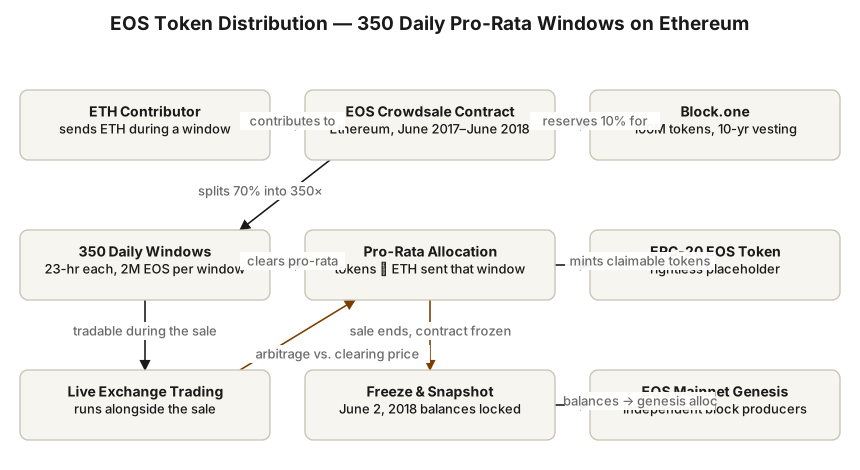
- 70% (700M tokens) were split into 350 equal tranches of 2M tokens each, distributed in 350 consecutive 23-hour windows running from July 1, 2017 to June 2018. The 23-hour period rotated the window boundary through time zones so no region was permanently advantaged.
- 10% (100M tokens) were reserved for Block.one, subject to a 10-year vesting schedule.
Each window was an uncapped pro-rata auction (sometimes described as a continuous "crowdsale Dutch auction"): buyers sent ETH to the contract during the window, and when it closed the 2M tokens were divided among contributors in proportion to ETH sent. There was no price floor, no cap, and no refund — the clearing price was simply total ETH in the window divided by 2M. Tokens were claimable immediately and tradable on exchanges while the sale was still running, so a live secondary-market price existed alongside the primary auction for the entire year, creating a standing arbitrage loop between exchange price and expected window clearing price.
Critically, the Token Purchase Agreement disclaimed that the ERC-20 tokens had any rights, uses, or claim on Block.one or any future network, and purported to exclude U.S. persons (without technical enforcement). At sale end, the ERC-20 contract was frozen (June 2, 2018) and the balance snapshot was used by an independent community of block producers to launch the EOS mainnet, to which Block.one contributed only the open-source EOSIO software.
Outcome
The sale raised roughly 7.2 million ETH, worth about $4.1 billion by its close — a record that still stands for a token sale. The mainnet launched from the snapshot in June 2018 and EOS briefly ranked in the top five assets by market capitalization. Academic researchers separately identified wash-trading and recycled-capital patterns during the sale. Token holders grew bitter that Block.one deployed relatively little of the raise into EOS (famously accumulating a very large bitcoin treasury and funding ventures like Voice and the Bullish exchange), and the community eventually forked away from Block.one's influence under the EOS Network Foundation, later rebranding the network. As a capital-raising mechanism the distribution was a historic success; as an alignment mechanism between raiser and network it is widely judged to have underperformed.
Why it worked
- The year-long pro-rata format removed every friction that killed capped sales: no gas wars, no whitelists, no single congestion event (a lesson from 2017's gas-auction ICO chaos), and anyone could enter at market-clearing prices any day for a year.
- Continuous sale + live secondary trading created a self-referential price feed that legitimized each day's clearing price and kept the sale in the news for twelve straight months — a marketing engine as much as a distribution.
- The disclaimer-and-snapshot structure (sell a rightless ERC-20, freeze it, let "the community" launch the real chain) cleanly separated the fundraise from the network that eventually launched.
Where the design broke
- Uncapped and continuous meant no commitment device: buyers had no assurance about total dilution cost, and the recycling allegation illustrates the format's core weakness — the seller (or allies) could contribute into windows and receive tokens plus most of the ETH back, at low cost, inflating apparent demand. (Alleged, not proven.)
- Proceeds were unconditioned: nothing in the mechanism bound the $4.1B to EOS development — no escrow, milestone release, or buyback obligation tied fundraise proceeds to the network's build-out, so capital could flow to unrelated ventures without breaching any term of the sale, leaving a gap between what the raise implied and what it enforced.
- The U.S.-person exclusion was paper-only: it was never backed by technical enforcement (KYC/geofencing), so it restricted nothing in practice.
Lessons
- Pro-rata daily windows are an elegant, congestion-free, sybil-irrelevant way to run an uncapped sale — but uncapped sales with recyclable proceeds are structurally vulnerable to demand-inflation by insiders; escrowing window proceeds until sale end would remove the recycling loop.
- Selling a token while explicitly disclaiming that it entitles holders to anything creates a principal-agent chasm: the record raise coexisted with near-zero enforceable obligation to build, and the ecosystem paid for that gap for years.
- Duration is marketing: a 350-day sale generated 350 news cycles and a continuously quoted price, which a one-day sale can never replicate — but it also gave a full year for reflexive price dynamics and manipulation windows.
- Geographic exclusions without technical enforcement (KYC/geofencing) restrict nothing — they exist only on paper.
Redesign (EDITORIAL — hypothesis, not fact)
This is editorial hypothesis, not fact. A redesigned EOS-style sale would keep the daily pro-rata windows (genuinely good UX and fairness properties) but add three constraints: (1) escrow all ETH in the sale contract until the final window closes, with per-window proceeds only releasable afterward on a public vesting schedule — this makes recycling capital-intensive and auditable; (2) hard-code a milestone escrow or on-chain buyback obligation so a defined fraction of proceeds is contractually committed to the network's development or returnable to holders, closing the "rightless token" alignment gap; (3) enforce jurisdictional restrictions with real attestation/geofencing rather than a paper disclaimer. A soft per-window cap with rollover (unsold allocation flowing to later windows) would also dampen the reflexive loop between secondary price and window clearing price while preserving the uncapped total.
Sources
- EOS Crowdsale contract on Etherscan — primary (contract)
- EOS: Old Token (ERC-20) on Etherscan — primary (contract)
- A Retrospective of the EOS Token Sale (Alethio / ConsenSys Media) (analysis)
- A blockchain start-up just raised $4 billion, without a live product (CNBC) (news)
- New research claims 21 accounts pumped the $4.4B EOS ICO with wash trades (Cointelegraph, on Griffin/Integra FEC paper) (analysis)
Related experiments
Last verified: 2026-07-27 · Spot an error? Suggest a correction