Dutch Auctions
A descending-price auction mechanism ported onchain — pioneered at scale by Gnosis's 2017 token sale and DutchX exchange, and later refined into gas-efficient Gradual Dutch Auctions — used for permissionless price discovery of tokens and NFTs.
▶ Run interactive simulation animated mechanism with editable parameters
How it works onchain
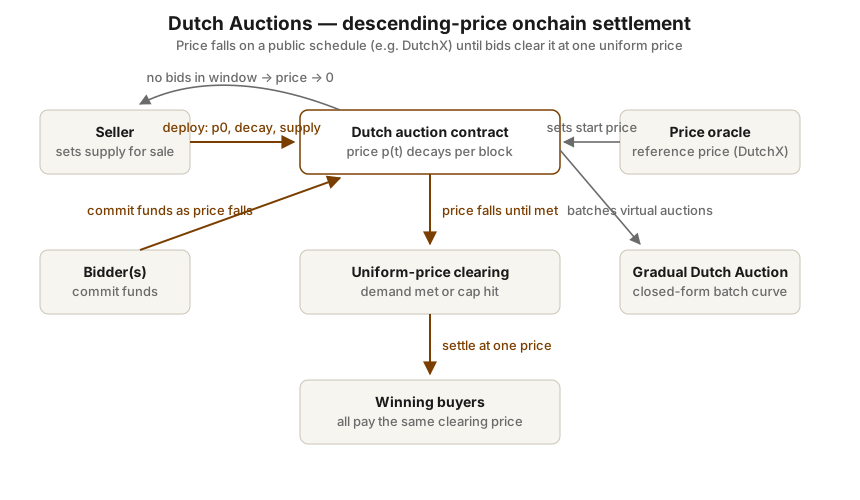 Open full-size diagram
Summary
A Dutch auction is a descending-price auction: the offer price starts high and falls over time until a buyer accepts, at which point the sale clears at that price. The mechanism is centuries old (the Dutch flower markets, and the U.S. Treasury's uniform-price bond auctions are close cousins), but it became a canonical onchain primitive because falling price over discrete blocks maps cleanly onto a smart contract that anyone can read and settle against without a trusted auctioneer.
The canonical-historical anchor is Gnosis, founded in 2015 by Martin Köppelmann and Stefan George. On 24 April 2017, Gnosis ran one of the first large-scale onchain Dutch auction token sales for its GNO token: the price started around $30/token and stepped down block-by-block per a smart contract, clearing when the raise cap was met. It sold out roughly $12.5M in about ten minutes to 760 participants at a uniform clearing price ($29.85 / 0.597 ETH), and the team retained ~95% of supply. Gnosis then generalized the idea into DutchX (mainnet, later fully deployed ~2018), a decentralized ERC-20 exchange whose entire order settlement was a rolling Dutch auction, explicitly designed to neutralize front-running.
Later the primitive was refined by Paradigm's Gradual Dutch Auctions (GDA) (April 2022), which batch a sequence of Dutch auctions into a gas-efficient closed-form pricing curve for selling assets that lack liquid markets. Dutch-auction pricing also underpins the daily Nouns auctions' spiritual siblings, Liquidity Bootstrapping Pools (Balancer/Copper), and countless NFT mint mechanisms.
Design (Mechanism)
Core Dutch auction: a contract defines a starting price p0, a decay function p(t) (linear, exponential, or step-per-block), and a supply. Buyers submit bids; the auction clears either when demand exhausts supply or when a cap/time is hit. Most onchain designs are uniform-price: every winner pays the same final clearing price, removing the incentive to snipe an exact block for a marginally better price.
- Gnosis GNO sale (2017): price declined per block via smart contract; because it was uniform-price and the raise cap was small relative to demand, it cleared almost instantly — a design outcome that later drew criticism (see below).
- DutchX (~2018): every token pair traded via sequential Dutch auctions. Price started at 2x a prior reference/oracle price and fell; bidders committed funds during the auction and all cleared at one price. If no bid arrived within a window (~24h), price could fall to zero, so the design depended on adequate bid-side liquidity. Core contracts:
DutchExchange,DutchExchangeProxy,TokenFRT(fee token),PriceOracleInterface. - Gradual Dutch Auctions (2022, Paradigm — Frankie, Dan Robinson, Dave White, Andy8052): Discrete GDAs run many virtual Dutch auctions in parallel (each successive auction starting higher) so an NFT collection can be sold with gas-efficient batch purchases. Continuous GDAs take the limit — assets are emitted at a constant rate across an infinite series of infinitesimal auctions, giving a closed-form price for fungible-token emission. The reference Solidity implementation prices bulk purchases in one transaction.
The unifying onchain property is credible neutrality: the price schedule is public and deterministic, so no privileged party sets the price and settlement is verifiable.
Outcome
major_success as a durable primitive, with mixed results for specific instances.
- Gnosis's 2017 sale was a headline success by raise speed (fastest crowdsale >$10M at the time) but became a cautionary tale: the cap/valuation design meant it sold only a sliver of supply at a >$300M implied valuation in minutes, concentrating supply with the team and provoking debate about fairness.
- DutchX shipped, was audited (Solidified) and deployed to mainnet, but never achieved meaningful trading volume; the repo was archived Feb 2020 as Gnosis pivoted toward Gnosis Protocol / CowSwap batch auctions. So DutchX itself is best characterized as technically_successful_commercially_unsuccessful.
- GDAs became a widely-cited, widely-forked reference and influenced NFT mint and token-emission designs across the ecosystem.
Dutch-auction pricing (descending) or its close relatives now appear in NFT mints, LBPs, MEV/orderflow auctions, and liquidation engines — making the mechanism one of the most reused onchain auction primitives.
Why it worked
- Determinism suits blockchains. A price that falls on a public schedule needs no off-chain auctioneer and is trivially verifiable; uniform-price clearing removes exact-block sniping incentives.
- Front-running resistance. DutchX's whole thesis was that a descending single-clearing-price auction denies the value of transaction-ordering games that plague continuous order books/AMMs.
- Price discovery without liquid markets. GDAs specifically solve selling illiquid assets (new NFTs, new token emissions) without needing a standing liquidity pool.
- Simplicity and composability. The curve is a few lines of math, cheap to reason about, easy to fork.
Limitations and criticisms
- Speed-vs-fairness trade-off (Gnosis 2017). Because it cleared in minutes at a high valuation with the team keeping ~95% of supply, the sale was criticized as insufficiently distributive and not true "price discovery."
- Liquidity dependence (DutchX). A Dutch auction only produces a fair price if enough bidders show up; thin books meant prices could collapse toward zero, and DutchX never attracted volume, leading to its archival.
- Gas and timing sensitivity. Naive per-block descending auctions reward gas-priority bidding and last-block races; academic work ("Loss-Versus-Fair," AFT 2024) shows Dutch auctions on blockchains leak value versus an idealized fair price due to block-time discretization and priority games.
- Winner's-curse and overpayment. Impatient buyers pay above the eventual clearing price they might have gotten by waiting, a known Dutch-auction inefficiency.
Lessons
- Deterministic price curves are a blockchain-native strength — they minimize trust and are naturally MEV/front-running resistant relative to continuous order matching, which is why the primitive keeps getting reused.
- A fast, "successful" raise is not the same as fair distribution. Gnosis 2017 shows cap and supply-retention parameters matter more to legitimacy than the auction type; the mechanism can clear "correctly" yet distribute poorly.
- Auctions need guaranteed demand to price well. DutchX proves an elegant mechanism dies without liquidity; descending price with no bidders converges to zero, not to fair value.
- Batching and closed-form pricing beat naive loops. GDAs' key contribution was making a sequence of Dutch auctions gas-efficient and analytically priced — the engineering, not the concept, unlocked adoption.
Redesign (EDITORIAL — hypothesis, not fact)
The following is the researcher's editorial hypothesis, not established fact.
A modern "Dutch Auction v2" for token launches would (1) decouple price discovery from distribution — e.g. run a continuous GDA emission over days/weeks rather than a single ten-minute cliff, so supply reaches a broad set of buyers and time-averages out block-level gaming; (2) settle on encrypted/commit-reveal or threshold-encrypted mempools (or an L2 with enforced fair ordering) to remove the gas-priority sniping that "Loss-Versus-Fair" quantifies; and (3) publish a circuit-breaker floor tied to an oracle TWAP so a thin-liquidity auction cannot decay to a degenerate near-zero clear the way DutchX could. For NFT mints, pairing discrete GDAs with per-wallet quantity dampening (rising marginal price per additional unit to the same buyer) would preserve gas efficiency while resisting single-whale sweeps. The core bet: the Dutch auction's determinism is worth keeping; the failures were parameter and ordering problems, both now addressable with encrypted ordering and closed-form emission curves that did not exist in 2017.
Sources
- Gnosis Prediction Market Scores $12.5M In 'Record-Breaking' Crypto Auction (Forbes) (news)
- Ethereum-based Gnosis chooses Dutch auction-style ICO (IBTimes) (news)
- gnosis/dx-contracts — DutchX core smart contracts (GitHub) — primary (contract)
- DutchX documentation (Read the Docs) — primary (docs)
- DutchX Smart Contracts Addresses — primary (docs)
- Gradual Dutch Auctions (Paradigm) — primary (analysis)
- FrankieIsLost/gradual-dutch-auction reference implementation (GitHub) — primary (contract)
- Securing Gnosis' Dutch exchange smart contracts — a case study (Solidified) (audit)
- Loss-Versus-Fair: Efficiency of Dutch Auctions on Blockchains (AFT 2024) (analysis)
Related experiments
Last verified: 2026-07-26 · Spot an error? Suggest a correction