EtherDelta
The first widely used Ethereum DEX, pairing an off-chain order book with on-chain signature-verified settlement, which collapsed under a DNS hack, a change in ownership, and the rise of AMMs like Uniswap.
▶ Run interactive simulation animated mechanism with editable parameters
How it works onchain
 Open full-size diagram
Summary
EtherDelta, launched in July 2016 by U.S. developer Zachary "Zack" Coburn, was the first Ethereum DEX to achieve meaningful adoption. It let anyone trade ETH against any ERC-20 token without giving custody to a company: funds sat in an audited-by-crowd, open-source smart contract, while a website run by Coburn hosted the order book. During the 2017 ICO boom it became the default secondary market for freshly issued tokens — users placed more than 3.6 million ERC-20 token orders in roughly 18 months, and at its late-2017 peak it handled daily volumes in the tens of millions of dollars. The project then unraveled in quick succession: a DNS-hijack phishing attack in December 2017, a sale to opaque new owners whose token ICO fell far short of its goal, and a community fork (ForkDelta) that kept the original contract alive after trust in the operators collapsed.
Design (Mechanism)
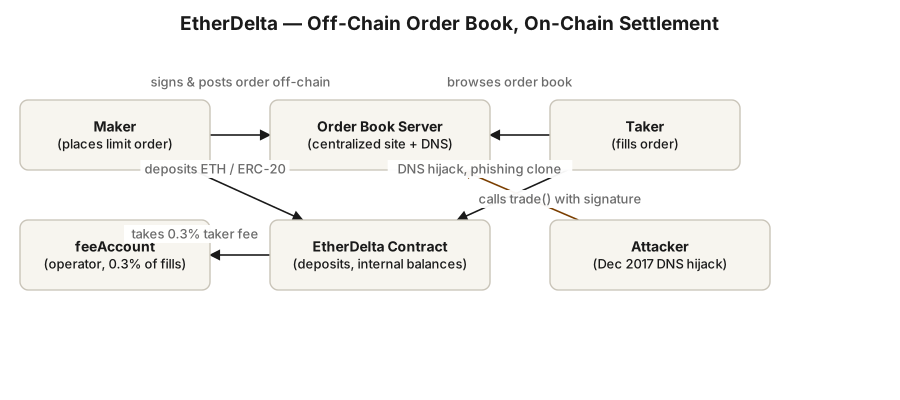
EtherDelta was a hybrid: on-chain custody and settlement, off-chain order discovery.
- Deposit contract with internal balances. Users deposited ETH or ERC-20 tokens into the EtherDelta contract (the long-lived version is
EtherDelta_2at 0x8d12...6819, ~300 lines of Solidity, verified on Etherscan and open-sourced on GitHub). The contract tracked per-user, per-token balances; trades were internal balance swaps, so a trade cost far less gas than token transfers. - Signed off-chain orders. A maker constructed an order (tokenGet, amountGet, tokenGive, amountGive, expiry block, nonce) and signed its hash. Orders were broadcast via EtherDelta's centrally hosted order book server and website (an on-chain
order()posting path also existed but was rarely used due to gas cost). - Taker-executed settlement. A taker called
trade()with the maker's order and signature. The contract verified the ECDSA signature, expiry, and remaining fill, then atomically adjusted internal balances. Partial fills were supported; makers could cancel on-chain. - Fees. Takers paid 0.3% to a
feeAccountcontrolled by the operator; makers paid nothing, so the taker-pays model gave makers free limit orders. - Permissionless listing. Any token could be traded by pasting its contract address — no listing approval. This made EtherDelta the instant secondary market for every new ICO token, and also a playground for counterfeit tokens with copied tickers.
The trust model was deliberately lopsided: settlement and custody were trustless, but order relay, the UI, and the DNS record were a single centralized point of failure.
Outcome
EtherDelta rode the 2017 ICO wave to become the dominant DEX of its era, then failed on every non-contract layer:
- December 2017 DNS hijack. An attacker socially engineered the domain registrar, pointed etherdelta.com at a pixel-perfect clone, and harvested private keys. At least 308 ETH (~$266K at the time) plus tokens were stolen in the initial window, with total losses across the incident later estimated near $1.4 million. The smart contract itself was never breached — hardware-wallet and MetaMask users were unaffected.
- Sale to new owners. Coburn sold EtherDelta to foreign buyers in late 2017. The new owners launched an EDT token ICO that reportedly reached only ~3% of its hard cap. Community trust collapsed, and in early 2018 volunteers forked the open-source client as ForkDelta, pointing at the original contract.
- Obsolescence. By 2019, 0x relayers, IDEX, and above all Uniswap's AMM model had absorbed the user base. The contract still exists and holds stranded funds, but the platform is defunct; the surviving etherdelta.com/related properties are widely treated as unsafe.
Why it worked
- Non-custodial settlement was a genuine breakthrough after Mt. Gox-style failures: the operator could not steal deposits, and the contract survived every attack on the platform.
- Permissionless listing matched the moment. Every ICO token was tradable minutes after deployment, giving EtherDelta a monopoly on the long tail during the 2017 boom.
- The internal-balance design was gas-efficient and the taker-pays fee model gave makers free limit orders, seeding liquidity.
Why it failed or underperformed
- Centralized everything-else. DNS, the order book server, and the UI were single points of failure run by one person; the December 2017 hijack proved "non-custodial" does not mean "trustless end to end."
- Governance by sale. Handing the platform to anonymous buyers mid-crisis destroyed trust faster than any exploit; the community fork captured the remaining goodwill.
- UX and adversarial listings. Clunky deposit/withdraw flows, tokens lost to direct transfers, and counterfeit-ticker scams made it hostile to newcomers, leaving it defenseless once Uniswap offered one-click swaps.
Lessons
- Decentralizing custody but centralizing order flow, DNS, and the frontend just relocates the attack surface; users experience the weakest layer, not the strongest.
- Open-sourcing the stack is real resilience: ForkDelta could resurrect the service against the original contract the moment the operator lost legitimacy.
- Permissionless listing is a growth superpower and a fraud vector at once; without namespace protection (verified addresses, not tickers), scams tax every user.
- First movers with poor UX have no moat: the AMM's abstraction of the order book erased EtherDelta's incumbency within months.
Redesign (EDITORIAL — hypothesis, not fact)
This section is editorial hypothesis, not historical fact. A redesigned EtherDelta would keep the settlement contract but decentralize the relay layer: orders gossiped over a p2p network or posted to multiple independent relayers (as 0x later attempted), with the frontend deployed on IPFS/ENS to neutralize DNS hijacking. Fees would accrue to a contract governed by token holders or be burned, removing the single-operator dependency entirely. Listings would be keyed to verified contract addresses with on-chain provenance metadata rather than tickers. Finally, an explicit succession mechanism — a time-locked, community-ratifiable handover of domain, keys, and fee switch — would have prevented the trust collapse that the opaque 2017 sale caused. Even so, the deeper lesson stands: passive liquidity (AMMs) beat maker-taker order books for long-tail assets, so the redesign would likely still have lost the market it created.
Sources
- SEC Charges EtherDelta Founder With Operating an Unregistered Exchange (Press Release 2018-258) — primary (governance)
- EtherDelta smart contract source (etherdelta/smart_contract) — primary (contract)
- EtherDelta_2 verified contract on Etherscan — primary (contract)
- U.S. Government Seeks Information About Victims of December 2017 EtherDelta Hack (DOJ, N.D. Cal.) — primary (governance)
- About ForkDelta (docs)
- SEC Charges EtherDelta Founder Over 'Unregistered Securities Exchange' (CoinDesk) (news)
- EtherDelta hack: over $200,000 worth of Ethereum stolen via DNS hijack (IBTimes UK) (news)
- EtherDelta Owners under Investigation for an Alleged $176K Exit Scam (Crypto Economy) (news)
- SEC's first crypto-exchange enforcement action analysis (Norton Rose Fulbright / Regulation Tomorrow) (analysis)
Related experiments
Last verified: 2026-07-27 · Spot an error? Suggest a correction